


Last updated: October 25, 2026
Published October 25, 2026 · Updated October 25, 2026
Car key decoding in Hollywood means a locksmith measures every cut on a worn key, matches each one to the automaker’s standard depth chart, and cuts a new key to factory spec instead of copying the wear. The finished blade is then tested in the door and ignition. On transponder-equipped vehicles, its chip is programmed before the engine will start.
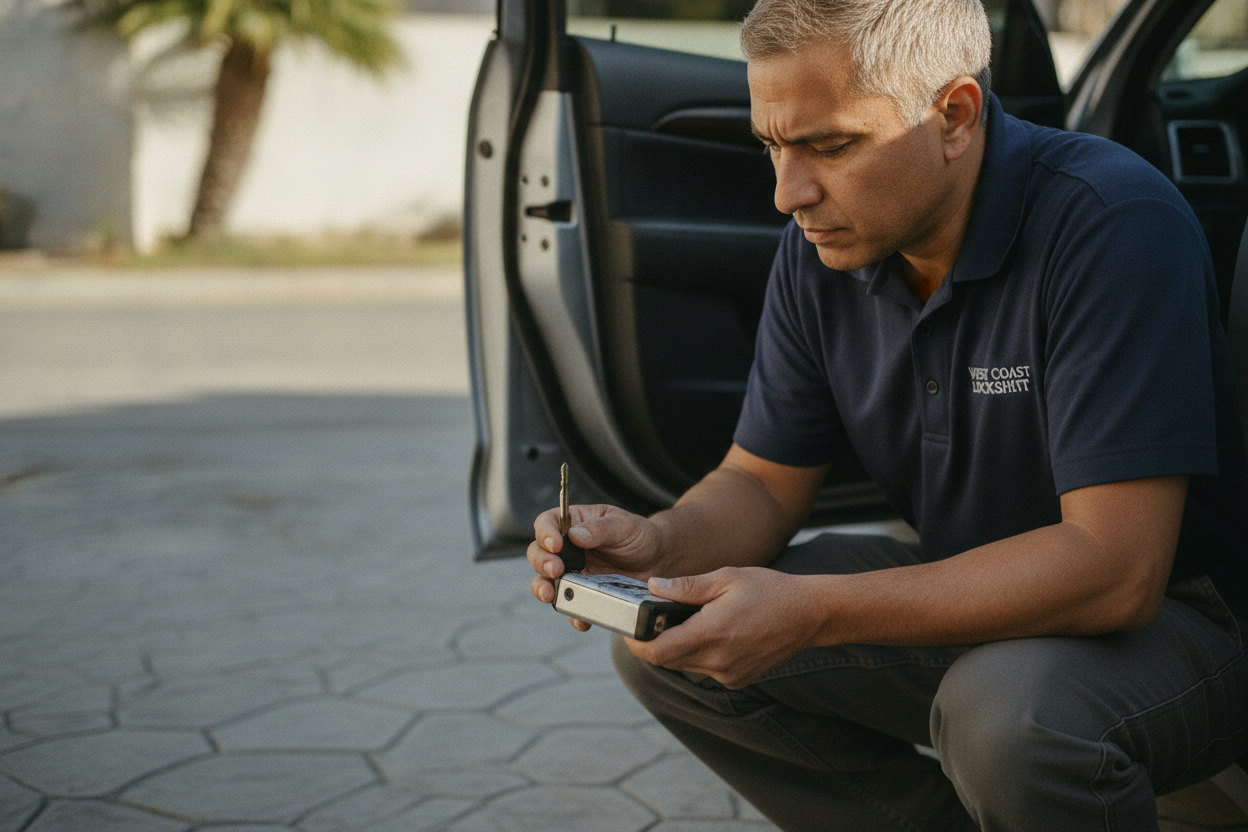
Decoding usually comes up at an awkward moment. The only key sticks in the ignition, the door lock needs a second jiggle, or a fresh copy from a duplicating counter refuses to turn at all. Knowing what happens at the bench helps you tell a precise job from a quick trace that simply copies the problem.
If you’re a Broward commuter whose only key has gone smooth from years on a heavy ring, or you bought a car that came with one tired key, this walkthrough shows what should happen before a new key is cut. It is not aimed at someone who has lost every key; that job starts from the vehicle and its code, not from a worn original.
- Car key decoding converts the cuts on a worn key into the manufacturer’s original bitting, so the new key is cut to factory depths rather than to copied wear.
- A traced duplicate reproduces every rounded peak and shallow cut of a worn original, which is why copies of copies often stick or fail.
- Lishi 2-in-1 tools, such as the HU101 used on many Ford models, let a locksmith read wafer positions straight from the lock when the key is too worn to measure.
- Code-cutting machines such as the Kaba Ilco Futura line cut a fresh blank directly from the decoded bitting code.
- A correctly cut blade still will not start most modern cars until its transponder chip is cloned or programmed to the vehicle’s immobilizer.
- Locksmiths registered through the NASTF Secure Data Release Model can request key codes from automakers after verifying the owner’s identity.
- The eight steps between handing over a worn key and starting the car with a new one.
- How a locksmith decides what a worn cut was supposed to be, using calipers, depth charts and the lock itself.
- Why a traced copy and a code-cut key behave differently in the same ignition.
- The situations where decoding gets hard: worn cylinders, swapped ignitions and internal-cut keys.
- Four questions worth asking before any locksmith cuts your key.
The Process, Step by Step: How Car Key Decoding in Hollywood Works
Car key decoding follows a fixed sequence, whether the key is a plain edge-cut blade or a high-security sidewinder. Each step narrows the gap between what the worn metal shows today and what the factory originally cut. Skipping a step is how bad keys get made.
- Identify the vehicle, keyway and key type. The locksmith confirms the year, make, model and VIN, then matches the blade profile to a key blank reference such as Ilco’s blank catalog. Edge-cut wafer keys, internal-cut (laser or sidewinder) keys and the emergency blades hidden inside smart fobs are each measured differently. This is also when the locksmith checks whether a transponder chip sits in the key head.
- Inspect the wear pattern. Held next to a new blank of the same profile, a worn key shows rounded peaks, a shortened tip or a shoulder pushed out of shape. The shoulder or tip is the stop that every measurement starts from. If that stop is damaged, every reading after it shifts.
- Measure each cut position. Digital calipers or a key micrometer measure the depth at each cut space. Car locks use a small set of defined depths, often four or five on common wafer systems, so each measurement is rounded to the nearest valid factory depth rather than recorded as is. That rounding step is the actual decoding.
- Read the lock when the key can’t be read. When cuts are worn past a confident reading, a Lishi 2-in-1 tool (for example the HU101 for many Ford models or the HON66 for many Honda models) goes into the door lock to pick it and read each wafer position directly. On many vehicles the door cylinder holds only some of the positions found in the ignition. The missing spaces are filled from the key, the ignition or a code lookup.
- Convert the depths into a code and check it. The decoded depths become a bitting, and key code software such as InstaCode checks it against the automaker’s code series. The software also flags combinations that break the maximum adjacent cut specification (MACS), a sign that one reading is wrong. Where a factory code is available by VIN, a NASTF-registered locksmith can request it after verifying ownership.
- Cut a fresh blank by code, not by tracing. A code-cutting machine such as the Kaba Ilco Futura cuts the new blank to the decoded bitting, with clean shoulders and full-depth cuts. The worn original is never used as the template. For many GM, Ford and Stellantis vehicles, Strattec manufactures the original-equipment keys and lock cylinders the code refers to.
- Test the blade in every lock. The new key should turn the door, ignition and trunk or glovebox smoothly, without wiggling or pressure. A sticking point usually means one misread depth or a worn cylinder. Either one gets sorted out now, before the key leaves the bench.
- Clone or program the transponder. Cutting handles only the mechanical side; the immobilizer still has to recognize the chip. Depending on the vehicle, the locksmith clones the existing chip or programs a new one through the OBD-II port with diagnostic equipment. The job ends when the engine starts and keeps running.
Decoding a worn car key means measuring each cut, rounding it to a valid factory depth, confirming the result against the lock or a code series, and cutting a new blank by code. The transponder chip is then cloned or programmed so the key starts the car, not just turns the cylinder.
Tools a Decoding Job Typically Involves
Automotive key decoding relies on five categories of tools, and each one handles a different part of the job. None of them replaces judgment. The table below lists real, widely used examples of each.
| Tool | Real example | What it does in decoding |
|---|---|---|
| Measuring instrument | Digital calipers or a key micrometer | Measures each cut depth from the blade’s reference edge so it can be rounded to a factory depth. |
| Lock decoder | Lishi 2-in-1 (HU101, HON66 and other profiles) | Picks the lock and reads wafer positions directly, without needing a readable key. |
| Key code software | InstaCode | Matches decoded depths to an automaker’s code series and flags impossible cut combinations. |
| Code-cutting key machine | Kaba Ilco Futura line | Cuts a new blank to the exact bitting code instead of tracing a worn key. |
| Transponder programmer | OBD-II key programmers such as the Autel MaxiIM series | Clones or programs the chip so the immobilizer accepts the new key. |
Blanks matter as much as machines. Ilco, part of dormakaba, publishes one of the most widely used key blank references in the trade, and Strattec supplies original-equipment keys and cylinders for many domestic vehicles. A precisely cut code on a soft, poorly milled blank still wears out fast.
The same measure-and-round logic applies to house keys from Kwikset, Schlage and Yale, which use pin tumblers rather than the wafers found in most car locks. High-security systems are a different story. Medeco and Mul-T-Lock, both ASSA ABLOY brands, use patented, restricted keyways that are meant to be duplicated only through authorized channels.
Why does a worn key need decoding instead of a copy?
A worn car key needs decoding because a duplicating machine traces whatever shape is in front of it, including the wear. Every rounded peak and shallow valley gets transferred to the new blank, and tracing adds a little error of its own. A copy made from that copy drifts further still.
A common mistake is assuming any car key can be handled at a hardware store counter. Most vehicles from the past two decades and more use transponder chips, and many need OBD-II programming or chip cloning that a key duplicator cannot do. The blade may turn the door, yet the engine stays dead.
| Factor | Traced duplicate | Code-cut key from decoding |
|---|---|---|
| Template | The worn key itself | The factory bitting code |
| Wear carried over | Yes, plus tracing error | No, cuts return to factory depth |
| Repeatability | Each copy drifts further | The same code cuts identical keys every time |
| Transponder | Often not addressed at a duplicating counter | Cloned or programmed as part of the job |
| Best fit | A crisp, lightly used original with no chip | Worn originals, keys that stick, chipped keys |
Tracing has its place. When the original is nearly new and has no chip, a careful duplicate can work well. Once the key is visibly worn, though, decoding is the only way back to the shape the lock was built for.
Where It Gets Tricky
Key decoding gets hardest when the lock has worn along with the key. Wafers in an ignition cylinder wear in step with the key that has turned them for years. A perfect factory-depth key can feel stiff in that cylinder, while the old, worn key still turns because the two have worn into each other.
A common and costly mistake is ignoring a worn lock cylinder until the key snaps inside it. Early attention to the tumblers is far simpler than extracting a broken blade and rebuilding or rekeying the lock afterward. For the warning signs, see this guide to diagnosing a car key that won’t turn in the ignition.
Swapped parts create a second trap. If a previous owner replaced the ignition or a door lock with an aftermarket cylinder, the factory code tied to the VIN no longer matches that lock. That is one reason a careful locksmith decodes the actual key or lock instead of relying only on a code lookup.
Internal-cut keys raise the bar again. Sidewinder blades such as the HU101 and HON66 profiles have a milled track down the middle rather than cuts along the edge, so calipers alone rarely give a clean reading. A Lishi decoder on the door lock, plus code software to fill gaps, is usually the more reliable path.
Climate adds its own wrinkle. Hollywood sits on the Atlantic coast in Broward County, and salt air plus year-round humidity speed up corrosion inside door cylinders that rarely get used. A door lock that has not turned in years may read poorly with a Lishi tool until it is cleaned, which is why training and patience matter more here than any single gadget.
What This Means for You as the Customer
Customers getting a key made from a worn original should expect a locksmith to measure, ask questions and test, not simply clamp the key into a duplicator. The visible signs of a decoding job are calipers, a code machine and a test in more than one lock. You can ask about every one of them.
For a rideshare driver whose key goes in and out of the ignition all day, the difference shows up fast: a decoded key turns cleanly from the first start, while a traced copy of a tired key can bind within weeks. Four questions cover most of what matters.
Will the key be cut by code or traced?
For a worn original, the answer you want is by code, on a machine such as the Kaba Ilco Futura.
Will it be tested in the door and the ignition?
Testing in both catches a misread depth in positions the door cylinder does not contain.
Is the transponder chip being cloned or programmed?
Either works on the right vehicle; the point is that the engine starts before you pay and leave.
Does the cylinder look worn?
An honest answer here can save a snapped key later, even if it means extra work now.
Bring a photo ID and your vehicle registration or title. Florida registration records come from the Florida Department of Highway Safety and Motor Vehicles, and locksmiths ask for proof of ownership before cutting any key by code. For pricing on decoding, cutting and chip programming, contact the business directly, since the work depends on the vehicle and key type.
If no original survives at all, the job changes; this explainer on making a car key without the original covers that route. For the broader picture, read the full car key replacement guide for the city, or see how the mobile automotive locksmith service nearby works.
Our view
Our opinion: drivers overweigh how fast a copy can be made and underweigh what it is being copied from. Car key decoding takes a little longer than tracing because it adds measuring, checking and testing. That extra time is the entire value of the job.
What actually matters is short. Cut by code, test in more than one lock, confirm the chip starts the engine, and listen if the locksmith says the cylinder is worn. A key is only as good as the lock it has to turn.
We would also make a spare while the decoded code is fresh. Once the bitting is known, a second key cut on a Kaba Ilco Futura is identical to the first, which is far easier than starting over after the last worn key is gone.
Frequently Asked Questions
Can a locksmith decode a key that is badly worn?
A badly worn key can usually still be decoded, because each cut only has to be matched to one of a small set of factory depths, often four or five on common wafer locks. When the cuts are too far gone to measure, a Lishi 2-in-1 tool reads the door lock directly. Code software then fills any positions the door does not contain.
Does decoding a key require taking the lock apart?
Decoding a car key rarely requires disassembling the lock, since calipers read the key and a Lishi decoder reads the cylinder in place. Disassembly comes into play mainly when a cylinder is seized, corroded or swapped for an aftermarket part. In those cases the locksmith may remove the cylinder to read the wafers directly.
Why does a new code-cut key feel stiffer than my old one?
A new code-cut key can feel stiffer because it matches the factory depths while the ignition wafers have worn alongside the old key. Slight stiffness that eases within the first few uses is normal, but a key that binds or needs force points to a worn cylinder. That cylinder is worth repairing before a key breaks inside it.
Is the transponder chip copied during decoding?
The transponder chip is handled as a separate step after the blade is cut and tested. Depending on the vehicle, the locksmith either clones the existing chip or programs a new one through the OBD-II port. A common mistake is trying this with consumer gadgets, since DIY attempts often fail when the immobilizer and chip are not properly synced.
Sources
- Key code release to registered locksmiths through the Secure Data Release Model: National Automotive Service Task Force (NASTF)
- Original-equipment automotive keys and lock cylinders: STRATTEC Security Corporation
- Ilco key blanks and Kaba Ilco key machines: dormakaba
- Florida vehicle registration and title records used as proof of ownership: Florida Department of Highway Safety and Motor Vehicles
 Listen to this articleAudio version
- A Customer Asked: “Can an Automotive Locksmith Make a New Car Key Without the Original?” — The Full Answer
- The Sunny Isles Beach Condo Owner Who Lost All 3 Key Fobs — How We Restored Full Access the Same Afternoon
- How We Replaced a Broken Transponder Key for a Coral Gables Customer Locked Out at Midnight — and Found a Damaged Ignition
- A South Beach Tourist Asked: ‘Can a Locksmith Make a Car Key for a Rental Vehicle if I’m Locked Out?’ — What’s Actually Allowed
- A Hialeah Customer Asked: ‘Why Won’t My Car Key Turn in the Ignition Even Though It’s the Right Key?’ — A Tech’s Diagnosis