


Last updated: October 4, 2026
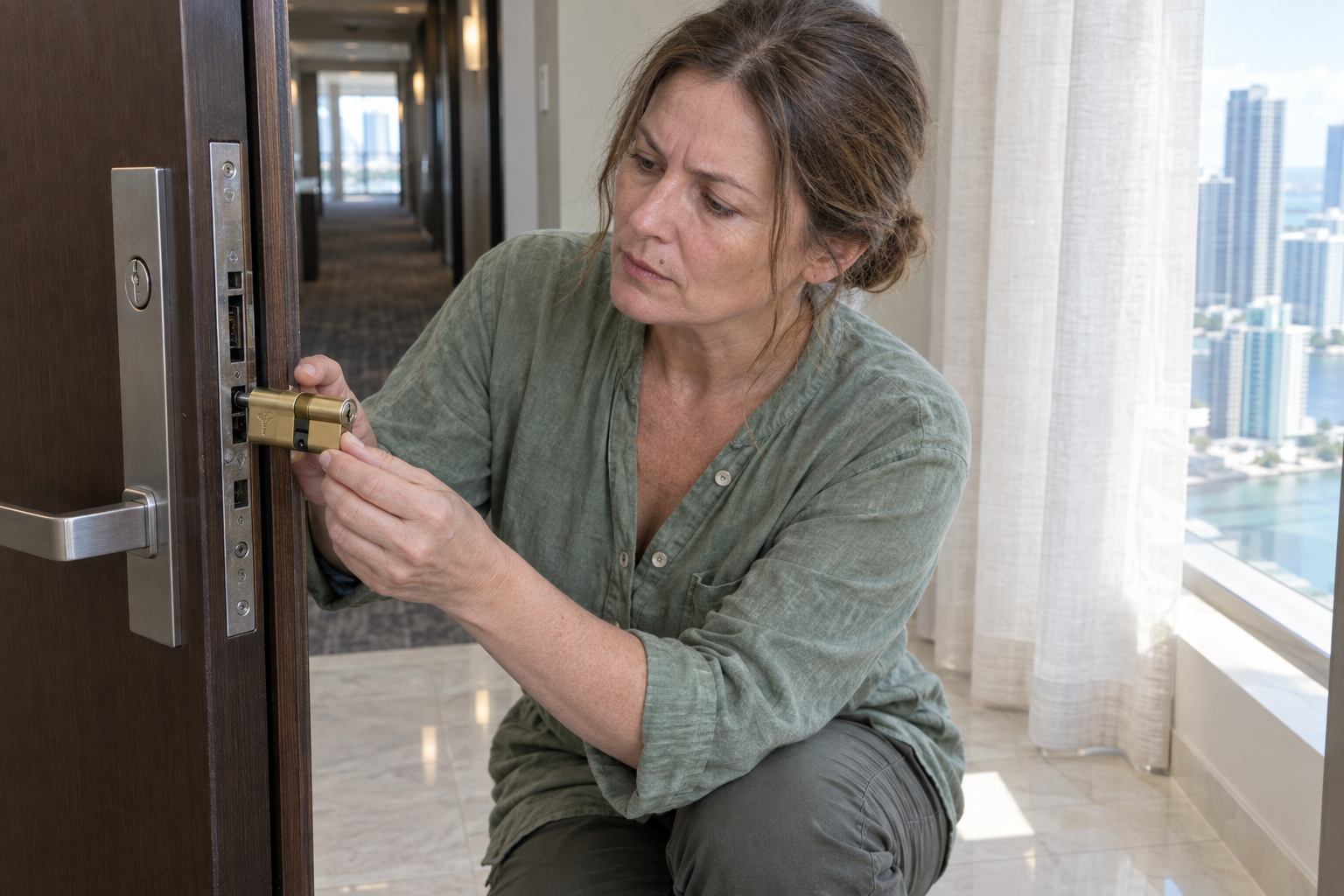
Mul-T-Lock high security deadbolt Brickell condo door compatibility, as a Miami locksmith checks it, is usually a yes. A Mul-T-Lock deadbolt or cylinder fits the existing holes when the door has the standard 2-1/8-inch cross bore and a 2-3/8- or 2-3/4-inch backset. If the door already has a mortise lock, which is common in high-rise towers, the cleaner route is often a Mul-T-Lock mortise cylinder threaded into the existing lock body with zero drilling.
Most people asking this question think the deadbolt is the hard part. It almost never is. The hard part is everything around it: the door thickness, the steel frame, the strike, the fire-rating label on the hinge edge, and the condo association’s rules about who holds a key.
If you own or rent a unit in a Brickell high-rise and you want restricted keys that nobody can copy at a hardware counter, this walkthrough is for you. It is not written for someone fitting a new front door on a single-family house in Hialeah, where the door is yours to drill as you please. Below is exactly what we look at, in the order we look at it, before anything gets ordered.
- Standard bore prep for US residential deadbolts is a 2-1/8-inch cross bore with a 1-inch edge bore, and a Mul-T-Lock deadbolt built to that prep drops into existing holes without drilling.
- Backset on most US doors measures either 2-3/8 or 2-3/4 inches from the door edge to the center of the bore, and adjustable deadbolt bolts are designed to cover both.
- Mortise locks, such as the Schlage L9000 series found on many commercial-grade condo doors, accept a standard 1-5/32-inch, 32-threads-per-inch mortise cylinder, so a Mul-T-Lock mortise cylinder can replace the old one with no new holes.
- Fire-rated unit entry doors in high-rise buildings fall under NFPA 80, which limits job-site cutting; unapproved field holes can void the door’s fire label.
- Florida condo associations hold a right of access to units under Florida Statutes section 718.111, which is why many Miami-area buildings ask for a working key on file after a lock change.
- Mul-T-Lock keys are restricted: duplicates come through authorized dealers using the owner’s key card, not from a hardware store cutting machine.
- The four measurements that decide whether a Mul-T-Lock fits your existing door prep
- Why a mortise cylinder swap often beats a full deadbolt replacement in a high-rise
- How fire-rated door labels and association rules limit what a locksmith can drill
- The specific tools we bring and what each one actually measures
- What to ask before you approve any high-security lock work in Miami
What Decides Mul-T-Lock High Security Deadbolt Brickell Condo Door Compatibility?
Mul-T-Lock deadbolt compatibility on a Brickell condo door is decided by four things: the type of lock already in the door, the bore and backset measurements, the door thickness, and the strike prep in the frame. Get those four right and the upgrade is a bolt-on job. Miss one and you are looking at a filler plate, a new strike, or a door that has to be re-prepped.
High-rise condo doors in Miami are often commercial-grade hollow metal or solid-core wood hung in steel frames. That changes the math compared with a house. Many of them left the developer with a mortise lock, a single box-shaped lock body set into a pocket in the door edge, rather than the two-hole cylindrical deadbolt most homeowners picture.
Cylindrical deadbolt doors vs mortise lock doors
A cylindrical (bored) deadbolt door has a 2-1/8-inch hole through the face and a 1-inch hole into the edge. Mul-T-Lock’s US deadbolts, such as the Hercular, are designed around that same standard prep. If the measurements match, the new deadbolt uses the existing holes.
A mortise door works differently. The lock body lives inside the door, and the key cylinder simply threads into the front of it, held in place by a set screw on the door edge. That means the high-security part, the cylinder with Mul-T-Lock’s telescopic pins, can be upgraded on its own without touching the lock body or the door.
| Measurement | Industry-standard figure | Why it decides the fit |
|---|---|---|
| Cross bore (face hole) | 2-1/8 inches | A smaller older bore needs an adapter or a different product; a larger or ragged bore needs a trim ring or filler. |
| Edge bore | 1 inch | The bolt housing must slide in cleanly and the faceplate must sit flush with the door edge. |
| Backset | 2-3/8 or 2-3/4 inches | The bolt length has to match the distance from door edge to bore center. |
| Door thickness | 1-3/8 to 1-3/4 inches for standard deadbolts | Thicker doors need a longer tailpiece or a manufacturer thick-door kit. |
| Mortise cylinder thread | 1-5/32 inches, 32 threads per inch | Shared across US mortise locks, so a Mul-T-Lock mortise cylinder can thread into an existing lock body. |
| Frame strike | ASA strike, 4-7/8 inches tall, on many steel frames | The bolt’s full 1-inch throw has to land in solid steel, not a shallow pocket. |
A Mul-T-Lock fits a standard condo door when the cross bore is 2-1/8 inches, the backset is 2-3/8 or 2-3/4 inches, and the door is within the 1-3/8 to 1-3/4-inch range. On mortise doors, a Mul-T-Lock mortise cylinder threads into the existing 1-5/32-inch opening, so no drilling is needed at all.
The Process, Step by Step: How Does a Miami Locksmith Check the Fit?
A Miami locksmith checks whether a Mul-T-Lock deadbolt will fit existing condo door holes in seven steps, starting with paperwork and ending with a closed-door bolt test. All the measuring happens before any part is ordered. Here is the sequence we follow.
- Confirm who controls the door. Before a tool comes out, we ask whether the unit entry door hardware is the owner’s responsibility or subject to association standards under the building’s declaration. Many Miami condo towers set rules on entry hardware finish and ask for a key on file, and Florida Statutes section 718.111 gives associations a right of access for maintenance and emergencies. A quick call to management avoids installing a lock that has to come back out.
- Identify the existing lock. We read the faceplate stamp on the door edge and check the screw pattern on the inside trim. That usually tells us right away whether we are dealing with a Schlage B60-series cylindrical deadbolt, a Kwikset deadbolt, a Schlage L9000 or Yale 8800-series mortise lock, or unbranded hardware a developer sourced in bulk. Unbranded hardware is the one that slows things down.
- Measure bore, edge bore and backset. With a digital caliper we measure the cross bore against the 2-1/8-inch standard, the edge bore against 1 inch, and the backset from the door edge to the bore center (2-3/8 or 2-3/4 inches). Older doors sometimes show a smaller 1-1/2-inch bore left over from earlier hardware. Those need an adapter or a different product.
- Measure door thickness at the lock. Standard residential deadbolts cover doors 1-3/8 to 1-3/4 inches thick, and many high-rise entry doors sit right at 1-3/4 inches. Heavier doors can run thicker, which calls for a longer tailpiece or a thick-door kit from the manufacturer. We measure at the bore itself, because applied trim or veneer can make the door thicker there than at the edge.
- On mortise locks, pull and measure the cylinder. We back out the cylinder set screw and unscrew the old cylinder. US mortise cylinders share a 1-5/32-inch diameter with 32 threads per inch, but length and cam vary: a cam made for a Schlage L9000 is not interchangeable with a Yale standard cam or an Adams Rite cam on aluminum-frame doors. The Mul-T-Lock replacement is ordered to match the exact length and cam, with blocking rings if the door face is thicker than the cylinder.
- Check the strike and frame. The best cylinder in the world fails if the bolt lands in a flimsy strike. Steel condo frames are often prepped for a 4-7/8-inch ASA strike, so we confirm the deadbolt extends its full 1-inch throw into the strike pocket without rubbing. We also look for a frame spread or dented from a past forced entry.
- Test with the door closed, not open. We cycle the bolt with the door shut, because corridor air pressure in many high-rise buildings pushes slightly on unit doors and loads the bolt against the strike. A bolt that throws smoothly with the door open can bind once it is closed. You can hear the difference: a clean, dry click versus a gritty scrape.
Tools We Use: What Does a Locksmith Bring to a Mul-T-Lock Fit Check?
A Mul-T-Lock fit check on a Miami condo door needs a short, specific kit, and most of it is about measuring rather than cutting. Nothing in this list involves a drill unless the measurements say a drill is unavoidable.
| Tool or product | What it does on this job |
|---|---|
| Digital caliper (Mitutoyo-class) | Measures cross bore, edge bore, door thickness and cylinder length precisely enough to order the right part the first time. |
| Schlage and Kwikset paper drill templates | Laid over the existing holes to confirm backset and bore centers match standard prep before a Mul-T-Lock is ordered. |
| Mortise cylinder blocking rings and matching cams | Set how far the Mul-T-Lock cylinder sits proud of the door face and match the cam to the Schlage, Yale or Adams Rite lock body. |
| Mul-T-Lock key card | The owner’s proof of authorization for future key duplication through an authorized dealer. |
| ilco key blanks | Used for ordinary non-restricted keys elsewhere in the unit (storage, mailbox, standard Schlage or Kwikset locks), never for Mul-T-Lock restricted keys. |
Where It Gets Tricky: What Goes Wrong on Brickell High-Rise Doors?
Mul-T-Lock upgrades on Brickell high-rise doors go wrong in three predictable places: fire-rated doors, off-standard holes from earlier owners, and corroded cylinders that hide a bigger problem. None of these show up in a product listing online. All of them show up on the door.
Fire-rated doors limit what anyone can drill
Unit entry doors that open onto a corridor in a high-rise tower are frequently fire-rated, with a label stamped or riveted on the hinge edge. NFPA 80, the standard that governs fire doors, sharply limits job-site cutting on labeled doors, and an unapproved hole can void the label. On those doors we work within the existing prep, or we recommend a mortise cylinder swap that leaves the door itself untouched.
Egress matters too. On mortise locks like the Schlage L9000 series with a deadbolt function, turning the inside lever retracts both the latch and the bolt at once. Replacing that setup with a separate surface deadbolt can add a second motion to get out in a fire. That is a step backward.
Off-standard holes from a previous owner
Resale condos sometimes come with a door that has been drilled more than once: a second deadbolt above the original, a bore that wandered off center, or an edge bore chewed oversized. A Mul-T-Lock deadbolt will not hide a ragged 2-1/4-inch hole. That job needs a wrap-around reinforcer or a filler plate, and on a fire-rated door it may need the association’s approval before anyone proceeds.
Salt air, humidity and the cylinder nobody maintained
Balcony and ground-level doors near Biscayne Bay breathe salt air every day, and the humidity in Miami never really takes a season off. What surprised me early on was how often the customer’s complaint was a sticky key, and the real issue was a cylinder so worn that the key was one bad turn from snapping. You feel it in the hand: a gritty drag instead of a smooth rotation.
That pattern lines up with one of the mistakes we see most across all our work, on cars and doors alike: ignoring a worn lock cylinder until the key breaks inside. Early attention to worn tumblers costs far less than an extraction plus a rekey after the fact. Training matters here, because over-tightening a mortise set screw can crack cylinder threads, and installing a cam a few degrees off can leave a bolt that throws only partway.
What This Means for You as the Customer: What Should You Ask Before a Mul-T-Lock Upgrade?
For a Miami condo owner, the Mul-T-Lock compatibility check translates into five questions to settle before anyone orders parts. Ask them of your locksmith, your building manager, or both. The answers decide whether this is a cylinder swap or a bigger job.
Is my current lock mortise or cylindrical?
A mortise lock usually means a Mul-T-Lock mortise cylinder swap with no drilling; a cylindrical deadbolt means matching bore and backset.
Does my door carry a fire label?
Look at the hinge edge. If there is a label, plan on working within the existing holes.
What does management need from me?
Many buildings want a key on file and a hardware finish that matches the corridor.
How many keys do I need on day one?
Restricted keys are easiest to order at installation, together with the key card.
Is the strike strong enough?
A high-security cylinder only pays off if the 1-inch bolt lands in solid steel.
Mul-T-Lock, Medeco or Schlage Primus: which wins where?
Mul-T-Lock is not automatically the right high-security lock for every door. Mul-T-Lock wins when an owner wants independent key control, a restricted keyway tied to a personal key card, and a cylinder that drops into standard US mortise prep. Medeco, like Mul-T-Lock part of the ASSA ABLOY group, wins when a building already runs a Medeco system and the owner wants to match it.
Schlage Primus makes sense when the association runs Schlage L9000 hardware and wants unit cylinders that can work alongside an existing Schlage key system. The best choice depends on the door and the building, not on a brand ranking. We help owners match the option to the situation.
The spare-key lesson from the car side
For the seasonal owner in Sunny Isles Beach or Aventura who rents a unit between visits, key count matters more than pick resistance. We see the same mistake with used vehicles: buyers drive off with a single key, and replacing it after it is lost becomes far more expensive than ordering a spare up front. A condo with restricted Mul-T-Lock keys works the same way, so order every key you will need at installation.
Easy Keys 4 Cars does not publish prices, because the cost depends on whether the door needs a cylinder, a full deadbolt, a new strike or a thick-door kit. The fastest way to an accurate answer is to contact Easy Keys 4 Cars about Mul-T-Lock cylinder pricing with a photo of the door edge and faceplate.
Our Take After Years of Locksmith Work in Miami
Our honest view of high-security condo lock upgrades in Miami is that people overweight pick resistance and underweight key control and the strike. A Mul-T-Lock cylinder with telescopic pins is a serious obstacle to picking. But the realistic risk in a tower is usually a copied key, an old key a former tenant kept, or a door kicked at a weak strike.
The one thing we would tell a friend: get the door measured before you buy a lock online. A deadbolt that arrives in the wrong backset or the wrong cam turns a clean, no-drill upgrade into a return and a wasted week. It happens constantly.
The same principle runs through our automotive locksmith work across Miami and South Florida. Many drivers assume any car key can be cut at a hardware store, when modern vehicles need OBD-II programming and transponder chip coding, and DIY key fob reprogramming without proper diagnostic equipment usually fails because the immobilizer never syncs to the chip. Restricted locks, on doors or in cars, reward people who let someone with the right equipment handle the setup once.
Frequently Asked Questions About Mul-T-Lock Deadbolts on Miami Condo Doors
Do I need condo association approval to change my deadbolt in Brickell?
Condo association approval in Brickell depends on your building’s declaration and rules, since many Miami towers hold entry door hardware to association standards. Florida Statutes section 718.111 also gives the association a right of access to units, so management often asks for a working key on file after any lock change. Check with management before the appointment so the new Mul-T-Lock does not have to come back out.
Can a Mul-T-Lock cylinder fit inside my existing Schlage or Yale mortise lock?
A Mul-T-Lock mortise cylinder can fit an existing Schlage L9000 or Yale mortise lock in most cases, because US mortise cylinders share a 1-5/32-inch diameter with 32 threads per inch. The cylinder must be ordered in the correct length and with the matching cam for that lock body. When those match, the upgrade needs no new holes in the door.
Why can’t a hardware store copy my Mul-T-Lock key?
Mul-T-Lock keys cannot be copied at a hardware store because the key profiles are restricted and duplication runs through authorized dealers who verify the owner’s key card. The telescopic pin design and the moving key elements on lines like the MT5+ and Interactive+ also require specialized cutting equipment. Plan your spares at installation, since adding keys later means a trip to an authorized dealer with the card in hand.
Will my building’s master key still work after I switch to Mul-T-Lock?
A building master key will not open a new Mul-T-Lock cylinder unless that cylinder is keyed into the building’s system, which an independent restricted keyway typically is not. Many Miami condo associations handle this by asking owners to leave a key on file with management, consistent with the access rights in Florida Statutes section 718.111. Settle that arrangement with management before the swap, not after.
Sources
- Mul-T-Lock product lines, telescopic pin technology and key-control program: Mul-T-Lock official website
- Condominium association right of access to units: Florida Statutes, Section 718.111 (Online Sunshine, Florida Legislature)
- Limits on field modification of labeled fire doors: NFPA 80, Standard for Fire Doors and Other Opening Protectives
- ANSI/BHMA door hardware standards and grading: Builders Hardware Manufacturers Association (BHMA)
Easy Keys 4 Cars
Automotive locksmith services
 Listen to article
- Medeco vs ASSA Abloy vs Mul-T-Lock: Which High-Security Deadbolt Cylinder Survives Miami’s Coastal Humidity Longest
- Mul-T-Lock vs Medeco: Which High-Security Deadbolt Actually Holds Up in Miami’s Salt Air
- Mul-T-Lock vs Medeco vs ASSA Abloy: Which High-Security Car Key System Holds Up in South Florida’s Salt Air
- A Miami Beach Driver Asked: ‘Can a Locksmith Program a New Key Fob Without the Original?’ — Here’s the Honest Answer
- Schlage vs Kwikset vs Yale: Which Residential Deadbolt Actually Resists Forced Entry in Brickell Condos