


Last updated: September 18, 2026
Published September 18, 2026 · Updated September 18, 2026
The push to start key not detected doral miami automotive locksmith fix usually has nothing to do with the fob’s buttons and everything to do with the immobilizer handshake: your car checks a 125 kHz transponder signal before it allows a crank, and an unprogrammed or unsynced chip fails that check even when the remote unlock works perfectly. If your doors unlock but the engine won’t turn over, the remote half of the fob is fine and the security half is not. That distinction is the whole diagnosis.
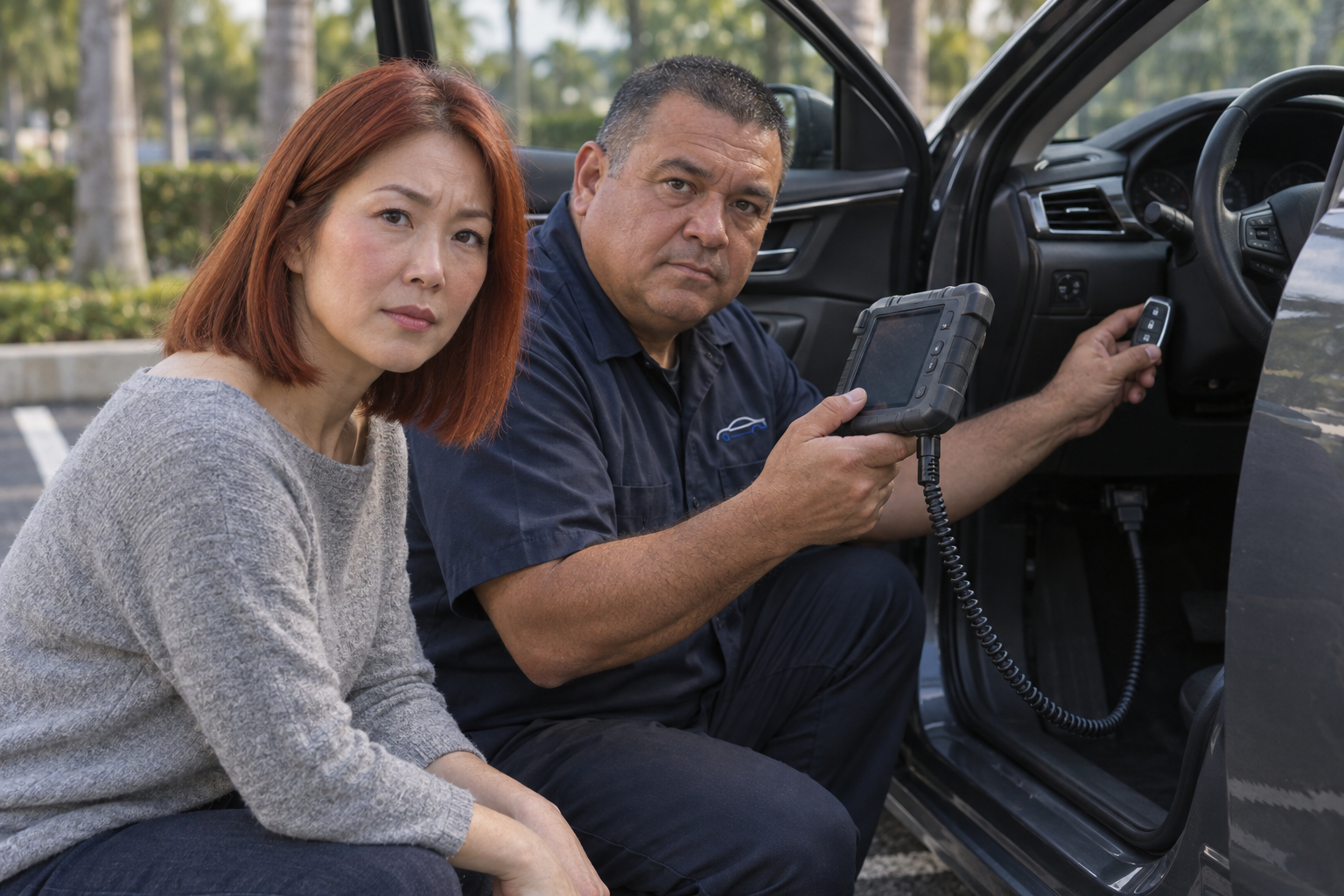
- Most “key not detected” messages on push-to-start vehicles are immobilizer communication failures, not dead remotes: the car verifies a low-frequency transponder signal (commonly 125 kHz) before allowing a crank.
- An aftermarket fob with the correct FCC ID will still throw the warning until it is programmed through the OBD-II port and synced to the vehicle’s immobilizer, which is why most DIY attempts fail.
- A CR2032 coin cell can measure close to 3 volts at rest and still collapse under transmit load, so a battery swap is the fastest 60-second test before anything else.
- Nearly every push-to-start vehicle has a backup start procedure: hold the fob flat against the start button or the marked spot on the column or console, then press.
- A weak 12-volt battery below roughly 12.4 volts at rest can produce a false “key not detected” message because the receiver module browns out during cranking.
- Some platforms, including Mercedes-Benz FBS4 systems on many 2015-and-newer models, generally require dealer-level access, and an honest locksmith will tell you that up front.
The Short Answer: Push to Start Key Not Detected in Doral, and the Miami Automotive Locksmith Fix
A push-to-start car that says “key not detected” with a brand-new fob is telling you the immobilizer never authenticated the transponder inside that fob, and the fix is a proper programming session with diagnostic equipment, not another fob. Smart-key systems run two separate conversations: a UHF remote link (315 MHz or 433.92 MHz on most vehicles sold in the US) that handles lock, unlock and panic, and a short-range low-frequency link that proves to the engine computer that a legitimate key is inside the cabin. Buying a fob online buys you the first conversation. Only programming buys you the second.
If you’re a Doral driver with a 2012-or-newer push-to-start sedan or crossover, you just installed a marketplace fob, and the doors respond while the engine sits there dead silent, this article is written for you. It is not written for someone whose original factory fob suddenly quit after five years, because that is a different and usually simpler problem. The push to start key not detected message means the same thing in both cases, but the path to a working car splits immediately.
A new fob that unlocks the doors but cannot start the engine has an unprogrammed or mismatched transponder. The repair is an OBD-II programming session that writes the fob’s chip ID into the immobilizer, performed by a mobile automotive locksmith. Doral drivers can have this done in the parking lot where the car sits.
The Full Answer
1. The fob was never paired to the immobilizer, only to the receiver
The single most common cause of a “key not detected” warning on a newly purchased fob is that the remote-keyless-entry side was learned and the immobilizer side was not. Some vehicles allow an onboard procedure (door cycling, button sequences, ignition toggles) that teaches the car a remote’s lock and unlock codes without ever touching the security module. Owners run that procedure, the doors chirp, and they assume the job is done.
Then they press the start button. Nothing. This is exactly the field mistake we see most: trying to reprogram a key fob without proper diagnostic equipment, where the DIY attempt fails because the immobilizer isn’t synced correctly to the transponder chip. The chip is a passive device, typically a Hitag or ID4A-family transponder depending on platform, and it has to be written into the vehicle’s key memory through the diagnostic port.
2. The fob is the wrong part number, even though it looks identical
Two smart fobs can share an identical shell and carry completely different radio frequencies and chip types. The FCC ID printed on the back is the number that matters, and it must match what your vehicle’s receiver expects: a 315 MHz fob will not talk to a 433.92 MHz receiver, and a chip from the wrong family will not authenticate no matter how many programming attempts you make. We have opened marketplace fobs and found a board that does not match the FCC ID molded into the case.
Genuine and reputable aftermarket supply matters here. Strattec builds OEM locksets, ignition modules and fobs for a large share of North American vehicles, and ilco produces aftermarket keys and transponder blanks that hold up to programming without the coin-flip quality of an unbranded listing. When a fob refuses to learn on the first pass, the part is the suspect before the car is.
3. The coin cell is weak, backwards, or not making contact
A CR2032 lithium cell reads about 3 volts fresh and still shows well over 2.7 volts when it can no longer hold voltage under transmit load, which is why “the battery tested fine” is a phrase we hear right before we replace the battery and the car starts. Brand-new fobs are also shipped with the cell installed upside down or with a protective film left under the contact, and some third-party shells have contact springs that simply do not reach the board.
Check the polarity marking. Press the cell down firmly. It takes a minute and it is free, and honestly, it resolves more no-start complaints than the internet suggests. Worth noting: on most systems the immobilizer’s low-frequency handshake is passive and will work with a completely dead battery if you hold the fob in the right spot, which is the next item.
4. You haven’t tried the backup start procedure, which is also a free diagnostic
Almost every push-to-start vehicle sold in the US has a documented backup method for a fob with a dead battery: hold the fob flat against the start button itself, or against a marked location on the steering column, the center console, the cupholder, or a slot inside the armrest, then press. Your owner’s manual shows the exact spot, and there is real diagnostic value in the result.
If the car starts that way, the transponder is programmed and the problem is antenna coverage, battery voltage, or interference. If it still says key not detected while the fob is physically touching the start button, the chip is not in the car’s memory. That single test splits the diagnosis in two before any tool comes out of the van.
5. The car’s antennas, receiver module, or 12-volt supply are the actual fault
Smart-key systems use multiple interior and exterior antennas, and a single unplugged or water-damaged antenna can blind the car to a perfectly good fob in one seat position while it works in another. South Florida humidity and the kind of hard afternoon downpour that fills a footwell through a clogged sunroof drain do reach connectors under carpet. If the message appears only from the driver’s seat, or only when the fob is in a back pocket against a phone, suspect the vehicle.
Voltage matters just as much. A 12-volt battery sitting below roughly 12.4 volts at rest can sag far enough during the start request that the receiver module resets mid-handshake, and the dash reports the only symptom it knows: key not detected. Heat is brutal on batteries here, and a battery that survived winter in a cooler climate does not always survive an August week in an uncovered Doral lot.
6. The order a tech actually works the problem
Verify the fob’s FCC ID and chip family against the VIN
Wrong frequency or wrong transponder family means the programming session cannot succeed, so this comes before tools.
Test system voltage and the backup start position
A resting 12-volt reading plus the fob-against-the-button test separates a programming issue from a vehicle-side fault in under five minutes.
Pull immobilizer and body-module codes through OBD-II
Stored codes name the missing link: no transponder response, antenna circuit fault, or communication loss on the bus.
Read the stored key count, then write the new chip
Many platforms require all keys present during a learn, and some erase every previously stored key, which is why the count is checked first.
Confirm from all seats, then cut a mechanical backup if the platform has one
Testing from multiple positions catches a marginal antenna, and an emergency blade or valet key keeps you out of a full lockout later.
| What you observe | Most likely cause | Who can resolve it |
|---|---|---|
| Doors unlock, engine won’t crank, no chime | Transponder not written to immobilizer | Automotive locksmith with OBD-II programming |
| Starts when fob touches start button only | Weak CR2032 or antenna coverage gap | Battery swap first, then antenna diagnosis |
| Warning appears intermittently while driving | Loose antenna connector or 12-volt supply sag | Locksmith or shop, electrical diagnosis |
| Neither fob works after a jump start | Module reset or lost sync, low system voltage | Locksmith re-sync after charging the battery |
| Fob shell matches but FCC ID differs | Wrong frequency or chip family purchased | Replace with correct part (Strattec, ilco) |
What We See in Doral Specifically
Doral is dense with office parks, warehouse and logistics facilities and structured concrete garages near Miami International Airport, and that environment shapes the calls we get. Smart-key fobs transmit at very low power under FCC Part 15 rules, which means they are designed to tolerate interference rather than fight it. Park in a concrete garage surrounded by commercial equipment, leave the fob sitting on top of a wireless charging pad or pressed against a laptop in a bag, and the receiver can miss the handshake.
The pattern we notice repeatedly with Doral drivers is not exotic: the fob lives in the same pocket as a phone and a stack of contactless cards, and the intermittent “key not detected” chime shows up mostly in the same garage. Move the fob to the other hand. Try again. If the message disappears, you were never dealing with a broken fob, and no amount of reprogramming would have helped.
There is a second Doral-specific pattern worth naming for anyone who bought a used vehicle from a dealer or a private seller here: one key and no spare. Dealers often hand over a single fob, and the moment that one fob fails or disappears, you are in an all-keys-lost situation that takes longer and costs more than a simple duplicate would have. Our mobile automotive locksmith services across Miami and South Florida exist largely because that one scenario repeats in Doral, Brickell, Hialeah and Coral Gables every week.
When the Answer Is Different
Not every push-to-start no-start is a locksmith job, and the honest version of this article says so plainly. Several platforms and situations change the answer completely.
High-security platforms that require dealer-level access
Mercedes-Benz FBS4 systems on many 2015-and-newer models, along with certain late BMW, Audi and Porsche architectures, are engineered so that key creation runs through manufacturer servers. A capable independent locksmith can still diagnose the fault, verify the fob and confirm whether the immobilizer is the problem, but key generation on those platforms may route through the dealer. Anyone who promises otherwise on every make and model is overselling.
All keys lost, versus adding a spare
Adding a key while you still have one working fob is a short, low-risk session. All-keys-lost is a different job: it may involve immobilizer data access, security waiting periods enforced by the vehicle (some platforms impose a timed lockout before a key can be learned), and proof-of-ownership documentation, which the National Automotive Service Task Force framework exists to govern. Bring your registration and photo ID. It speeds everything up.
When the real problem is mechanical, not electronic
Plenty of push-to-start vehicles still have a mechanical lock cylinder in the driver’s door and an emergency blade hidden inside the fob, and those wear. We see worn cylinder tumblers ignored until the blade snaps off inside, and extraction plus rekeying afterward costs far more than the early maintenance would have. If your door lock feels gritty or the emergency blade has to be jiggled, deal with it before it strands you.
When a hardware-store key was the plan
Assuming all car keys can be cut at a hardware store is one of the costliest assumptions in this trade. Modern vehicles require OBD-II programming and chip coding that only an automotive locksmith or a dealer can perform, and a cut blade with no coded transponder produces exactly the symptom this whole article is about. A key that turns and a key that starts are two different products.
Our Take After Years of Automotive Locksmithing in Miami
Drivers overweigh the fob and underweigh the car. The fob is the part you can hold, so it gets blamed, while the immobilizer module, the antenna harness and the 12-volt battery do the actual failing. When someone calls us about a push to start key not detected warning in Doral and mentions they have already bought two fobs online, we know the third one will not fix it either.
The one thing we would tell a friend: get a spare programmed while your current key still works. A second key made today is a routine appointment in the parking lot where your car already sits. A second key made after the only key dies is a tow, a document check, sometimes a manufacturer waiting period, and a wrecked afternoon. Same car. Completely different day.
We also think the FCC ID deserves more respect than it gets. Check the number printed on the back of your existing fob before buying anything, or simply send it to us and let us confirm the part against your VIN. The team behind Easy Keys 4 Cars would rather spend two minutes verifying a part number than two hours explaining why a mismatched board cannot be programmed. For pricing on any of this, reach out with your year, make, model and current key situation and we will give you a straight answer.
FAQ: Push to Start Key Not Detected
Can a mobile automotive locksmith program a push-to-start fob at my location in Doral?
Yes, a mobile automotive locksmith can program most push-to-start fobs on site in Doral, because the work is performed through the vehicle’s OBD-II port and does not require a lift or a shop bay. Easy Keys 4 Cars covers Doral along with Brickell, Aventura, Coral Gables, Hialeah, Miami Beach, Hollywood and Fort Lauderdale. Bring your registration and photo ID so ownership can be verified before any key is created.
Why does my car say key not detected when the fob is right next to the start button?
“Key not detected” with the fob touching the start button almost always means the transponder ID is not stored in the vehicle’s immobilizer memory, since that position bypasses the need for a healthy CR2032 battery. The other possibility is a 12-volt system battery below roughly 12.4 volts at rest, which can reset the receiver module mid-handshake. Test the battery voltage first, then have the immobilizer codes read.
Will replacing the CR2032 battery fix a key not detected warning?
Replacing the CR2032 coin cell fixes a meaningful share of key-not-detected warnings, particularly intermittent ones, because the cell can read near 3 volts at rest yet collapse under transmit load. It takes about a minute and it is the first thing worth trying. If the warning persists with a fresh, correctly oriented cell, the problem is programming, antenna coverage, or vehicle voltage.
Are online replacement fobs worth buying for a push-to-start car?
Online replacement fobs are worth buying only when the FCC ID and transponder family match your VIN exactly, and even then the fob still needs an OBD-II programming session to sync with the immobilizer. Parts from established manufacturers such as Strattec and ilco program far more reliably than unbranded listings. Send us the FCC ID from your current fob before you order, and we will confirm compatibility for your specific vehicle.
Sources
- Low-power radio transmitter rules that govern key fob operation and interference tolerance – Federal Communications Commission, Part 15 Radio Frequency Devices
- Vehicle security, key programming and proof-of-ownership framework for independent locksmiths – National Automotive Service Task Force
- OEM automotive lock, ignition, key and fob manufacturing referenced for part quality – Strattec Security Corporation
- Keyless ignition vehicle safety information and owner guidance – National Highway Traffic Safety Administration
Easy Keys 4 Cars
Automotive locksmith services
- A Hialeah Customer Asked: ‘Why Won’t My Car Key Turn in the Ignition Even Though It’s the Right Key?’ — A Tech’s Diagnosis
- A Miami Beach Driver Asked: ‘Can a Locksmith Program a New Key Fob Without the Original?’ — Here’s the Honest Answer
- A Coconut Grove Driver Asked: ‘Is It Safe to Buy a Cheap Aftermarket Key Fob Online Instead of Going to a Locksmith?’ — The Real Risk
- A Brickell Resident Asked: ‘How Long Does It Take a Locksmith to Program a Push-to-Start Key in Miami?’ — Actual Time Breakdown
- A Customer Asked: “Can an Automotive Locksmith Make a New Car Key Without the Original?” — The Full Answer