


Last updated: October 20, 2026
Published October 20, 2026 · Updated October 20, 2026
Before paying for auto key fob repair in Miami, know this: when one button dies and the others still work, the coin battery is rarely the cause, because every button on the fob draws from the same cell (often a CR2032). The usual suspects are a worn switch under that button, a rubber pad whose conductive coating has rubbed off, corrosion at one spot on the circuit board, or a fault on the car’s side, such as a failed trunk actuator. Miami adds its own pressure: year-round heat inside parked cars, humid air for much of the year, and salt-laden moisture near Biscayne Bay and the Atlantic all age the contacts inside a fob faster than a cooler, drier climate would.
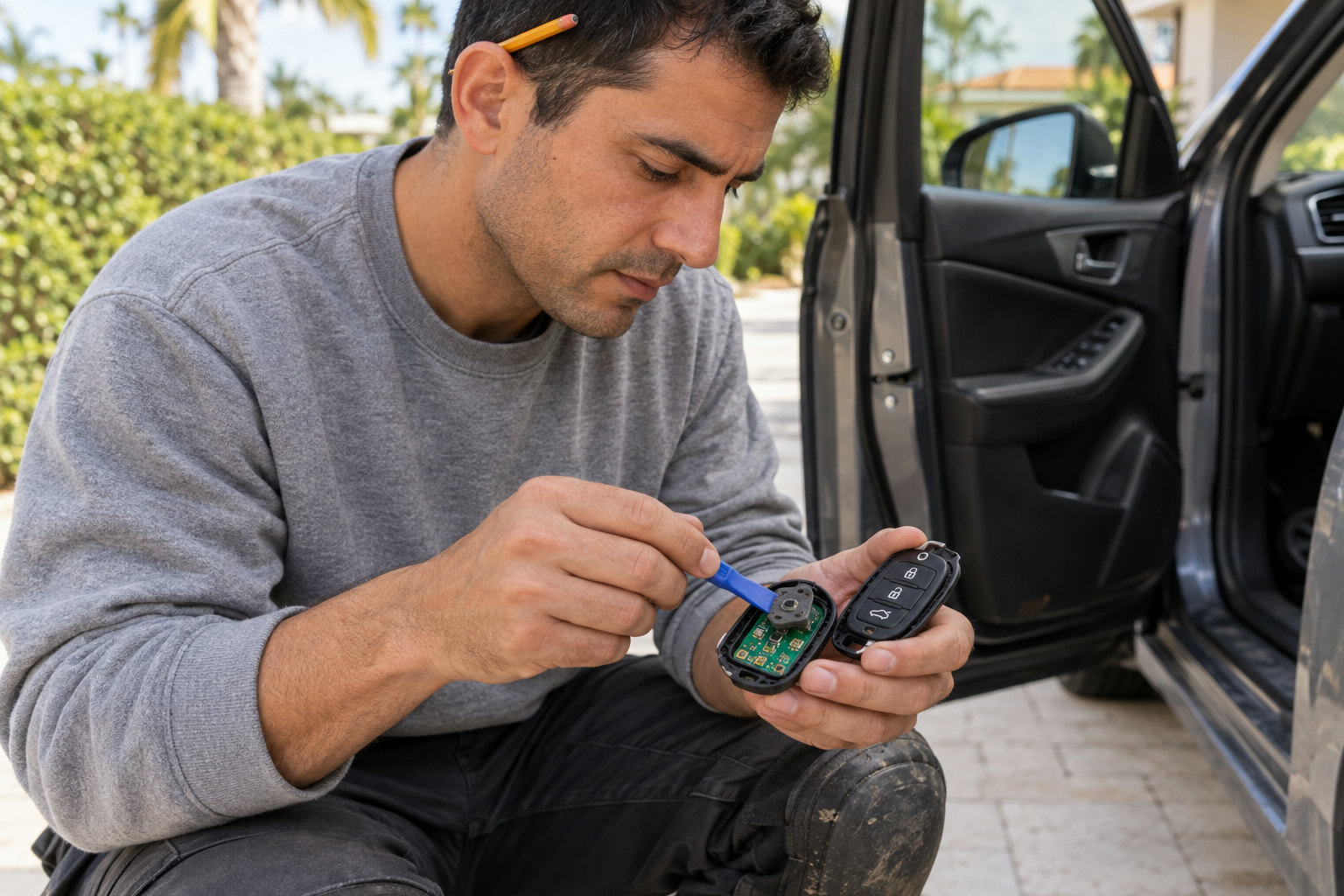
If you drive in Brickell, Doral or Hialeah and your trunk or unlock button stopped answering while lock and panic still work, run the checks below before you order a new fob. Several of them take less time than finding the phone number for a dealer.
- One dead button with the others working usually points to that button’s switch, rubber contact pad or local corrosion, not the battery, since all buttons share one coin cell.
- A spare fob test separates fob faults from car faults in under a minute: if the same button works on the spare, the original fob is the problem.
- Interior controls settle car-side questions: if the dash or door trunk release also fails, the fault is the latch actuator, a fuse or wiring, and no fob repair will fix it.
- Energizer’s CR2032 datasheet lists an operating range up to 60°C (140°F), a limit a fob left on a sun-baked dashboard can approach in a South Florida summer.
- Keeping the original circuit board during a switch or shell repair usually means no reprogramming, because the board’s identity that the car already knows does not change.
- Most US key fobs transmit around 315 MHz, and a locksmith’s RF tester can confirm whether one specific button is transmitting at all.
- The National Weather Service treats roughly mid-May through mid-October as the rainy season, so months of humid air are the norm, not the exception.
- The Atlantic hurricane season runs June 1 to November 30, overlapping almost the entire wet season.
- Summer daytime highs typically sit in the low 90s °F, and a closed car parked in full sun gets considerably hotter inside than the air outside.
- Brickell, Coconut Grove, Sunny Isles Beach and South Beach sit along Biscayne Bay or the Atlantic, where salt-laden moisture reaches parked cars.
- Much of the housing in Brickell, Aventura and Sunny Isles Beach is high-rise condominium towers with multi-level concrete parking garages.
Why Miami Heat, Humidity and Salt Air Change Auto Key Fob Repair
Auto key fob repair here is shaped by three conditions working on the same small parts: heat, humidity and salt. A key fob is a plastic shell around a circuit board, a coin battery and a rubber keypad whose underside carries small conductive pads. Every one of those parts ages faster in a hot, wet, coastal climate.
Heat comes first. Energizer’s datasheet for its CR2032 lithium coin cell lists an operating range of -30°C to 60°C (-22°F to 140°F), and a fob left on a dashboard or in an open cupholder in a closed car can approach the top of that range on a July afternoon. Heat also softens the plastics and adhesives in lower-grade shells, which can let a button sit unevenly on its switch.
Humidity is the second pressure. Condensation forms when a fob that has been sitting in an air-conditioned condo meets warm, wet air outside, and that thin film settles on board contacts over and over across a rainy season that runs roughly five months. Salt is the third. Moisture carrying salt is more conductive and more corrosive than plain water, which matters for drivers who park near the bay or carry their keys to the beach.
Corrosion rarely spreads evenly across a board. It tends to start at one exposed spot, often near a seam in the shell or under the button pressed most often. That is exactly why one button can quit while the rest still answer.
Parking adds one more variable. Multi-level concrete garages in high-rise towers can shorten remote range, so a fob that seems to fail only deep in a garage may simply be at the edge of its range. The giveaway is that range problems affect every button, not just one.
Why Does One Key Fob Button Stop Working While the Others Still Work?
A single key fob button usually fails because something specific to that button has worn, corroded or cracked, or because the car is not acting on a signal the fob is sending correctly. The battery is shared by every button, so a weak cell typically shows up as shorter range on all of them. Here are the causes, roughly in the order a technician checks them.
A worn tactile switch
Under each rubber button sits a tiny tactile switch or metal dome soldered to the circuit board. These switches are rated for a finite number of presses, and the unlock button on a daily driver gets pressed far more than panic or trunk. A worn switch often needs a hard, off-center press before it responds, then stops responding entirely.
A rubbed-off conductive pad
On fobs that use a rubber keypad with no separate switch, the underside of each button carries a small black carbon pad that bridges two contacts on the board. Years of pressing wear that coating away. When the pad on one button goes bare, that button goes dead while the others work normally.
Corrosion at one contact
Green or white crust on a contact means moisture got in, whether from a pool, a beach bag, rain, or a fob carried in a sweaty pocket on a humid day. Corrosion on the trace or contact under one button can block that button alone. Caught early, a cleaned contact can work again; left for months, the copper trace underneath can be eaten through.
A cracked solder joint
A fob dropped on concrete can crack the solder holding one switch to the board. The button may work intermittently, especially when the case is squeezed, then fail. This is a microsoldering repair, not a battery swap.
The car, not the fob
Plenty of dead buttons are not dead at all. A failed trunk latch actuator, a blown liftgate fuse, a power liftgate switched off on the dash (common on some minivans and SUVs), or a door lock actuator that has given out will all look like a fob problem. So will a vehicle setting such as two-stage unlock, where the first press opens only the driver’s door.
Press patterns cause confusion too. On many models the trunk or hatch button must be held for a moment or pressed twice, and a remote start button does nothing on a vehicle that was never equipped with remote start. Reading the owner’s manual for the exact press pattern costs nothing.
What Should You Check Before Paying for a Key Fob Repair?
Six checks, done in order, tell you whether a single dead key fob button needs a repair, a setting change or a mechanic. None requires tools beyond a small flat screwdriver or a coin.
Test the spare fob
If the same button works on the spare, the original fob is at fault. If it fails on both, look at the car first.
Use the interior control for the same function
Pull the dash trunk release or press the door unlock switch. If that also fails, the actuator, fuse or wiring is the problem.
Confirm the press pattern and settings
Try a long press and a double press, check for a power liftgate switch, and look for a two-stage unlock setting in the vehicle menu.
Replace the coin cell with the exact type
Match the code printed on the old cell (CR2032, CR2025, CR1620 and CR2450 are all common), and check that the battery contacts are clean and springy.
Stand next to the car and retest
Testing within a few feet, outside a concrete garage, rules out range. A button that fails at arm’s length is genuinely faulty.
Look inside, then stop
With the case open, look for a worn black pad, a lifted switch or green crust. If you see any of these, bring the fob in rather than scraping at the board.
Check one only works if a spare exists. A common mistake is not having a second key made after buying a used vehicle, since dealers and private sellers often hand over just one. Without a spare, there is nothing to compare against, and losing or breaking the only fob turns a simple button repair into a full key replacement.
A spare fob and the car’s interior switches answer the biggest question, fob or car, before any money is spent. A fresh coin cell of the exact printed type rules out the battery. A visibly worn pad or corroded contact means the fob needs a bench repair.
Will a Car Still Start If a Fob Button Is Dead?
A car with a single dead key fob button will almost always still start, because starting relies on a separate system from the remote buttons. In a traditional remote-head key, the immobilizer transponder chip is a passive part that the ignition reads without any battery power. The buttons are a separate remote circuit that only handles locks, trunk and panic.
Push-to-start smart keys combine everything on one board, so the picture is different. Even so, a dead button does not stop the proximity signal the car uses to detect the key, and most smart-key vehicles have a backup spot (often near the start button or in the console) for reading a fob whose battery has died. If the car stops detecting the key entirely, that is a different problem; this guide to diagnosing a push-to-start key that is not detected walks through it.
The difference between chip types matters during a reshell, because the transponder must move with the board. The explainer on the difference between a chip key and a transponder key covers how each one is built.
How Is a Single Dead Button Fixed: Repair, Reshell or Replace?
Fixing a key fob button that stopped working comes down to three paths: repair the switch or contact on the existing board, move the existing board into a new shell, or replace the fob and program a new one to the car. The right path depends on what failed, and the first step is confirming the button transmits at all.
An automotive locksmith checks that with an RF frequency tester. Most fobs sold for the US market transmit around 315 MHz, with some European-built models using 433 MHz, and the tester shows whether pressing the suspect button produces any signal. No signal points to the switch, pad or board. A clean signal points back to the car.
| What failed | Typical sign | Usual fix | Reprogramming? |
|---|---|---|---|
| Worn rubber pad | Button feels normal but does nothing | New shell and keypad, original board kept | Usually no |
| Worn tactile switch | Needs hard or off-center press, then quits | Switch replaced by microsoldering | Usually no |
| Light corrosion | Green or white crust near one contact | Board cleaned and dried | Usually no |
| Cracked solder joint | Works when the case is squeezed | Joint reflowed | Usually no |
| Eaten-through trace or dead board | No RF signal, visible damage | New fob, cut and programmed | Yes, via OBD-II tools |
| Car-side actuator or fuse | Interior switch also fails | Mechanic or body-shop repair | No |
Keeping the original board is the key advantage of repair and reshelling. The car already recognizes that board, so a switch replacement or shell swap normally needs no programming at all. The catch on remote-head keys is the transponder: on many designs it sits in the plastic head as a separate glass or carbon chip, and a reshell that leaves it behind produces a key that unlocks the doors but will not start the car.
Replacement shells and blanks vary in fit. Strattec supplies OEM-style keys and fobs for many domestic vehicles, and ilco makes a broad range of aftermarket key blanks and remote-head keys; the comparison of ilco and Strattec transponder keys explains where each fits. For a heat-prone climate, a shell with firm, well-seated buttons matters more than appearance, because a loose keypad lets moisture reach the board.
When the board is beyond saving, a new fob has to be paired with the car. A common mistake is trying to reprogram a key fob without proper diagnostic equipment: most DIY attempts fail because the immobilizer is not synced correctly to the transponder chip, which can leave a fob that locks the doors but will not start the engine. Cheap online fobs add a second risk, since the FCC ID printed on the original must match the replacement’s transmitter. The breakdown of buying an aftermarket key fob online versus going to a locksmith covers what to look for.
Our view
In our opinion, drivers overweigh the battery and underweigh the car. A fresh coin cell is cheap and worth trying, but when only one button fails, the evidence points to that button’s switch or pad, or to a trunk or lock actuator that a fob repair cannot touch. Running the interior-switch test first can save a trip to the wrong shop.
We also think a single dead button is rarely a reason to buy a whole new fob straight away. A worn keypad or switch on an otherwise healthy board is a repair problem, and keeping that board avoids programming entirely. A full replacement makes sense when the board itself is corroded through or cracked.
The most valuable item in this whole process is a second working key. It diagnoses problems, prevents lockouts and keeps a broken fob from becoming an emergency. If your vehicle came with just one, getting a spare made is worth more than any button repair.
Frequently Asked Questions
Can one key fob button be repaired without replacing the whole fob?
One key fob button can often be repaired on its own, by replacing the tactile switch, reflowing a cracked solder joint or moving the original board into a new shell with a fresh keypad. Because the original circuit board stays in use, the car usually needs no reprogramming. A full replacement is only needed when the board is corroded through or physically broken.
Why did the trunk button still not work after a new battery?
A trunk button that fails after a new battery usually has a worn pad or switch, or the fault is on the car side. On many models the trunk button must be held or double-pressed, and a failed latch actuator or blown fuse will also stop the dash release from working. If the interior trunk release fails too, the fob is not the problem.
Does humidity really damage car key fobs?
Humidity damages car key fobs gradually by letting condensation and moisture settle on circuit board contacts, which corrode over time. In South Florida the rainy season runs roughly mid-May through mid-October, and salt-laden air near the coast speeds the process. Corrosion often starts under one button first, which is why a single button can fail while the rest still work.
Will a repaired key fob need to be reprogrammed?
A repaired key fob normally does not need reprogramming if the original circuit board and transponder chip stay in use. A new board or new fob does need pairing, which on most modern vehicles is done through the OBD-II port with dedicated diagnostic equipment. For pairing without a working original, see this explainer on whether a locksmith can program a key fob without the original.
Sources
- Atlantic hurricane season dates (June 1 to November 30): NOAA National Hurricane Center
- South Florida climate and rainy season: National Weather Service, Miami-South Florida Forecast Office
- CR2032 coin cell operating temperature range: Energizer CR2032 Product Datasheet
- Looking up the FCC ID printed on a key fob transmitter: Federal Communications Commission, FCC ID Search
 Listen to this articleAudio version
- A Coconut Grove Driver Asked: ‘Is It Safe to Buy a Cheap Aftermarket Key Fob Online Instead of Going to a Locksmith?’ — The Real Risk
- A Doral Driver Asked: ‘Why Does My Push-to-Start Car Keep Saying Key Not Detected Even With a New Fob?’, A Tech’s Diagnosis
- A Miami Beach Driver Asked: ‘Can a Locksmith Program a New Key Fob Without the Original?’ — Here’s the Honest Answer
- A South Beach Driver Asked: ‘Should I Call a Locksmith or Roadside Assistance for an Emergency Car Lockout?’ What to Consider Before You Call
- A Sunny Isles Beach Driver Asked: ‘How Do I Know If My Car’s Ignition Cylinder Needs to Be Replaced or Just Repaired?’