


Last updated: October 13, 2026
Published October 13, 2026 · Updated October 13, 2026
A common question from homeowners in Broward County
An ASSA Abloy or Medeco deadbolt cylinder upgrade on an existing lock lets Fort Lauderdale homeowners keep their current deadbolt body, bolt and strike while replacing only the part the key goes into, as long as the housing accepts a retrofit cylinder. Medeco is itself part of the ASSA ABLOY group, and both lines include high-security cylinders designed to fit hardware made by other brands. If the bolt is worn, the housing is proprietary or the lock is a smart lock, a full replacement is usually the better call.
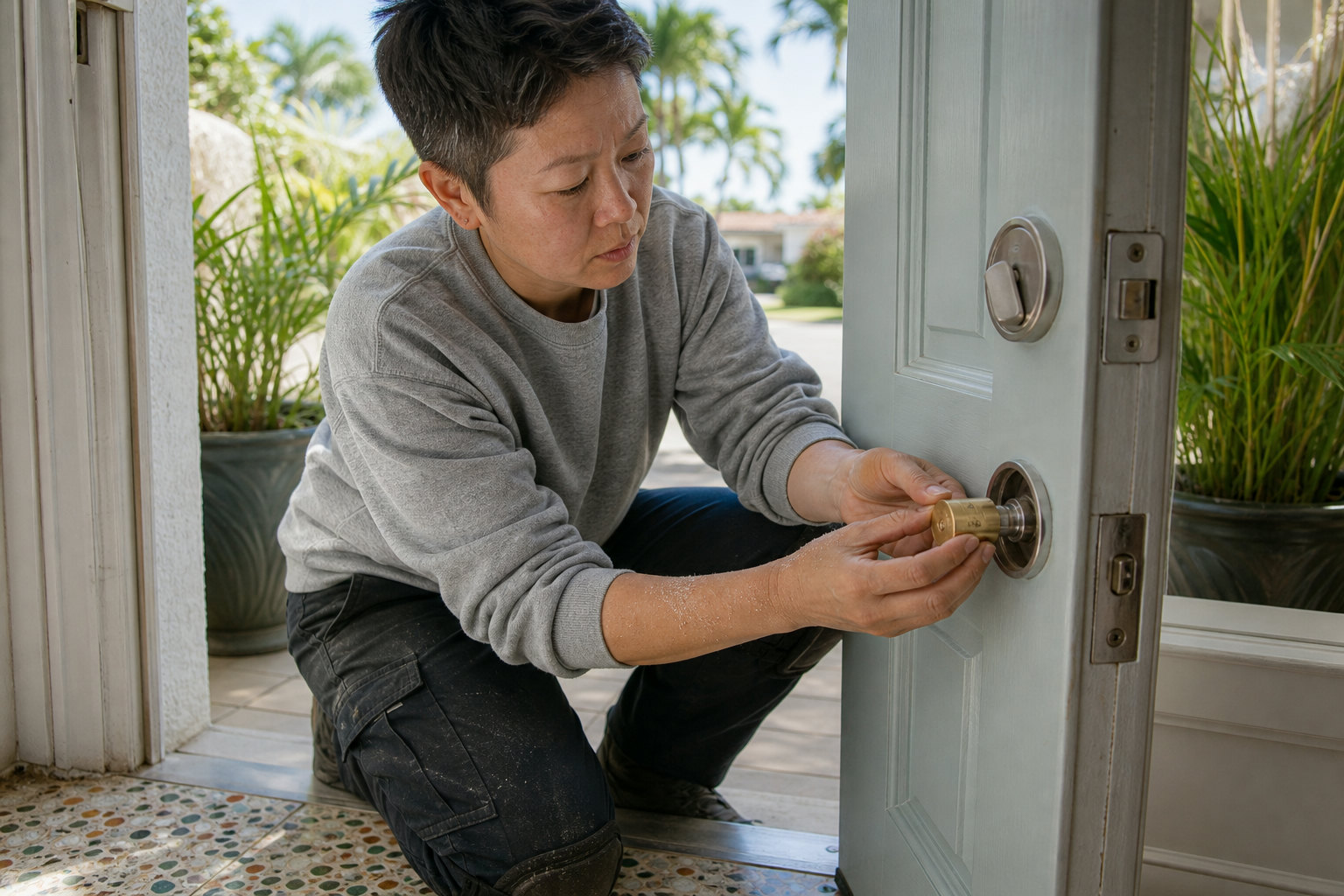
- A cylinder-only upgrade replaces the keyed part of a deadbolt and leaves the existing bolt, strike plate, housing and door bore in place.
- Medeco is a brand within the ASSA ABLOY group, so choosing between ASSA and Medeco is really choosing between two high-security cylinder lines from the same parent company.
- Retrofit fit depends on the housing: Schlage-style residential deadbolts are common candidates, while Kwikset SmartKey locks and most smart locks use cylinder designs that limit drop-in options.
- High-security cylinders are evaluated against standards such as UL 437 and ANSI/BHMA A156.30, which address picking, drilling and key control.
- A new cylinder does nothing for a weak strike; a strike plate anchored with 3-inch screws into the door framing is what resists a kicked-in door.
- Exterior doors in Broward and Miami-Dade fall under the Florida Building Code’s High-Velocity Hurricane Zone, so check a door’s product approval before replacing the entire deadbolt; a cylinder-only change leaves the bolt and strike alone.
The Short Answer: ASSA Abloy or Medeco Deadbolt Cylinder Upgrades for Fort Lauderdale Homeowners
A Medeco or ASSA deadbolt cylinder upgrade on an existing lock is possible whenever the deadbolt housing has a removable cylinder and a retrofit cylinder exists for that housing. You keep the bolt that slides into the frame, the strike plate, and the holes already drilled in your door. Only the keyed cylinder and the keys change.
If you own a single-family house in Broward with a Schlage or similar deadbolt that still locks smoothly, and your goal is pick resistance and key control rather than a new look, a cylinder-only upgrade is aimed squarely at you. It is not the right path for someone whose bolt drags, whose key already sticks, or whose lock is a keypad or app-controlled model. Those situations usually call for new hardware.
One more point surprises a lot of people. Swapping the cylinder is the security upgrade; swapping the whole deadbolt is mostly a hardware upgrade. The cylinder is where picking, bumping and unauthorized key copying happen, so that is where Medeco and ASSA put their engineering.
The Full Answer
Upgrading a deadbolt cylinder to Medeco or ASSA without replacing the lock comes down to six questions: what the cylinder actually is, whether your housing accepts a retrofit, which brand fits your needs, what dimensions must match, how the local climate affects the choice, and how the swap itself is done. Here is each one in plain terms.
| Option | What changes | Security gain | Best fit |
|---|---|---|---|
| Rekey existing cylinder | Pins inside the same cylinder; new keys | Old keys stop working; no added pick or copy resistance | Move-in day, lost keys, lock in good shape |
| Cylinder-only upgrade (Medeco or ASSA) | Keyed cylinder and keys only | Pick, bump and drill resistance plus restricted key duplication | Sound, compatible housing; owner wants key control |
| Mul-T-Lock retrofit cylinder | Keyed cylinder and keys only | High-security cylinder from a different manufacturer | Housing better supported by Mul-T-Lock’s retrofit range |
| Full high-security deadbolt | Cylinder, bolt, housing, often strike | Cylinder plus stronger bolt and housing | Worn bolt, smart or proprietary lock, damaged door prep |
What part of a deadbolt does a cylinder upgrade replace?
A deadbolt cylinder upgrade replaces the keyed plug assembly on the outside of the door, plus its tailpiece, the flat bar that reaches through the door and turns the bolt. Everything else stays: the bolt mechanism in the edge of the door, the interior thumbturn housing in most cases, and the strike plate in the frame.
That split matters because the two halves do different jobs. The cylinder decides who can operate the lock without force. The bolt and strike decide how well the door holds when someone uses force. A high-security cylinder improves the first job a great deal and the second job not at all.
Does my deadbolt brand accept a Medeco or ASSA retrofit cylinder?
Medeco and ASSA retrofit cylinders are made to fit specific housings, so the brand and model of your existing deadbolt is the first thing to identify. Schlage residential deadbolts are among the most widely supported housings for high-security retrofits, which is one reason they make good candidates.
Kwikset is less straightforward. Kwikset SmartKey deadbolts use a sidebar-and-slider cylinder design rather than a traditional pin stack, which narrows the list of drop-in options. Yale and other brands vary by model line. The honest answer for any specific lock is that a locksmith checks the housing against the manufacturer’s current compatibility list before ordering anything.
You can do a quick check yourself. Look at the face of the cylinder or the interior plate for a brand name, then note whether the deadbolt is single-cylinder (thumbturn inside) or double-cylinder (key on both sides). That alone tells a locksmith most of what they need for a first answer.
Is ASSA Abloy or Medeco the better cylinder for a home?
ASSA Abloy versus Medeco is a slightly misleading matchup, because Medeco is a brand owned by the ASSA ABLOY group. In the U.S., the ASSA name on a cylinder usually means ASSA High Security Locks, which sells lines such as Maximum+, while Medeco sells lines such as the M3 and X4. Both are high-security brands from the same corporate family with different internal designs.
Medeco cylinders use pins that must lift to the correct height and rotate to the correct angle, with the M3 adding a slider for another layer of key control. ASSA cylinders combine a pin stack with a sidebar that reads a separate set of cuts on the key. For a homeowner, the practical differences are which one has a retrofit for your housing, how easy authorized key duplication is near you, and whether you want other doors on the same key system.
Mul-T-Lock is the other name worth comparing, since it also makes retrofit cylinders for common deadbolts. Our side-by-side look at Mul-T-Lock and Medeco high-security deadbolts covers where each one fits better.
What has to match: door thickness, tailpiece and keying?
A retrofit cylinder’s tailpiece has to suit the door’s thickness and the existing bolt’s cam. Residential doors in the U.S. are commonly 1-3/8 or 1-3/4 inches thick, and thicker custom or impact doors may need an extended tailpiece or a different cylinder length. A tailpiece that is too short will not engage the bolt; one that is too long can bind.
Keying is the second match. If you want one key for the front deadbolt, the back door and the garage entry, every one of those locks needs a compatible high-security cylinder keyed alike. A patented Medeco or ASSA key will not operate a standard cylinder, so a single upgrade on one door means carrying two keys until the rest are converted.
Finish is the third, and the easiest. Retrofit cylinders come in common finishes such as satin chrome and polished brass, so the new cylinder face can usually blend with the existing hardware.
A Medeco or ASSA retrofit needs three matches: a cylinder made for your housing brand, a tailpiece suited to your door thickness (commonly 1-3/8 or 1-3/4 inches), and keying that covers every door you want on one key. Miss any one and the swap stalls.
Do humidity and salt air change which cylinder to pick?
Coastal humidity and salt air affect every lock cylinder, high-security or not, by encouraging corrosion and gummy buildup inside the keyway. Fort Lauderdale sits on the Atlantic with miles of tidal canals, so exterior doors here take more moisture and salt than the same door would inland.
The cylinder brand matters less than the maintenance. Brass internals tolerate humidity reasonably well, but grit plus moisture will still wear pins and springs over time, and heavy oil-based sprays tend to attract that grit. Follow the cylinder maker’s lubrication guidance, which typically favors a light, dry product. Our comparison of Medeco, ASSA Abloy and Mul-T-Lock deadbolts in coastal humidity goes deeper on this.
A common mistake is ignoring a key that sticks or needs a jiggle until it finally snaps inside the cylinder. Dealing with a worn cylinder early is simpler than an extraction, and it is the perfect moment to upgrade rather than repair. The seasonal resident who closes up a house for the summer should test every exterior lock on return, before a stiff cylinder becomes a broken key.
How does a cylinder-only swap work on the day?
A cylinder-only swap on a compatible deadbolt is a short job once the right Medeco or ASSA cylinder is in hand. The general sequence looks like this.
Identify the housing
Note the brand, model, single or double cylinder, and door thickness so the correct retrofit cylinder and tailpiece can be specified.
Order the keyed cylinder
High-security cylinders are often keyed to a registered system, so the cylinder may be ordered rather than pulled from stock.
Remove the old cylinder
Depending on the design, that means taking off the interior side and lifting out the exterior cylinder, or releasing a retainer that holds the cylinder in place.
Fit and set the new cylinder
The tailpiece is cut or selected for the door and aligned with the bolt’s cam before the hardware is reassembled.
Test with the door open and closed
The bolt should throw fully and retract smoothly from both sides; any drag at this stage points to strike alignment, not the cylinder.
Hand over keys and the key card
Keep the key card or registration paperwork somewhere safe, because authorized duplicates usually require it.
When the Answer Is Different
A deadbolt cylinder upgrade to Medeco or ASSA without a new lock stops making sense in a handful of specific situations. If any of these describe your door, plan on a full high-security deadbolt or a different approach.
- Smart locks and keypad deadbolts. Models such as the Schlage Encode and Yale Assure use their own cylinder housings, and most do not accept a third-party high-security cylinder. Our comparison of Schlage Encode Plus, Yale Assure 2 and ASSA Abloy smart locks covers the trade-offs.
- A worn or loose bolt. If the bolt sticks, wobbles, or does not throw fully, a new cylinder will turn a bad mechanism. Replace the deadbolt.
- Housings with no retrofit option. Some budget and older imported deadbolts have no compatible high-security cylinder at all.
- Condo and multi-unit buildings. Many associations run a master-key system and control which keyway is allowed on unit entry doors. Check the association’s rules before changing anything.
- Double-cylinder deadbolts. These need two matched cylinders, and a key-only interior can conflict with fire-safety egress expectations, so it is worth asking whether a single-cylinder setup is the better choice.
- Impact-rated exterior doors. Broward and Miami-Dade are designated as the High-Velocity Hurricane Zone under the Florida Building Code, and impact door assemblies are approved with specific hardware. A cylinder-only swap leaves the bolt and strike in place; replacing the whole deadbolt is the point where you should check the door’s product approval.
The landlord turning a unit over between tenants is a different case too. Rekeying or a quick cylinder change is often what that situation needs, and the landlord deadbolt replacement case study with Mul-T-Lock hardware walks through why a full replacement was chosen there.
Our view
In our opinion, homeowners weighing a Medeco or ASSA cylinder upgrade spend too much energy on the brand name and too little on the door around it. Medeco and ASSA come from the same parent group and both build serious cylinders. The better pick is usually whichever one has a clean retrofit for your exact housing.
What actually matters, in our view, is the boring stuff. A strike plate held by 3-inch screws into the framing, a bolt that throws fully, and key control you will actually use (keeping the key card, limiting copies) do more for a home than any marketing claim. A high-security cylinder on a door with half-inch strike screws is a strong lock on a weak door.
Our opinion on timing is simple. If the existing deadbolt is solid, the cylinder-only upgrade is the efficient move. If the deadbolt is tired, stop patching it and replace the whole thing once.
Frequently Asked Questions
How long does a deadbolt cylinder swap take?
A deadbolt cylinder swap usually takes well under an hour per door once a compatible Medeco or ASSA cylinder is on hand. The longer part is often sourcing a cylinder keyed to your system, since high-security cylinders are frequently ordered rather than taken from stock.
Can I copy Medeco or ASSA keys at a hardware store?
Medeco and ASSA high-security keys generally cannot be copied at a hardware store kiosk, because the key blanks are restricted and distributed through authorized dealers. Duplicates are typically cut only when the registered owner presents the key card or identification tied to the key system.
Will a high-security cylinder stop a break-in?
A high-security cylinder such as a Medeco M3 or an ASSA Maximum+ makes picking, bumping and drilling far harder, and high-security lines are commonly tested to UL 437. It does not reinforce the door itself, so pair the upgrade with a strike plate anchored by 3-inch screws into the framing.
Is rekeying the same as a cylinder upgrade?
Rekeying and a cylinder upgrade are different jobs: rekeying changes the pins inside your existing Schlage or Kwikset cylinder so old keys stop working, while an upgrade installs a new Medeco or ASSA cylinder. Rekeying adds no pick or copy resistance; a high-security cylinder adds both, plus restricted key duplication.
Have a similar question about your own deadbolt in Fort Lauderdale? Send the brand name on your lock and whether it is single or double cylinder, and ask Easy Keys 4 Cars whether a Medeco, ASSA or Mul-T-Lock retrofit fits and what the job would cost. If your door cylinders are already stiff, the case study on a failing door lock cylinder and an ilco replacement key shows why early attention pays off.
Sources
- Medeco high-security cylinder lines, including the M3 and X4, and retrofit cylinder information: Medeco
- ASSA ABLOY group structure and its brands, including Medeco: ASSA ABLOY
- ANSI/BHMA standards for high-security cylinders (A156.30) and residential deadbolts: Builders Hardware Manufacturers Association
- Florida Building Code and the High-Velocity Hurricane Zone covering Miami-Dade and Broward counties: Florida Building Commission
Easy Keys 4 Cars
Automotive locksmith services
 Listen to this articleAudio version
- Medeco vs ASSA Abloy vs Mul-T-Lock: Which High-Security Deadbolt Cylinder Survives Miami’s Coastal Humidity Longest
- ASSA Abloy vs Medeco vs Mul-T-Lock: Which Restricted Keyway System Prevents Unauthorized Duplication in Miami Commercial Buildings
- Mul-T-Lock vs Medeco vs ASSA Abloy: Which High-Security Car Key System Holds Up in South Florida’s Salt Air
- Will a Mul-T-Lock High-Security Deadbolt Fit a Brickell Condo Door Without New Holes? What a Miami Locksmith Checks
- Mul-T-Lock vs Medeco: Which High-Security Deadbolt Actually Holds Up in Miami’s Salt Air