


Last updated: November 3, 2026
Published November 3, 2026 · Updated November 3, 2026
 Listen to this articleAudio version
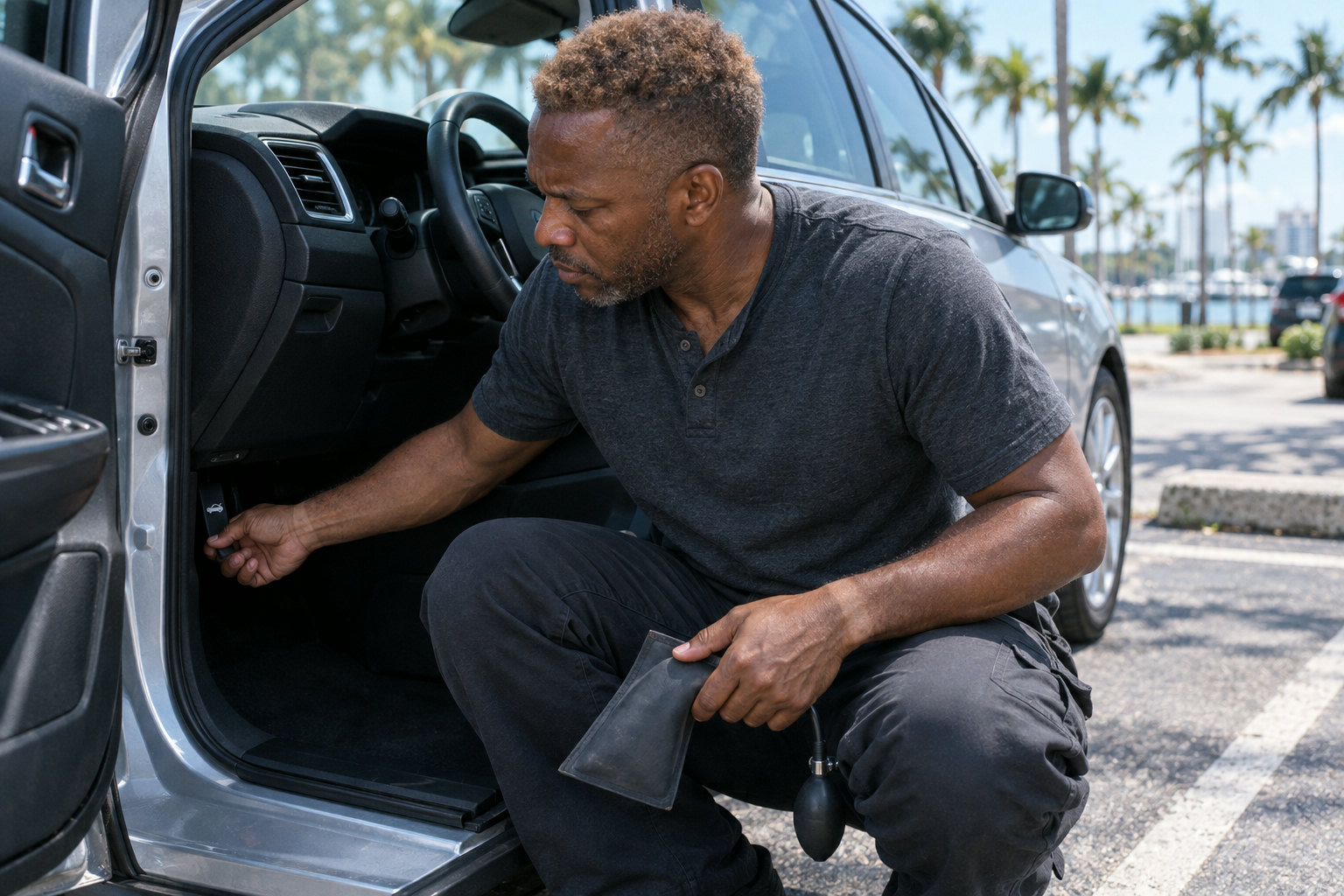
A car trunk lockout in Fort Lauderdale when keys are inside is usually solved by opening a door first and then reaching the trunk through the cabin release, the fold-down rear seats or the SUV cargo area, because the driver’s door is the one lock nearly every car still exposes. Direct trunk entry (picking or decoding the trunk’s own lock cylinder) wins only when the car still has a trunk keyhole and the cabin route is blocked. For most drivers, cabin access is the winner; for a specific group of older sedans, going straight through the trunk lid is faster.
- Cabin access is the default method when keys are locked in a trunk, because most cars, including push-button-start models, still hide a mechanical key cylinder on the driver’s door.
- Direct trunk entry only works on vehicles that still have an exterior trunk lock cylinder, a part many newer sedans have dropped entirely.
- On many sedans, the rear seatback release levers sit inside the trunk, so folding the seats down from the cabin is not always possible.
- FMVSS No. 401 requires an interior trunk release on passenger cars with trunks built on or after September 1, 2001, but that glow-in-the-dark handle only works from inside the trunk.
- A dead 12-volt battery disables electric trunk releases, which turns the job into cabin access plus restoring power.
- Easy Keys 4 Cars works across Miami and South Florida, from Hialeah and Doral to Hollywood, Aventura and Sunny Isles Beach.
Car Trunk Lockout in Fort Lauderdale When Keys Are Inside: Cabin Access vs Direct Entry
Cabin access beats direct trunk entry for a car trunk lockout when keys are inside on most vehicles, because the door lock is almost always present while the trunk lock often is not. The table below compares the two methods across the attributes that actually decide which one a locksmith reaches for.
| Attribute | Cabin access | Direct trunk entry |
|---|---|---|
| Point of entry | Driver or passenger door, then the interior trunk release or rear seats | The trunk lid’s own lock cylinder |
| Works with no trunk keyhole | Yes | No |
| SUVs and hatchbacks | Yes, the cargo area is reachable over the rear seats | Only if the liftgate has a key cylinder |
| What blocks it | Trunk main switch turned off, key-locked seatbacks, dead battery | Missing cylinder, seized or corroded cylinder |
| Main damage risk | Door weatherstripping and interior trim if done carelessly | Paint around the lock and cylinder wear if forced |
| Typical tools | Air wedge and long-reach tool, or a pick-decoder on the door lock | Pick-decoder or impressioning on the trunk lock |
| Best fit | Most sedans, all SUVs and hatchbacks, push-button-start cars | Older sedans with a trunk keyhole and a disabled cabin release |
One detail changes the math: direct trunk entry reaches the keys in a single step. Cabin access is two steps, first the door and then the trunk, and the second step can fail on certain sedans.
If you’re a beach-day driver who tossed the fob into a cooler bag in the trunk, or a parent who closed the lid on a diaper bag with the keys clipped to it, the method matters less than one question. Does your car have a keyhole on the trunk lid? Check before you call, because it tells the locksmith which route to plan.
How does cabin access work when the keys are locked in the trunk?
Cabin access means a locksmith opens a door without the key, then uses the car’s interior trunk release button, the fold-down rear seats or the open cargo area to reach the keys. On SUVs, minivans and hatchbacks, this is nearly always the whole job, because the cargo area shares the cabin.
Strengths of cabin access
The driver’s door is the most universal entry point on a car. Even push-button-start models usually hide a mechanical cylinder under a small cap on the driver’s door handle, sized for the emergency blade tucked inside the fob. Door locks from suppliers like Strattec, a long-time maker of locks and keys for North American automakers, are designed to be serviced, which means a trained technician can decode them without drilling.
Opening the door also gives access to the hood release, the glove box and the power trunk button. That matters when the problem turns out to be bigger than a closed lid.
Weaknesses of cabin access
The second step can stall. On many sedans, the rear seatback release levers are mounted inside the trunk, not in the cabin, so the seats cannot be folded from the back seat. Some sedans also have a trunk main switch in the glove box, or rear seatbacks that lock with the mechanical key, both meant to protect cargo when a valet drives the car.
Power releases fail without power. A dead battery leaves the interior trunk button useless.
Cabin access works on almost every SUV and hatchback and on most sedans. It stalls when the sedan’s seat release levers sit inside the trunk, when a glove-box trunk switch is off, or when the 12-volt battery is dead.
When does direct trunk entry make more sense than going through the cabin?
Direct trunk entry makes more sense when the car still has an exterior trunk lock cylinder and the cabin route to the trunk is disabled. In that case, picking or decoding the trunk lock reaches the keys in one step, with no need to open a door or touch the interior.
Strengths of direct trunk entry
Direct entry sidesteps every valet feature. A glove-box trunk switch, key-locked seatbacks and a dead battery have no effect on a mechanical trunk cylinder, because that cylinder physically releases the latch. A technician using a pick-decoder can also read the cuts while opening the lock, which helps if a new key is later cut on an ilco blank.
It also leaves the cabin untouched. For an owner with a freshly detailed interior or delicate door trim, that is a real advantage.
Weaknesses of direct trunk entry
The biggest weakness is simple: many cars have no trunk cylinder to work on. The second is condition. A trunk lock that never gets used sits exposed to sun and rain for years, and cars parked near the coast in Miami Beach, Sunny Isles Beach or Hollywood face salt air that corrodes idle lock parts.
A seized cylinder can turn a one-step job into a slow one. When that happens, a locksmith will usually switch to cabin access rather than force a corroded lock.
Why do so many newer cars have no trunk keyhole?
Newer cars often skip the trunk keyhole because electric trunk releases, remote fobs and proximity keys made the exterior trunk cylinder redundant for daily use. Automakers kept one mechanical cylinder, usually on the driver’s door, as an emergency backup and dropped the rest.
That design choice is why a trunk lockout on a newer sedan almost always becomes a cabin job. There is simply no second lock to work on.
A related point surprises many drivers. Federal Motor Vehicle Safety Standard No. 401 requires passenger cars with trunks built on or after September 1, 2001, to have an interior trunk release, usually a glow-in-the-dark handle. That release exists to free a person trapped inside the trunk, so it offers no help to someone standing outside with the keys on the other side of the lid.
Why do push-button-start cars still end up with keys locked in the trunk?
Push-button-start cars still get keys locked in the trunk because fob detection inside the trunk is less reliable than detection inside the cabin. Many proximity-key systems try to sense a fob left in the cargo area and will warn the driver or refuse to lock, but the signal can be missed.
Several conditions weaken that signal. A fob buried in a metal toolbox, a foil-lined cooler bag or under heavy luggage may go undetected, and a weak coin-cell battery (often a CR2032) shrinks the fob’s range further. Heat shortens battery life in general, so a fob that rides in a hot car all summer can fade without warning.
For a rideshare driver between airport runs, that combination is the classic trap: luggage goes in, the fob slips into a bag, and the lid closes. If you drive a Hyundai, the Hyundai locked-keys walkthrough covers how that brand’s smart key and door cylinder behave during a lockout.
Smart-key cars favor cabin access. Opening the driver’s door with the hidden cylinder, then pressing the trunk button with the system awake, is the most common route.
What should you check before calling a locksmith for keys locked in the trunk?
Before calling for keys locked in the trunk, check every door, your automaker’s phone app and any spare key, because one of those may end the lockout on its own. If none works, a few details about the car help the locksmith pick the right method before arriving.
Confirm nobody is inside
If a person or pet is in the trunk or cabin, call 911 first. Everything else can wait.
Try every door and the liftgate
A rear door or tailgate left unlatched turns the job into a simple reach over the seats.
Open your automaker’s app
Connected services such as Hyundai Blue Link, Kia Connect and FordPass offer remote unlock on eligible vehicles with an active account.
Look for a trunk keyhole
Check the trunk lid, the license plate trim and under the trunk handle. Tell the locksmith whether one exists.
Skip the coat hanger and the pry bar
Doors hold window regulators, wiring and often side airbag components, and a pried trunk lid bends easily.
The full sequence for door lockouts is laid out in the step-by-step car lockout guide, which pairs well with the checks above.
Would a spare key have prevented this?
A spare key turns almost any car trunk lockout when keys are inside into a short wait for someone to bring it over. That is why one of the most avoidable situations is owning a car with a single key.
A common mistake is skipping the spare after buying a used vehicle. Dealers often hand over only one key, and if that key ends up in a locked trunk or goes missing, there is no backup at all. Getting a second key made soon after purchase is the cheapest insurance against this exact problem.
Another mistake is assuming any hardware store can copy a modern car key. Most current vehicles use a transponder chip that must be coded to the immobilizer, often through the OBD-II port, which hardware-store key duplication does not do. A copied blade may open the door and still refuse to start the engine. For background on that process, see what goes into a programmed replacement car key.
- Choose cabin access for any SUV, minivan or hatchback, any push-button-start car, and any sedan with no trunk keyhole.
- Choose cabin access when the trunk cylinder is visibly corroded or stiff, which is common on coastal cars that rarely use it.
- Choose direct trunk entry for an older sedan that has a trunk keyhole and a glove-box trunk switch turned off, or rear seats locked with the key.
- Choose direct trunk entry when the 12-volt battery is dead and the trunk has a working mechanical cylinder, since it skips the power problem entirely.
- Choose a new key instead only when the original is lost rather than locked in, because opening the trunk is far simpler than cutting and programming a replacement.
Our Verdict
Cabin access is the right first plan for a trunk lockout with the keys inside on the large majority of cars on the road. It works on vehicles with no trunk keyhole, it works on every SUV and hatchback, and the driver’s door cylinder is the one lock automakers almost never remove.
Direct trunk entry earns its place in a narrow lane. The owner of an older sedan with a trunk keyhole, a valet switch turned off and seats locked with the key should expect the trunk route, and it will often be quicker there.
The property manager moving boxes between buildings, the commuter with a dead battery in a parking garage and the tourist whose rental fob slid into a beach bag all have different cars and different blockers. A mobile technician who asks about the vehicle first, then picks the method, beats one who arrives with a single routine. If you’re stuck anywhere in Fort Lauderdale, a mobile car locksmith service can assess both routes on site.
Our view
This is opinion, plainly labelled. Drivers tend to overweight the trunk itself, assuming the fix has to happen where the keys are. In practice, the door is the gateway on most modern cars, and the trunk lid is only a shortcut on certain older sedans.
What actually matters is knowing three facts about your own car before anything goes wrong: whether it has a trunk keyhole, where the rear seat releases are, and whether a trunk switch sits in the glove box. Five minutes with the owner’s manual answers all three.
The single best fix is a second key kept somewhere other than the car. It does not prevent the lid from closing, but it makes the closing almost irrelevant.
- How to Handle a Car Lockout with Help from Easy Keys 4 Cars
- A Fort Lauderdale Resident Asked: ‘How Much Does It Cost to Get a Replacement Car Key Programmed in South Florida?’ — Real Numbers
- The Sunny Isles Beach Condo Owner Who Lost All 3 Key Fobs — How We Restored Full Access the Same Afternoon
- A South Beach Driver Asked: ‘Should I Call a Locksmith or Roadside Assistance for an Emergency Car Lockout?’ What to Consider Before You Call
- What a Typical Car Key Lockout Job in Aventura Looks Like, From the First Call to a Working Key in the Door
Frequently Asked Questions
Can a locksmith open a trunk that has no keyhole?
A locksmith can open a trunk with no keyhole by going through the cabin first, usually via the hidden mechanical cylinder on the driver’s door. Once inside, the interior trunk release, the fold-down rear seats or the cargo area provides access to the keys.
Does opening a locked trunk damage the car?
Opening a locked trunk professionally should not damage the car when the technician uses an air wedge, a long-reach tool or a pick-decoder rather than force. The risk rises with DIY prying, which can bend a trunk lid or harm door wiring and side airbag components.
What if the car battery is dead and the keys are in the trunk?
A dead 12-volt battery with keys in the trunk disables electric trunk releases, so the cabin button will not work. The fix is either direct entry through a mechanical trunk cylinder, if the car has one, or opening the door, pulling the hood release and restoring power before using the trunk button.
Should I get a new key made instead of opening the trunk?
Getting a new key made instead of opening the trunk rarely makes sense when the original key is sitting inside the car. A new key for most vehicles built since the late 1990s needs a cut blade plus transponder programming, often through the OBD-II port, which is a bigger job than a lockout.
Sources
- Interior trunk release requirement for passenger cars with trunks, FMVSS No. 401 – Electronic Code of Federal Regulations, 49 CFR 571.401
- Overview of the Federal Motor Vehicle Safety Standards – National Highway Traffic Safety Administration
- Strattec as a manufacturer of automotive locks and keys – Strattec Security Corporation
- Car lockout steps and service details – Easy Keys 4 Cars car lockout guide