


Last updated: October 23, 2026
Published October 23, 2026 · Updated October 23, 2026
Key shell replacement in Hialeah usually lets you keep your working transponder chip: the chip or remote circuit board is moved from the cracked case into a new shell, and the car keeps recognizing it without reprogramming. The exceptions are keys whose chip is molded into the broken plastic and fobs whose circuit board is damaged, which need a new chip and OBD-II programming.
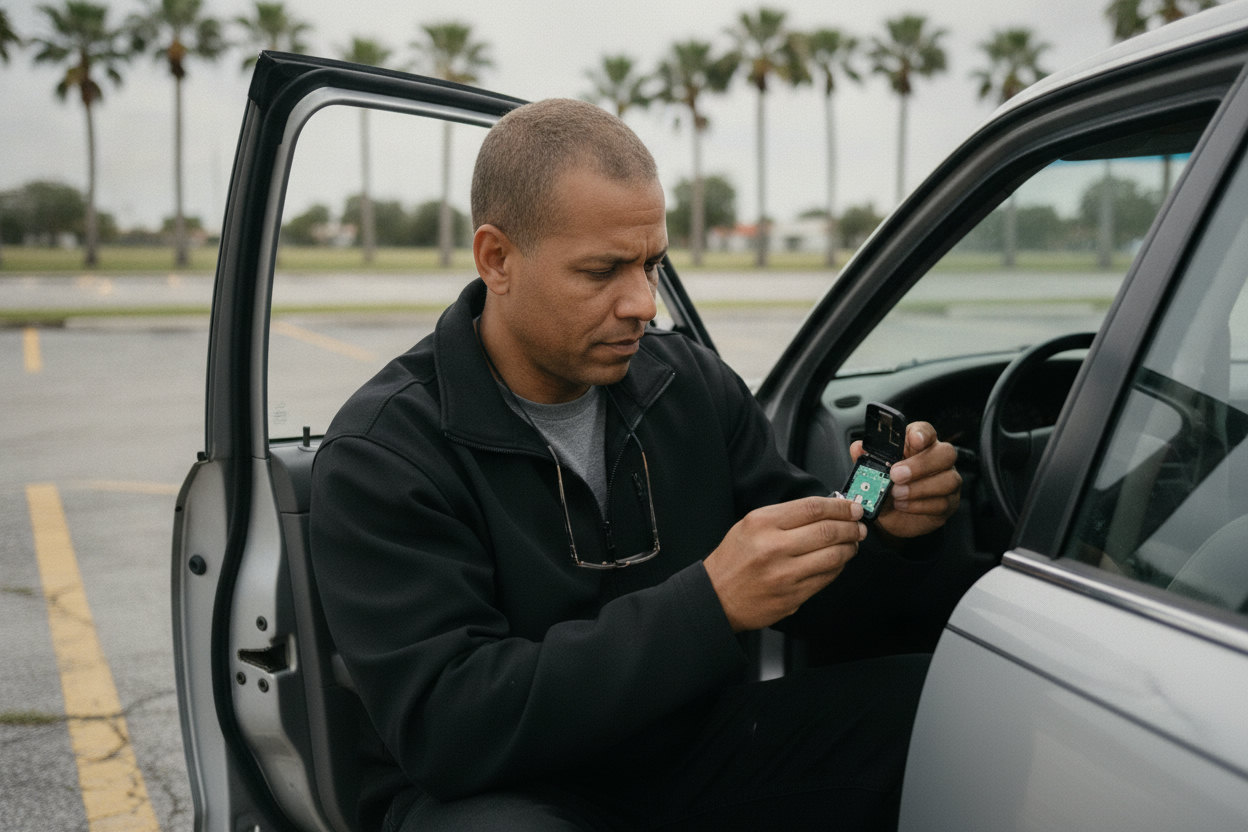
This is for drivers whose key still starts the car but is now held together with tape or a rubber band. It is not for someone whose key has stopped starting the car altogether, because that is a chip or programming problem, and it gets its own section further down.
- A transponder chip has no battery and stores a fixed code, so moving an undamaged chip into a new key shell does not erase its pairing with the car’s immobilizer.
- Remote lock and unlock functions live on the circuit board inside the fob, and a board transferred intact keeps its programming in most vehicles.
- The new shell’s metal blade must be cut to match your ignition and door locks, ideally to the factory key code rather than copied from a worn original blade.
- Chips molded into the plastic head cannot be moved, so a key built that way needs a new transponder programmed to the car through the OBD-II port.
- Heat, sun and salt air in South Florida break down key plastics and corrode battery contacts, so the board and the coin cell (often a CR2032 or CR2025) deserve a check during any shell swap.
The Short Answer: Key Shell Replacement in Hialeah
A key shell replacement keeps your original transponder chip whenever that chip is a separate part that can be lifted out of the broken case. The chip carries a fixed code your car’s immobilizer already knows. Once it sits in a new shell, the engine starts exactly as it did before.
Two things are new after the swap: the plastic housing and, usually, the metal blade, which has to be cut to match your ignition and door locks. If your key has remote buttons, the circuit board moves across too, and in most vehicles its lock and unlock pairing comes with it.
Reprogramming only enters the picture in three cases. The chip is molded into the plastic you are throwing away, the chip went missing after the case split, or the board itself is damaged. Outside those cases, a cracked case is a housing problem, not an electronics problem.
The Full Answer
Moving a transponder chip into a new key case sounds simple, and often it is. The details depend on how your key was built, what kind of remote it carries, and how much damage the crack has already done. Each piece is covered below.
Where does the chip actually live inside your key?
The transponder chip in most car keys built since the late 1990s is a tiny passive radio part with no battery of its own. When you turn the key, a coil antenna around the ignition cylinder powers the chip for a moment and reads its code. If the code matches, the immobilizer lets the engine run.
Where that chip sits varies by maker and model. On many older Toyota and Honda keys it is a small separate piece, such as a glass capsule or a carbon wedge, tucked into a pocket inside the head. On other keys it is molded straight into the plastic, and that changes the answer.
So the first job is always the same. Open the cracked head carefully and see which design you have.
| Key type | Where the chip or board lives | Moves to a new shell? | What else is needed |
|---|---|---|---|
| Basic transponder key | Loose glass capsule or carbon wedge in a pocket in the head | Usually yes | Blade cut to match the car |
| Molded-chip key | Sealed inside the plastic head | Often no | New transponder plus OBD-II programming |
| Remote head key (blade and buttons in one head) | Circuit board carrying the remote and, often, the transponder | Usually yes, if the board is intact | Blade cutting, battery and contact check |
| Flip (switchblade) key | Board inside the housing, folding blade on a hinge | Usually yes | Blade cut or transferred, new hinge pin and spring |
| Push-to-start smart fob | Single board handling remote and keyless start | Usually yes, if the board is intact | Emergency blade cut to the door lock |
| Water- or corrosion-damaged fob | Board with corroded traces or contacts | Sometimes, after cleaning or repair | Board repair or a new fob programmed to the car |
If you’re not sure which kind of chip your key uses, the guide to the difference between a chip key and a transponder key walks through the common types and how each one talks to the car.
Will the car need reprogramming after the swap?
No, an intact transponder chip moved into a new shell needs no reprogramming. Car immobilizers pair with the code stored on the chip, not with the plastic around it, and that code does not change when the chip changes houses.
That is the main reason a shell swap is worth asking about before buying a whole new key. A new key means a new chip. A new chip has to be introduced to the car with diagnostic equipment through the OBD-II port, which is a separate and more involved job.
A common mistake is trying to reprogram a new key or fob without proper diagnostic equipment. DIY attempts commonly fail because the immobilizer is not synced correctly to the transponder chip, and the result is a car that cranks but will not stay running. Keeping your original chip sidesteps that risk entirely.
What happens to the remote buttons and the battery?
The remote functions on a key fob (lock, unlock, trunk, panic) run on a small circuit board, and that board is usually transferred as one piece. In most vehicles, the remote’s pairing is stored between the board and the car, so it survives the move to a new housing.
The rubber button pad does not need saving. Torn or flattened pads are one of the usual reasons people go looking for a new case, and a fresh shell brings fresh buttons with it.
The battery is the other easy fix. Most fobs run on a coin cell such as a CR2032 or CR2025, and a shell replacement is the natural moment to fit a new one and check the contacts for green or white corrosion.
Remote fobs are also licensed radio transmitters. The board or the original case usually carries an FCC ID, and that ID is how a locksmith confirms a replacement board or fob matches your car if the old board cannot be reused.
If the buttons stopped working before the case cracked, the fault may be on the board rather than the shell. The breakdown of key fob repair versus replacement for a failed button explains how to tell the two apart.
Does the new shell’s blade have to be cut?
Yes, the metal blade on a replacement key shell almost always arrives uncut, so it must be cut to match your vehicle’s ignition and door locks. Without that step, the new case holds your chip but cannot turn anything.
There are two ways to cut it. The blade can be traced from your existing key, or it can be cut to the original factory key code, obtained through proper channels or decoded from the lock. Cutting to code is the better route when the old blade is worn, because tracing a worn blade copies the wear.
Laser-cut, or high-security, blades have a groove milled down the face instead of notches on the edge. They need a different cutting machine from a standard edge-cut key. Some shells also accept the original blade, which can move across with the chip if the mounting style matches exactly.
Another mistake worth avoiding is assuming any hardware store key counter can handle a modern car key. Many can copy a plain metal blade, but vehicles with transponders need chip coding and OBD-II programming whenever a new chip is involved, and that work belongs with an automotive locksmith.
A careful transfer, start to finish, follows five steps:
Confirm the chip still works
The key should start the car before anything is opened, which proves the transponder is readable and paired.
Open the old shell without prying on the electronics
The chip and board come out without stress on solder joints, and a glass capsule is handled so it does not crack.
Match the new shell exactly
Button layout, blade profile and internal mounting posts must match the original, or the board sits loose and the buttons misfire.
Cut or transfer the blade
The blade is cut to code or traced from the original, then checked in the door lock and the ignition.
Test every function
Start the engine, then test lock, unlock, trunk and panic from a normal distance, not just from beside the car.
Are flip keys and push-to-start fobs handled the same way?
Flip keys, the switchblade style where the blade folds into the head, take a shell transfer well, but the folding mechanism adds parts. The hinge pin and spring are common failure points, and a new shell replaces them along with the case.
Push-to-start smart fobs work differently. There is no blade in the ignition; the fob talks to the car over short-range antennas, and the keyless-start function lives on the same circuit board as the buttons. If that board is clean and intact, a new housing changes nothing electronic.
Most smart fobs also hide a small emergency blade for the driver’s door. Replacement housings often include an uncut emergency blade, so it needs cutting too. Skip that step and you lose your way into the car the day the fob battery dies.
For rideshare and delivery drivers who pull a fob out of a pocket many times a day, the housing takes most of the wear. When the electronics still work, a shell swap is the sensible first step before anyone talks about a new fob.
Why do key cases crack so quickly in South Florida?
Key plastics in South Florida face heat, strong ultraviolet light and constant humidity. A key left on a dashboard or in a cup holder of a car parked in the Miami sun gets very hot, and repeated heat cycles make plastic brittle and rubber button pads stiff.
Coastal air adds a second problem. Cars parked near the water in Miami Beach, Sunny Isles Beach or along the beach in Hollywood sit in salty, humid air, which speeds corrosion on battery contacts and circuit traces once a crack lets moisture in.
That is why the board deserves a close look during any shell swap. A crack that let in moisture for months can leave corrosion that a new case will not fix.
A removable transponder chip or intact fob board keeps its pairing when moved into a new key shell, so no OBD-II programming is needed. The new blade must be cut to code or traced, and a CR2032 or CR2025 battery and corrosion check belongs in the same visit. Molded chips, lost chips and damaged boards are the cases that need programming.
When the Answer Is Different
A key shell replacement is the wrong fix in a handful of situations, and it helps to know them before you order a case. Each one below turns a simple transfer into a chip, board or programming job.
The chip is gone. When a key head splits, a loose glass or carbon chip can fall out without anyone noticing. A key with no chip still turns the ignition and may crank the engine, but the immobilizer will not let it run. The fix is a new transponder programmed to the car through the OBD-II port.
The chip is molded into the broken plastic. Some keys seal the transponder inside the head during manufacturing. Cutting it out risks destroying it, so the usual route is a new key with a new chip, programmed to the vehicle.
The board is damaged. Water, a cracked solder joint or heavy corrosion can knock out the remote functions, the transponder, or both. Board-level repair is sometimes possible. Otherwise, a new fob with a matching FCC ID is programmed to the car.
The key stopped starting the car before the case broke. In that case the shell is not the problem. The chip, the antenna ring around the ignition or the cylinder itself needs diagnosis first, as in this transponder key replacement after a broken ignition.
The replacement shell is a poor match. Aftermarket shells vary widely. A case with a slightly different button layout or a missing internal post leaves the board loose, which shows up as buttons that work one day and not the next. Original-equipment keys from makers like Strattec, a long-standing supplier of locks and keys to American automakers, and established aftermarket lines like ilco tend to hold board and blade more consistently than unbranded shells sold in bulk online.
Our view
This part is opinion. In a key shell swap, the blade matters more than the plastic. A case that looks perfect but carries a blade traced from a worn original feels fine for a while and then starts sticking in the ignition, so ask how the blade will be cut, and prefer cutting to code.
The circuit board deserves more attention than it usually gets. With the fob already open, it is the easiest moment to fit a fresh CR2032 or CR2025, clean the contacts and look for corrosion. That check takes very little effort and can head off a dead remote later.
Finally, don’t let a cracked case linger. A key held together with tape keeps working right up until the chip drops out in a parking lot. At that point, a simple transfer becomes a programming job.
Frequently Asked Questions
Do I need to bring my car for a key shell replacement?
A key shell replacement with a new blade works best with the car nearby, because the blade has to be checked in the door lock and ignition and the engine started as a final test. For a push-to-start fob with an intact board, the car is still needed to confirm lock, unlock and keyless start after the transfer. Mention your make, model and year when you call so the right shell can be matched before anything is opened.
Will a new shell fix key fob buttons that stopped working?
A new key shell fixes buttons that failed because of a torn or flattened rubber pad, since the shell comes with a fresh pad. It will not fix a dead CR2032 or CR2025 battery on its own, a broken solder joint or a corroded board. Testing the board with a fresh battery before ordering a shell separates the two problems.
Can I swap a key shell myself?
Swapping a key shell yourself is possible on keys with a removable chip, but the blade on most replacement shells arrives uncut and still needs a key machine. The biggest risk is losing or cracking a glass transponder capsule while opening the old case. That turns a simple transfer into a job that needs OBD-II programming equipment.
How can I tell if my transponder chip is damaged?
A damaged transponder chip usually shows up as a key that turns the ignition and may crank the engine, but the engine won’t stay running, often with a security or key-shaped warning light on the dashboard. If the key started the car normally right up until the case cracked, the chip is most likely fine. A locksmith can confirm by reading the chip with a transponder tester before the transfer.
Have a Similar Question About Your Key?
A cracked key that still starts the car is the best position to be in, because your original chip can usually stay with you. The sooner the transfer happens, the less chance that chip has to go missing.
Easy Keys 4 Cars is an automotive locksmith serving Hialeah and the wider Miami and South Florida area, including Doral, Coral Gables and Miami Beach. Send your vehicle’s make, model and year, plus a photo of the cracked key if you can, through the Easy Keys 4 Cars contact page. That is enough to say whether a shell transfer will work, what the job involves and what it will cost.
Sources
- Remote key fobs are FCC-authorized radio transmitters identified by an FCC ID: Federal Communications Commission, FCC ID Search
- Strattec as a manufacturer of automotive locks and keys: Strattec Security Corporation
- Types of chip and transponder car keys: Easy Keys 4 Cars, Chip Key vs Transponder Key
- Telling a failed fob button from a failed board: Easy Keys 4 Cars, Key Fob Repair vs Replacement
Easy Keys 4 Cars
Automotive locksmith services
Cracked Key Case? Ask If Your Chip Can Move to a New Shell →
- The Aventura Customer Whose Ilco Replacement Key Kept Failing — What We Found Inside the Door Lock Cylinder
- Car Key Replacement: What Actually Happens in the 34 Minutes Between Your Call and a Working Key
- What a Typical Car Key Lockout Job in Aventura Looks Like, From the First Call to a Working Key in the Door
- The Complete Guide to Car Key Replacement Services
- Why Are Replacement Car Keys So Expensive at Dealerships