



Getting locked out of your car or realizing your key fob has stopped working can turn an ordinary day in Miami or Fort Lauderdale into a stressful ordeal. Quick action matters, but knowing exactly what kind of car key problem you face helps you avoid wasted time and extra costs. This guide empowers you to assess your situation clearly and connect with mobile locksmiths who offer professional and trustworthy service across South Florida.
Table of Contents
- Step 1: Assess Your Car Key Situation
- Step 2: Contact A Local Mobile Locksmith
- Step 3: Verify Ownership And Car Details
- Step 4: Approve On-Site Key Replacement
- Step 5: Test And Secure Your New Key
Quick Summary
| Key Point | Explanation |
|---|---|
| 1. Understand Your Car Key Issue | Identify whether you lost all keys, one key, or if it’s stuck to choose the best solution. |
| 2. Contact a Professional Automotive Locksmith | Find a professional automotive locksmith for assistance. |
| 3. Prepare Documentation for Verification | Have your driver’s license, registration, and VIN ready for ownership confirmation. |
| 4. Approve Costs and Services Before Work | Review and approve the service agreement to avoid unexpected charges and ensure transparency. |
| 5. Test New Keys Thoroughly | Verify all functions of your new keys, including ignition and fob operations, before locksmith leaves. |
Step 1: Assess Your Car Key Situation
Before you call a locksmith or head to the dealership, take a few minutes to understand what you’re actually dealing with. Your specific situation determines the fastest solution, the cost, and whether you need emergency roadside help or can wait for an appointment.
Start by identifying which problem matches your situation:
- Lost all keys: You have no way to start or access your vehicle
- Lost one key: You still have a spare but want replacements
- Key stuck in ignition: Your key won’t turn or come out
- Broken key: Part of the key snapped off, either in the ignition or in your hands
- Key fob not working: Your remote unlock or push-to-start button stopped responding
- Locked out: You’re stuck outside your car with no access
If your key is stuck in the ignition, check if the steering wheel is locked or if your transmission isn’t fully engaged in park, these are common culprits that can prevent key removal. A locked steering wheel or incorrect transmission status can trap your key even when everything seems fine.
Next, gather basic information about your vehicle. You’ll need your vehicle’s year, make, and model. Newer cars with push-to-start systems or smart keys require different solutions than older models with basic mechanical keys. Also note whether your car has any active recalls related to key or ignition issues, this information can help when discussing your service needs.
Consider your timeline. Are you stranded now and need immediate help, or do you have time to schedule an appointment? This changes which services you’ll contact and what to expect for pricing.
Knowing your exact situation upfront saves you hours. A locksmith can provide accurate quotes and arrival times when you explain whether you’re locked out, have a broken key, or lost all your keys.
When you’re ready to move forward, understanding these details means you’ll get faster service and the right solution. Professional locksmiths in South Florida can typically assess your specific needs and provide solutions without requiring a tow to the dealership.
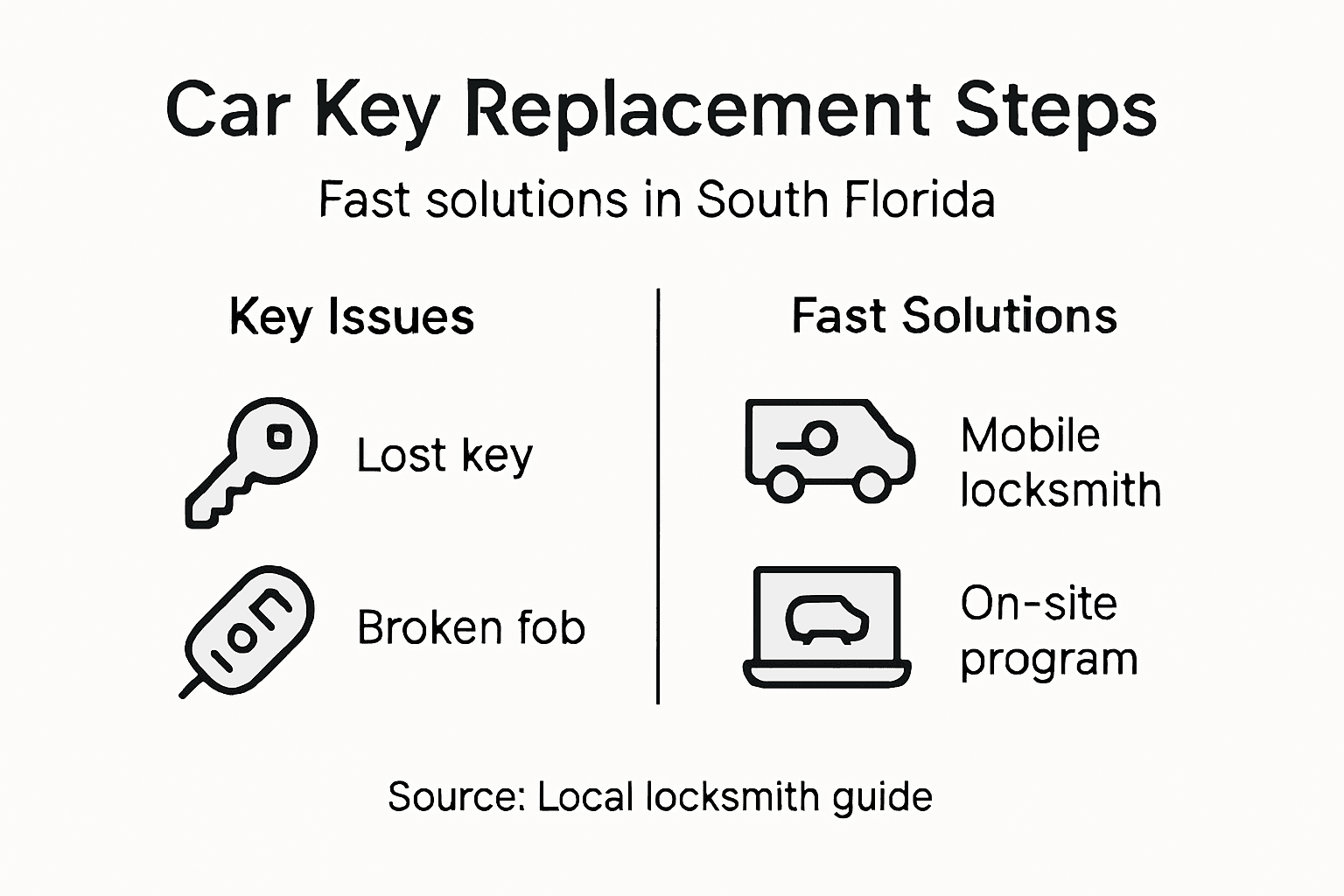
Here’s a quick summary comparing common car key issues and typical solutions:
| Car Key Issue | Usual Solution | Typical Cost Range | Time Required |
|---|---|---|---|
| Lost all keys | Locksmith or dealership replacement | Priced per job | Timing varies by vehicle and service |
| Lost one key | Duplicate at locksmith or dealership | Priced per job | Timing varies by vehicle and service |
| Key stuck in ignition | Extraction and possible repair | Priced per job | Timing varies by vehicle and service |
| Broken key | Key cutting and/or extraction | Priced per job | Timing varies by vehicle and service |
| Key fob not working | Fob replacement/reprogramming | Priced per job | Timing varies by vehicle and service |
| Locked out | Emergency unlock service | Priced per job | Timing varies by vehicle and service |
Pro tip: Have your vehicle registration or identification details ready before you call for service.
Step 2: Contact a Local Mobile Locksmith
Once you know what you’re dealing with, reaching out to a qualified locksmith is your fastest path to getting back on the road. Mobile locksmiths in South Florida can come to you, whether you’re at home, at work, or stranded on the highway.
Start by looking for locksmiths with these key qualifications:
- Professional service: Ask whether the locksmith handles your vehicle’s key issue
- Service availability: Confirm what assistance is available when you call
- Emergency availability: Ask about availability for urgent situations
- Pricing: Ask for the exact price before any work starts
- Customer reviews: Check ratings on Google or local directories
When you call a locksmith, have this information ready to give them. Your vehicle’s year, make, model, and whether you have any keys present helps them provide an accurate estimate. Tell them specifically whether you’re locked out, have a broken key, lost all keys, or need a key fob reprogrammed.
Locksmiths affiliated with professional locksmith organizations follow ethical standards and receive ongoing training in vehicle security. This matters because they’ll handle your car correctly and provide trustworthy service without unnecessary upselling.
A professional automotive locksmith can help with key-related situations. Ask about timing and service options when you call.
The fastest solution isn’t always the most expensive one. Mobile locksmiths can often solve your problem on-site for less than a dealership would charge, and you avoid the dealership wait times.
Before you hang up, confirm the service cost, what’s included, and whether they accept your preferred payment method. Getting these details upfront prevents surprises when they arrive.
Pro tip: Keep contact information for a professional automotive locksmith in your phone for emergencies.
Step 3: Verify Ownership and Car Details
Before a locksmith can make replacement keys, they need to confirm you actually own the vehicle. This protects both you and them legally, and it’s a standard security practice in the industry.
Gather your official documentation first. You’ll need your driver’s license and vehicle registration or title. These documents prove ownership and match your identity to the car. The locksmith will verify these match the vehicle identification before proceeding.
Locate your Vehicle Identification Number, or VIN. You can find it in several places:
- On your registration or title paperwork
- On your insurance card
- On the dashboard, visible from outside the driver’s side window
- On the driver’s side door jamb
Your VIN contains encoded information about your vehicle including its manufacturing location, model year, and safety features. Locksmiths use this to determine which key types and programming methods your specific car requires.

If you’ve lost your registration or title, contact your local Florida DMV office or use their online services. You can request a replacement document or verify ownership status before your locksmith appointment. This prevents delays and confirms you have legal right to key replacement.
Note any relevant details about your car’s condition. Does it have push-to-start technology? A traditional ignition? A keyless entry system? These details help the locksmith bring the correct equipment and programming tools.
Ownership verification can help protect against theft and fraud.
When the locksmith arrives, have everything ready in one place. This speeds up the verification process and gets you keys faster. Clear documentation prevents misunderstandings and ensures smooth service.
For reference, here are common locations to find your Vehicle Identification Number (VIN):
| VIN Location | Accessibility | Why It Matters |
|---|---|---|
| Registration/title | Always available | Used for legal verification |
| Insurance card | Easy to access | Confirms vehicle specifics |
| Dashboard (driver’s side) | Visible from outside | Quick proof for service calls |
| Door jamb (driver’s side) | Requires door open | Matches car details |
Pro tip: Keep a photo of your VIN and registration stored in your phone’s cloud storage so you can quickly share proof of ownership even if your physical documents aren’t with you.
Step 4: Approve On-Site Key Replacement
Now that the locksmith has verified your ownership and understands your vehicle’s specifications, you’ll review and approve the service before work begins. This step protects both you and the technician by confirming expectations upfront.
The locksmith should present you with a clear service agreement. This includes the final cost, the type of keys being made, and the timeframe for completion. Review these details carefully before giving approval. Ask questions if anything is unclear.
You’ll typically see charges broken down like this:
- Service call fee
- Key cutting and programming
- Materials and equipment
- Any specialized technology fees for smart keys or push-to-start systems
Confirm that the price quote matches what was discussed over the phone. Legitimate locksmiths use formal authorization procedures to document key replacement requests and ensure everything is transparent. You should receive written documentation of what’s being approved.
Before giving final approval, verify the locksmith’s identification and credentials. They should have a company name on their vehicle, uniform, or ID badge. Take note of their license number if Florida requires it for their service area. Legitimate professionals welcome this verification.
Ask whether warranty details are available for the key services you need.
Clear approval upfront means no surprises later. You know exactly what you’re paying for and what to expect from the service.
Once you’ve reviewed everything and feel confident, you can authorize the locksmith to proceed. This is when they’ll begin cutting and programming your replacement keys on-site.
Pro tip: Request an itemized receipt that lists each key made, any programming completed, and the warranty period so you have proof of service and know what’s covered if issues arise.
Step 5: Test and Secure Your New Key
Before the locksmith leaves, thoroughly test your new key to confirm everything works correctly. This is your chance to catch any issues while the technician is still there and can fix them immediately.
Test the mechanical functions first. Insert the key into the ignition and turn it to see if it starts smoothly. Try unlocking and locking your doors manually with the key. The key should turn without excessive resistance and engage all mechanisms properly.
If you have a key fob, test these functions:
- Lock button
- Unlock button
- Remote start, if applicable
- Trunk release or other specialty buttons
- All four windows if equipped
Testing key fob functions ensures the remote works at various distances from your vehicle. Stand at different distances and try unlocking your car to verify the fob’s range works properly.
If your vehicle has a push-to-start system, test that the new key fob allows you to start the engine. Make sure the brake is engaged and press the start button while holding the fob. The vehicle should start without hesitation.
For newer vehicles with digital security systems, ensure the locksmith has properly programmed the key to your vehicle’s security system. The programming prevents unauthorized copies from being used. Ask the locksmith to confirm the programming was successful and explain any security features activated.
A key that works right now should work consistently. If anything feels wrong during testing, address it immediately while the locksmith is present.
After testing, secure your new keys properly. Keep one key in a safe location separate from daily use keys. Never leave keys visible in your car or write the VIN on a key tag. Store spare keys in a secure place at home that others don’t know about.
Pro tip: Keep one spare key in a lockable drawer at your office or with a trusted friend nearby so you always have backup access if you lose your primary keys.
Get Fast and Reliable Car Key Replacement in South Florida
Facing lost or broken car keys can feel overwhelming and stressful especially when time is critical. The guide clearly highlights challenges like emergency lockouts, key fob failures, and stuck ignition keys all situations where you want swift, professional assistance without added hassle or unexpected charges. At Easy Keys we understand these exact pain points and are equipped to deliver fast 24/7 mobile locksmith services that come directly to your location anywhere in South Florida.
If you need automotive locksmith services, contact Easy Keys 4 Cars to discuss your situation and service options. You get the exact price before any work starts.
Frequently Asked Questions
What should I do first if I’ve lost all my car keys?
To handle losing all your car keys, assess your situation and gather details about your vehicle, such as the year, make, and model. Then, contact a mobile locksmith to discuss replacement options and get a cost estimate.
How much does it typically cost to replace a car key?
Car key replacement costs depend on the type of key and your vehicle’s model. Discuss your vehicle’s specifics to receive an exact price before work starts.
How long will it take for a locksmith to replace my car key?
Typically, key replacement services can take anywhere from 30 minutes to a couple of hours, depending on your location and the locksmith’s availability. Be ready to provide all necessary vehicle information to expedite the process.
What documents do I need to provide to a locksmith for key replacement?
You will need to provide your driver’s license and vehicle registration or title to verify ownership. Make sure to have these documents ready so the locksmith can begin the process smoothly.
How can I test my new car key after replacement?
Before the locksmith leaves, test all functions of your new key, including starting the ignition and using remote functions like locking or unlocking doors. Confirm that all features work properly to ensure you won’t face issues later.
What precautions should I take with my new car keys?
Secure your new keys in a safe place and consider keeping a spare key in a secure spot at home or with a trusted friend. Avoid storing keys where they can be easily seen or accessed to prevent unfortunate losses.
Recommended
- Car Key Replacement Guide Hollywood FL: Fast Solutions
- Step by Step Car Key Replacement for South Florida Owners
- Car Key Replacement Guide Doral: Fast Step-by-Step Help
- 7 Essential Car Key Replacement Tips for Fast Solutions
- Why Choose Mobile Mechanics: Convenience Redefined
- How To Mobile Detail For Pristine Car Care Results
- 7 Essential Car Care Tips for South Jersey in 2025
This article was drafted with AI assistance to ensure factual accuracy.