



Losing access to your vehicle or finding your key fob suddenly unresponsive leaves any South Florida driver stranded and frustrated. In places like Miami and Fort Lauderdale, a reliable and fast solution is not optional but necessary. Understanding key fob programming reveals why your car’s onboard computer needs to communicate perfectly with your fob, giving you peace of mind and safeguarding your vehicle against unauthorized use. Discover how professional programming restores both convenience and advanced security to modern cars.
Table of Contents
- What Key Fob Programming Involves
- Different Types of Car Key Fobs
- Key Fob Programming Process Explained
- South Florida Mobile Locksmith Solutions
- Common Issues and Avoidable Mistakes
Key Takeaways
| Point | Details |
|---|---|
| Key Fob Programming Process | Key fob programming links a fob to a vehicle’s computer, requiring specialized tools and manufacturer-specific procedures. |
| Types of Key Fobs | Different fob types range from basic remotes to smart keys, each with varying security levels and programming requirements. |
| Professional Assistance | For most modern vehicles, using a professional locksmith is crucial to ensure proper programming and avoid security system lockouts. |
| Testing Functionality | Always test the fob after programming to confirm all features work before leaving the site. |
What Key Fob Programming Involves
Key fob programming is the process of electronically linking your key fob to your vehicle’s computer system so it recognizes your unique digital signature. This happens through your car’s onboard computer, which stores encrypted information about authorized keys and fobs.
When you program a fob, you’re essentially teaching your vehicle to accept it. Your car won’t start or unlock unless the fob’s digital code matches what’s stored in the vehicle’s memory. This security layer prevents thieves from simply copying your key signal.
The Two Main Components Being Programmed
Key fob programming covers two distinct systems working together:
- Transponder chip programming: Syncs the security code that communicates with your car’s immobilizer system, preventing unauthorized engine starts
- Remote control functions: Configures the lock, unlock, and panic button signals so your fob communicates with the car’s receiver module
Both systems must work in sync. A programmed transponder chip without configured remote functions means your key won’t unlock the doors remotely, even though it might start the engine.
What Happens During Programming
The programming process involves specialized diagnostic tools to access your vehicle’s computer system and enter programming mode. Your locksmith will follow manufacturer-specific sequences, which vary significantly between vehicle makes and models.
Here’s what occurs step by step:
- Connect diagnostic equipment to your vehicle’s onboard computer
- Access the security system through the correct programming sequence
- Input the new key or fob information into vehicle memory
- Verify the programming worked by testing lock, unlock, and start functions
- Clear the programming mode to finalize the process
Modern vehicles require exact manufacturer protocols, and one wrong step can lock you out of reprogramming until the vehicle resets its security system.
In South Florida’s heat and humidity, specialized equipment sometimes needs climate-controlled environments to function properly. That’s why mobile locksmiths bring proper tools rather than improvising.
Why Your Specific Vehicle Matters
A 2020 BMW doesn’t program the same way as a 2015 Honda or 2022 Ford. Each manufacturer uses different security codes, programming sequences, and tool requirements.
Some vehicles allow owner programming through specific button combinations. Most modern vehicles require professional equipment that is locked behind manufacturer authorization.
Pro tip: If your fob was recently lost or stolen, get all your keys reprogrammed immediately, not just the replacement. This erases any codes the missing key might have contained from your vehicle’s memory.
Different Types of Car Key Fobs
Not all key fobs are created equal. Your vehicle uses one of several distinct types, each designed with different security levels and convenience features. Understanding what you have determines how it gets programmed and what you can expect from it.
The type of fob in your pocket affects everything from cost to replacement options. A basic remote fob costs less than a smart key with push-to-start capability, but offers fewer features. Knowing your fob type helps you make informed decisions when programming or replacing lost keys.
Basic Remote Key Fobs
These are the simplest option. They control locking and unlocking doors and sometimes the trunk from a distance using radio frequency signals.
Basic remotes don’t communicate with your ignition system. You still need to insert your key physically into the ignition to start the engine. Many older vehicles and budget models use this type exclusively.
Features typically include:
- Lock and unlock buttons for all doors
- Trunk release button
- Panic alarm for security
- Simple radio frequency technology
These fobs are durable and reliable but lack the advanced security features of modern alternatives.
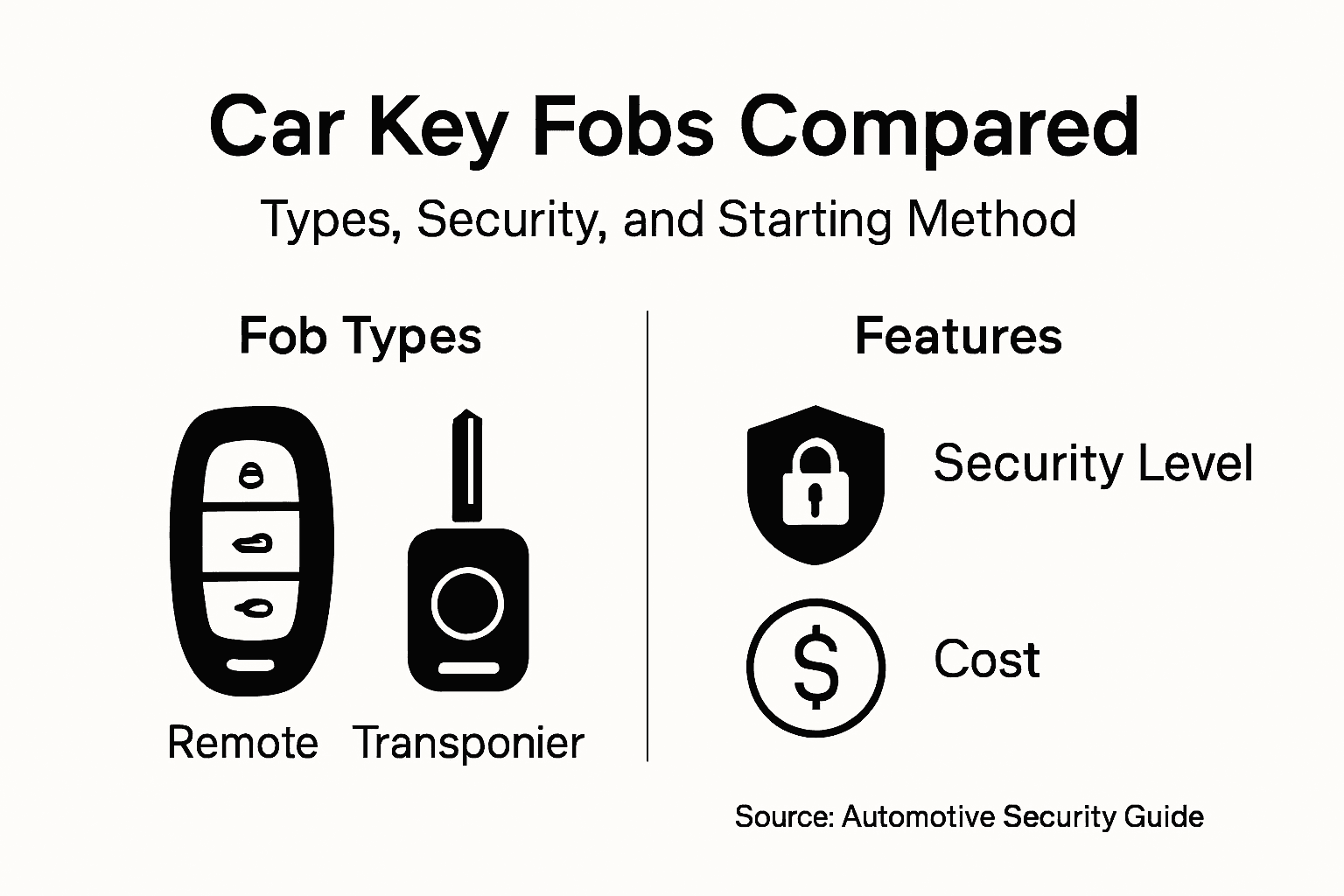
Here’s a quick comparison of common car key fob types and their main attributes:
| Fob Type | Security Level | Starting Method | Typical Replacement Cost |
|---|---|---|---|
| Basic Remote | Low | Key in ignition | Priced per job |
| Transponder Key | Medium | Chip in ignition | Priced per job |
| Smart Key (Proximity) | High | Push button/start | Priced per job |
| Valet Key | Limited/Restricted | Key in ignition | Priced per job |
Transponder Fobs with Security Chips
Transponder keys with embedded chips communicate a unique digital code to your vehicle’s immobilizer system. Without the correct code, the engine won’t start, even if someone steals your key physically.
<img decoding="async" src="https://csuxjmfbwmkxiegfpljm.supabase.co/storage/v1/object/public/blog-images/organization-8415/1771592334917_image.png" alt="Driver uses transponder key near ignition”>
This technology revolutionized car security starting in the mid-1990s. The chip inside the fob sends a coded signal that must match your vehicle’s computer. If codes don’t match, your car treats the key as unauthorized.
Transponder fobs offer:
- Chip-based security preventing hot-wiring
- Unique code synced only to your vehicle
- Combination of remote functions and ignition security
- Protection against most theft methods
Most vehicles manufactured after 2000 use transponder technology as standard.
Smart Keys and Keyless Entry Systems
These are the premium option. Proximity fobs enable keyless entry and push-button start without removing the key from your pocket. Your car detects the fob’s presence within a certain range.
Smart keys use advanced coding with proximity sensors and encrypted signals. You approach your car, the doors unlock automatically, and starting requires only a button press. No key insertion needed.
Capabilities include:
- Passive keyless entry and start
- Advanced encryption and rolling codes
- Automatic door unlock as you approach
- Integration with vehicle security systems
- Panic and trunk functions
Smart keys can cost more to replace than basic fobs, including programming.
Most luxury vehicles and modern mid-range cars now offer smart key systems as standard or optional equipment.
Valet Keys and Restricted Access
Some vehicles include valet keys that restrict functionality. A valet can start the engine and drive your car but cannot access the trunk or glove compartment. This type requires different programming than your primary key.
Valet keys won’t work if you lose your main fob, and they need separate programming when coded.
Pro tip: If you’re planning to replace a lost smart key, do it soon after purchasing your vehicle while pricing is documented, as waiting years can make finding equivalent replacement fobs more difficult and expensive.
Key Fob Programming Process Explained
Key fob programming isn’t something you typically do yourself. The process requires precise timing, manufacturer-specific sequences, and often specialized equipment. Understanding how it works helps you see why professional locksmith services matter in South Florida.
The basic goal is simple: teach your vehicle’s computer to recognize and accept your fob. But the execution involves multiple technical steps that vary significantly depending on your vehicle’s make, model, and year.
The Initial Setup Phase
Before any programming begins, you need the correct equipment and documentation. A professional locksmith gathers your vehicle owner’s manual and diagnostic tools compatible with your car’s system.
The first physical step is getting inside your vehicle. You’ll sit in the driver’s seat with the fob ready. Nothing happens from outside the car,the vehicle must be in a specific state for programming mode to activate.
What you’ll need:
- Your vehicle’s owner’s manual or service documentation
- The new or replacement key fob
- Diagnostic equipment compatible with your vehicle
- Your vehicle identification number (VIN)
Some vehicles allow basic reprogramming without special tools, but most modern cars require professional equipment.
Entering Programming Mode
Programming a key fob involves placing the vehicle’s control module into a temporary learn mode through a specific timed sequence. This usually starts with ignition cycles, turning the key on and off in a precise pattern.
Timing matters. Miss the sequence by even a second or two, and the vehicle won’t enter programming mode. Different manufacturers use different sequences. A Toyota won’t respond to a Honda’s programming sequence.
Typical ignition cycle patterns include:
- Turn ignition to “On” position for 1-2 seconds
- Turn back to “Off” position for 1-2 seconds
- Repeat this cycle 3-5 times, ending in “On”
- Wait for confirmation light or sound from vehicle
When your vehicle enters programming mode, you’ll see visual or audio confirmation. Dashboard lights might flash, or the doors might lock and unlock automatically.
Syncing the New Fob
Once in programming mode, pressing buttons on the new fob signals your vehicle’s control unit to accept the new code. Each button press tells the car: “This fob is authorized.”
You typically press the lock button multiple times until the vehicle signals acceptance. The process repeats for each fob being programmed in a single session.
Most vehicles allow programming multiple fobs at once, but each one must complete its full sequence before moving to the next.
If your vehicle has smart key features, specialized diagnostic tools interface with the car’s computer to insert the fob’s unique ID directly into immobilizer memory. This happens automatically through the equipment.
Testing and Verification
After programming ends, testing confirms everything works. Lock the car from distance. Unlock it. Try the panic button. If you have push-to-start, verify the engine cranks.
A failed test means returning to programming mode and repeating the sequence. Most Miami-Dade locksmiths complete this on-site, so you drive away with a fully functional fob.
Pro tip: Keep your programming receipt and document which fobs were coded on that date, as this information helps if you need reprogramming or replacement within the next few years.
South Florida Mobile Locksmith Solutions
Living in Miami-Dade or Broward County means you need locksmith services that understand the region’s unique challenges. South Florida’s heat, humidity, and coastal salt air affect vehicle electronics differently than other parts of the country. Mobile locksmiths equipped for this environment make all the difference.
When your key fob fails or you lose all your car keys, waiting for a dealer appointment isn’t practical. A 24/7 mobile locksmith arrives at your location with the tools and expertise to reprogram fobs on-site, usually within 30-60 minutes of your call.
Why Mobile Service Matters in South Florida
Traditional dealerships require you to tow your vehicle. That’s expensive, time-consuming, and often unnecessary for key fob programming. Mobile locksmiths eliminate these hassles by coming to your car.
South Florida traffic makes this especially valuable. If you’re stranded in downtown Miami, a Broward locksmith, or pulled over near the airport, you don’t want to wait hours for roadside assistance. Mobile response means you’re back on the road faster.
Advantages of mobile locksmith services:
- Same-day programming without appointments or waiting
- Transparent upfront pricing so no surprise charges
- Non-destructive methods protecting your vehicle’s integrity
- Dealer-level equipment without dealer-level pricing
- 24/7 availability for lockouts at 2 AM
Professional Equipment and Expertise
Mobile locksmiths carry specialized diagnostic tools designed for multiple vehicle manufacturers. These are not generic devices. They are precision equipment that interfaces directly with your vehicle’s computer systems.
A trained locksmith knows exactly which sequence to use for your specific year, make, and model. They understand the differences between programming a 2015 Honda and a 2023 Mercedes. This expertise prevents errors that could damage your vehicle’s security system.
Professional locksmiths maintain relationships with manufacturers and stay current with the latest vehicle security protocols through continuous education.
They also handle complications smoothly. If your vehicle’s security system has been disabled or requires special reset procedures, they troubleshoot on-site. A dealer would require multiple visits and extended diagnostic time.
Coverage Across Miami-Dade and Broward
The best mobile locksmith service covers your entire county quickly. Response times matter when you’re locked out or stranded. Look for locksmiths operating throughout Miami-Dade and Broward with multiple technicians ensuring fast arrival.
Coverage should include:
- Miami, Homestead, and Miami Beach areas
- Fort Lauderdale, Deerfield Beach, and Pompano Beach
- Surrounding suburbs and highways
- Airport access and commercial districts
Cost Efficiency vs. Dealer Pricing
Dealerships charge premium rates for key fob programming because you have limited alternatives. Mobile locksmiths compete on value, offering the same dealer-level service at transparent, reasonable prices.
You avoid towing fees, diagnostic charges, and dealer markup. For a lost fob or broken key situation, you save hundreds of dollars compared to dealer services.
Finding Reliable Service
When choosing a mobile locksmith for car key replacement, ask about their experience with your vehicle type. Read reviews from local customers who had similar situations.
Reliable locksmiths offer straightforward communication about pricing before work begins. They explain what they’re doing and why. They answer your questions honestly, whether your issue requires programming, replacement, or both.
Pro tip: Save your locksmith’s contact information in your phone right now, before you need emergency service, so you have it ready if you’re locked out or stranded.
Common Issues and Avoidable Mistakes
Key fob programming looks simple on the surface. In reality, small errors derail the entire process. Most failures stem from rushing through steps or skipping critical preparation. Understanding these pitfalls saves you time, money, and frustration.
Many South Florida car owners attempt DIY programming after watching online videos. They end up with non-functional fobs and locked security systems requiring professional intervention. Professional locksmiths see these mistakes repeatedly.
Misunderstanding Vehicle-Specific Procedures
This is the most common error. Your 2019 Ford uses a completely different programming sequence than your neighbor’s 2019 Toyota. Following the wrong instructions can lead to failure.
Ownersmanuals contain the correct procedure for your exact vehicle. Guessing or using generic instructions wastes time. Some vehicles require specific timing between button presses measured in tenths of a second.
Common mistakes include:
- Using instructions for the wrong vehicle year or model
- Following online guides that don’t match your manufacturer
- Skipping manufacturer-specific sequences entirely
- Assuming all vehicles program the same way
Inconsistent Ignition Cycles
Mistakes often occur from inconsistent ignition cycles or failing to test the programmed fob, leading to programming failure. Timing matters more than you think. Miss the sequence by one second, and your vehicle exits programming mode.
The ignition must cycle precisely. Turn it on for exactly 2 seconds, not 1.5 or 2.5. Turn it off for exactly 1 second. Do this five times in sequence without hesitation.
Even experienced DIYers struggle with consistency. Professional equipment eliminates this guesswork by controlling timing automatically.
The following table summarizes major errors during DIY key fob programming and their potential impact:
| Common Mistake | Resulting Problem | Preventive Action |
|---|---|---|
| Using wrong procedure | Programming fails or system locks | Verify vehicle model instructions |
| Inconsistent ignition cycles | Key not recognized by system | Use timer or professional tools |
| Choosing incompatible fob type | Fob will not function | Match fob to VIN and year |
| Skipping post-program testing | Find issues only later | Test every feature before leaving |
Wrong Key Fob or Incompatible Devices
Not all replacement fobs work with all vehicles. A generic remote-control fob won’t program if your vehicle requires a transponder fob. Buying the wrong type can waste money and lead to programming failure.
Your Vehicle Identification Number (VIN) determines compatibility. Different model years need different fobs. Confirm compatibility before purchasing or attempting programming.
Failure to Test Functionality
After programming, testing is essential. Press the lock button from 20 feet away. Does the car respond? Try unlocking from distance. Test the panic alarm if available.
Skipping this step means you drive away with a non-functional fob and only discover the problem later. Testing immediately reveals failures so you can reprogram on-site rather than returning days later.
One failed test during the programming session saves you from discovering non-working functions after the locksmith leaves.
Ignoring Manufacturer Instructions
Vehicle manufacturers publish specific procedures for a reason. Proper preparation and following detailed guides prevents common pitfalls in key fob programming. Your owner’s manual contains this critical information.
Carefully read each step before starting. Don’t skip sections or assume steps are optional. If the manual says “wait for three door lock cycles,” don’t proceed after two.
Security System Lockouts
Attempting programming multiple times incorrectly can lock your vehicle’s security system. Once locked, you cannot reprogram until the system resets, which can take 24 hours. This prevents thieves but also prevents you from reprogramming.
If this happens, you need professional help. A locksmith with diagnostic equipment can reset the system properly.
Pro tip: Before attempting any DIY programming, photograph your owner’s manual’s key fob section with your phone so you have the exact instructions available while working on your vehicle.
Secure Your Vehicle Effortlessly with Expert Key Fob Programming
If you have faced the complexity of key fob programming or worry about vehicle security after losing a key fob, you are not alone. The detailed processes involving transponder chip syncing, specialized diagnostic tools, and manufacturer-specific programming sequences can overwhelm even the most determined car owners. Correct programming can help avoid security lockouts and support full functionality of your smart key or remote fob.
Easy Keys 4 Cars provides automotive locksmith services.
To learn more about our complete automotive locksmith solutions, check out our services and prepare yourself for every key or fob emergency before it happens.
Frequently Asked Questions
What is key fob programming?
Key fob programming is the process of linking your key fob to your vehicle’s computer system, allowing it to recognize and accept your fob’s unique digital signature for functions like unlocking doors and starting the engine.
How does key fob programming enhance vehicle security?
Key fob programming enhances security by ensuring that only authorized fobs with matched digital codes can interact with your vehicle, preventing unauthorized access and ignition.
What steps are involved in the key fob programming process?
The key fob programming process typically involves connecting specialized diagnostic equipment to your vehicle, entering programming mode, syncing the new fob, and verifying functionality through testing.
What are the different types of car key fobs, and how do they vary?
Car key fobs come in several types, including basic remote fobs, transponder fobs with security chips, smart keys for keyless entry, and valet keys that restrict access. Each type varies in security features, starting methods, and cost.
Recommended
- Key Fob Programming: Security and Convenience Unlocked
- Car Key Replacement Guide Doral: Fast Step-by-Step Help
- 7 Types of Car Locksmith Services Every Owner Should Know
- Easy Keys 4 Cars
- Key Blank – 35mm Blade: GoKarts USA®
This article was drafted with AI assistance to ensure factual accuracy.