


Last updated: October 27, 2026
Published October 27, 2026 · Updated October 27, 2026
A locksmith for car door repairs in Coral Gables can sort a freely spinning key with one test. If the key spins a full 360 degrees with no springback, the fault is usually in the lock: a worn key, a slipping cylinder clutch or a broken tailpiece. If the key turns to its normal stop, springs back and the door stays locked, the problem is usually the linkage inside the door. That gives three real fixes to compare: rebuilding the existing cylinder, replacing it with an OEM Strattec or aftermarket unit, or repairing the rod, clip or latch. No single fix wins every time, and the test result decides which one you need.
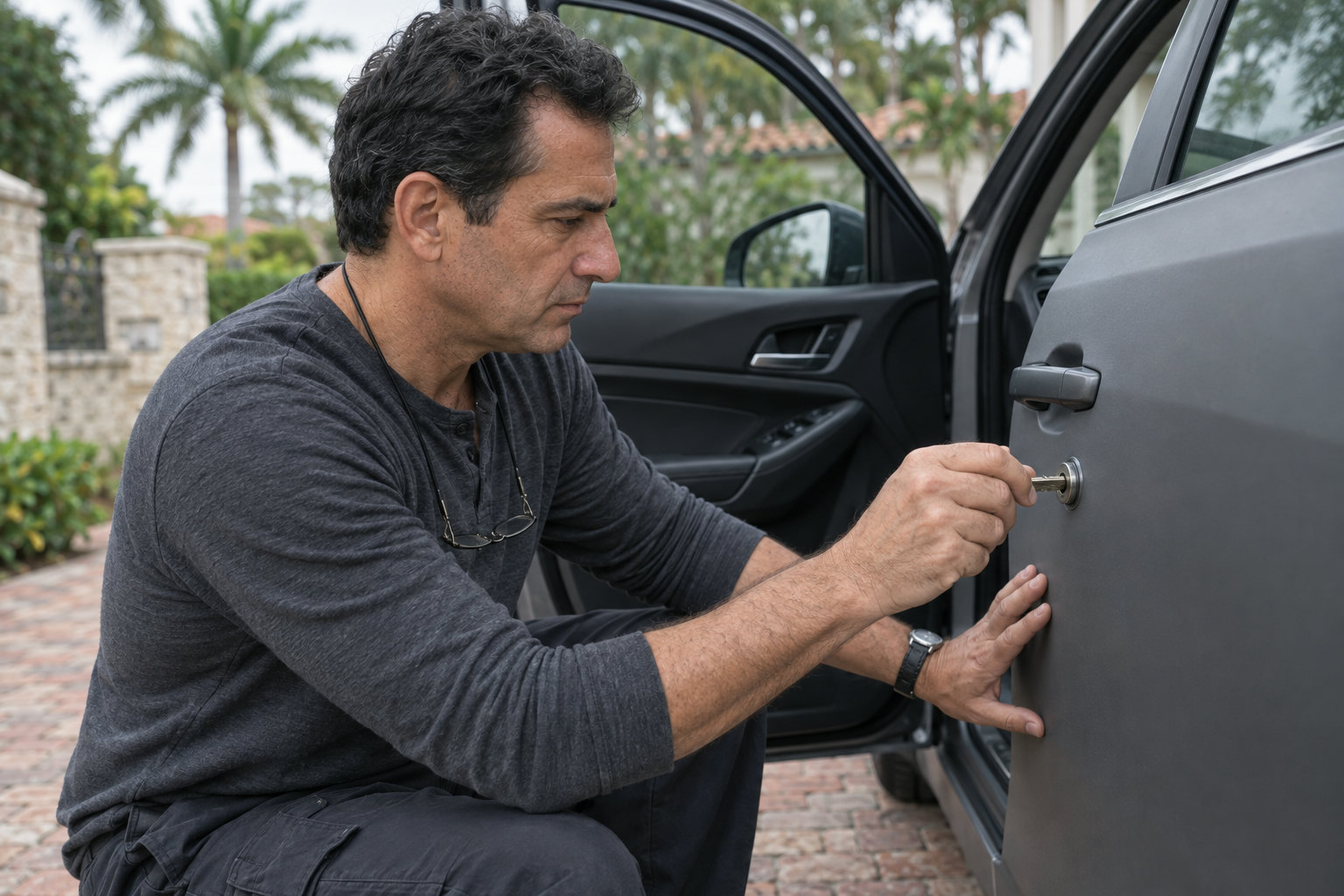
A spinning key does not always mean a broken lock. On a number of late-model vehicles, the door cylinder is built to spin freely when someone forces it with a screwdriver or the wrong key. That anti-theft design also starts to slip when the correct key wears down.
This guide is for two kinds of drivers. The first owns a push-button-start car with a dead fob battery and just found that the hidden key slot under the cap on the driver’s handle spins uselessly the first time it has ever been used. The second owns an older pickup, turns the door key every day, and felt it go slack this morning.
- A full 360-degree spin with no springback usually means the fault is inside the lock cylinder: a worn key, a slipping free-wheeling clutch or a snapped tailpiece.
- A key that turns to its normal stop and springs back while the lock button stays put usually points to a popped clip, bent rod or stretched cable inside the door.
- Testing the spare key first separates a worn key from a worn cylinder. Dealers often hand over only one key with a used vehicle, so plenty of owners have no spare to test.
- Strattec supplies original-equipment locks and keys to major North American automakers, while ilco is a long-established key blank and key machine brand used to cut matching keys.
- If the power locks and the remote still work, the actuator and latch are probably fine, and the fault sits somewhere between the key cylinder and the latch.
- Salt air in bayfront neighborhoods such as Cocoplum and Gables by the Sea speeds corrosion on door cylinders that rarely see a key.
How does a locksmith for car door problems tell a lock fault from a linkage fault?
A locksmith for car door problems separates a lock fault from a linkage fault by watching how far the key turns and whether it springs back. A healthy door cylinder typically rotates a limited distance in each direction, stops firmly, and returns to center when you let go. A cylinder that keeps spinning past that stop has lost its connection somewhere inside the lock itself.
The linkage is everything that carries the cylinder’s motion to the latch. On most vehicles that means a metal rod or a cable, held to a lever on the cylinder by a small plastic clip. When the clip pops off or the rod bends, the cylinder still turns and springs back normally, but nothing on the other end moves.
Here is how the three fixes compare across the attributes that matter before you book a repair.
| Attribute | Rebuild the cylinder | Replace the cylinder | Repair the linkage |
|---|---|---|---|
| Fault it fixes | Worn wafers, slipping clutch, corrosion, worn key | Snapped tailpiece, cracked housing, break-in damage | Popped clip, bent rod, stretched cable, failed latch |
| Telltale symptom | Key spins a full circle, or works only with jiggling | Key spins 360 degrees with no springback, any key or tool turns it | Key stops and springs back normally, lock button does not move |
| Keeps your current key? | Yes, wafers are matched to the key code | Yes, if the new cylinder is coded to your key | Yes, the cylinder is not touched |
| Typical parts and brands | Wafer and spring kits, fresh key cut on an ilco blank | Strattec OEM (where original), dealer cylinder or aftermarket unit | Retaining clips, lock rods, cables, latch assembly |
| Relative effort and cost | Moderate, often the lightest cylinder repair | Moderate to high, priced like a part plus labor | Low for a clip, high if the latch must be replaced |
| Door panel removal? | Often, to pull the cylinder out | Often, to reach the cylinder retainer | Almost always |
| Best fit | Intact cylinder that slips with a worn key | Damaged or forced cylinder | Recent door panel or window regulator work |
What can you check in the driveway before calling a locksmith?
Four driveway checks narrow a spinning car door lock to the cylinder or the linkage before anyone opens the door panel. None of them needs tools. Each one rules something in or out, and the answers make the repair conversation faster and more accurate.
Watch the spin
Turn the key gently and note whether it goes a full 360 degrees or stops and springs back. A full circle points to the cylinder; a normal stop points to the linkage.
Try the spare key
If the spare engages the lock and the daily key does not, the daily key is worn. If both spin the same way, the cylinder or its clutch is the likely fault.
Test the power locks and remote
If the remote and the interior switch lock and unlock that door, the actuator and latch work. The fault then sits between the key cylinder and the latch.
Try the inside handle and lock button
If the door also refuses to open from inside, the latch itself may have failed. That is a bigger job than a loose clip.
Step 2 trips up many used-car owners. A common mistake is driving away from a used-car purchase with the single key the dealer handed over and never having a spare made. Without a second key, nobody can tell quickly whether the key or the lock is worn, and losing that one key later turns a simple diagnosis into a full key replacement.
Do not force the key with pliers. Extra torque on a slipping cylinder is how tailpieces snap and keys break off inside the plug.
When is rebuilding the existing door lock cylinder the right fix?
Rebuilding the existing door lock cylinder is the right fix when the housing and tailpiece are intact but the internals have worn or corroded. Inside the plug, small spring-loaded wafers line up with the cuts on your key. When the wafers wear, stick or lose their springs, the cylinder either refuses to turn or, on a free-wheeling design, slips and spins.
A free-wheeling cylinder only connects the plug to the tailpiece when every wafer sits at the right height. A worn key that sets most wafers but not all of them leaves the clutch disengaged. The result looks like a broken lock, yet the fix may be a fresh key.
Why a new key should be cut by code, not copied
Duplicating a worn key copies its wear. A locksmith can decode the cylinder or use the key code and cut a new key to factory depths on a quality blank, such as an ilco blank made for that vehicle. If that key also has to start the car, its transponder chip must be programmed to the immobilizer, which is separate from the cut.
Strengths: you keep the original cylinder, which already fits the door and matches the ignition key. The work usually includes cleaning out corrosion and grit, replacing worn wafers and springs, and lubricating with a lock-appropriate product.
Weaknesses: some cylinders are staked or sealed at the factory and are not built to be taken apart. A snapped tailpiece or a cracked housing cannot be rebuilt in any practical way. In those cases, replacement is the honest answer.
Rebuilding fits a door cylinder that slips because of worn wafers or a worn key. A key cut to factory code on an ilco blank often re-engages a free-wheeling clutch. Staked cylinders and broken tailpieces need replacement instead.
When does the door lock cylinder need replacing, and is Strattec or aftermarket better?
Replacing the door lock cylinder is the right fix when the cylinder is physically damaged: a snapped tailpiece, a cracked housing or marks from a forced entry attempt. On many cylinders the tailpiece is a small cast part, and a twist with a screwdriver or years of pressure from a sticky lock can break it. Once it is gone, the plug spins and nothing behind it moves.
OEM: Strattec or the dealer
Strattec supplies original-equipment locks and keys to major North American automakers, so on vehicles where Strattec made the factory part, an OEM-grade replacement matches the door’s fit and the clutch design exactly. Dealer cylinders can also arrive pre-coded to the vehicle’s key code. The trade-off is availability, because a coded dealer cylinder sometimes has to be ordered.
Aftermarket cylinders
Aftermarket cylinders are often easier to get quickly and can be coded by a locksmith to your existing key, so one key still runs the door and the ignition. Fit and finish vary by maker. A good aftermarket part matches the original tailpiece shape; a poor one can bind on the linkage lever and create a new problem.
One brand point is worth knowing. Schlage, Kwikset, Medeco, Mul-T-Lock, Yale and ASSA Abloy are respected names in residential and commercial door hardware, but a car door cylinder comes from the automotive supply chain. If a quote for a car door lists a house-lock brand, ask what part is actually going into the door.
Weaknesses of replacement overall: it is usually the most involved of the cylinder repairs, and an uncoded cylinder means carrying a separate door key. Asking for the new cylinder to be coded to your current key avoids that.
When is the door linkage the real problem?
The door linkage is the real problem when the key turns to its normal stop, springs back to center, and the lock button does not move. That behavior tells you the cylinder and its tailpiece are working. The motion is simply not reaching the latch.
The most common link to fail is the plastic retaining clip that holds the lock rod to the cylinder lever. Clips get brittle with age and heat, and they often pop loose after a door panel comes off for speaker, window regulator or handle work. Some vehicles use a cable instead of a rod, and a cable can stretch or slip out of its bracket.
The latch is the far end of the chain. If the key, the remote, the interior switch and the inside handle all fail on the same door, the latch assembly itself is the suspect. Door latches have been the subject of safety recalls on some models, so checking the VIN on the NHTSA recall lookup is a sensible first step before paying for a latch.
Strengths: a reconnected clip or a straightened rod is often the simplest fix of all three, and your key and cylinder stay untouched. Weaknesses: almost every linkage repair means removing the door panel, and a failed latch with an integrated actuator can be a larger job that some owners prefer to send to a dealer or body shop. A locksmith can confirm which part failed before you decide where it gets fixed.
- Choose a cylinder rebuild (or a code-cut key) when the spare key works better than the daily key, the cylinder spins only with a worn key, and there are no pry marks around the handle.
- Choose a cylinder replacement when the key or any tool spins the plug a full 360 degrees, the tailpiece is snapped, or someone has clearly tried to force the lock. Ask for it coded to your existing key, and compare a Strattec OEM part with a quality aftermarket unit.
- Choose a linkage repair when the key springs back normally but the lock button stays still, especially after recent door panel or window regulator work.
- Check for a recall first when the key, remote and inside handle all fail on the same door, because that points to the latch.
Heat, humidity and salt air in Coral Gables
South Florida heat, year-round humidity and summer downpours are hard on both halves of a car door lock. Moisture that reaches the cylinder corrodes wafers and springs. Heat trapped inside a closed door panel ages the small plastic clips that hold the linkage together.
Neighborhoods along Biscayne Bay, such as Cocoplum and Gables by the Sea, add salt air to the mix. A door cylinder on a keyless car may go years without a key ever entering it, so corrosion builds with nothing moving the parts. The first time the fob dies is often the first time anyone learns the cylinder has seized or the clutch no longer engages. If you need a working key for one of those homes, see our page on car key replacement in Cocoplum.
Two habits help. Turn the mechanical key in the driver’s door once in a while so the parts keep moving, and use a lock-appropriate lubricant rather than heavy oil, which can hold grit inside the plug.
A common mistake is ignoring a door cylinder that has started to feel stiff, gritty or loose until the key snaps off inside it. Early service on worn tumblers is far simpler than extraction followed by a rekey. If that has already happened, our guide on how to extract a broken key from a car door lock explains what comes next.
Our Verdict
The right call on a freely spinning car door cylinder depends on who you are and what the key test showed. These are the four profiles that cover most situations.
The keyless-car owner with a dead fob: start with a fresh fob battery and a code-cut emergency key. If the hidden cylinder still slips, a rebuild is usually the better first step than replacement, because the housing on a rarely used cylinder is often intact and the problem is corrosion.
The daily-key pickup or older sedan owner: test the spare. If the spare works, cut a new key by code and keep the cylinder. If both keys spin a full circle, plan on a cylinder rebuild or replacement coded to your key.
The owner whose car shows pry marks: replacement wins. A forced cylinder often has a broken tailpiece or a damaged housing, and a Strattec OEM part or a quality aftermarket cylinder coded to your current key restores security properly.
The owner who just had door panel work done: suspect the linkage first. A clip left unseated during a window regulator repair is a far more likely cause than a lock that failed the same week.
For mobile diagnosis at the car, our car locksmith near me in Coral Gables page covers the area we serve. For a related read on how a replacement key can wear a door cylinder, see this case study on an ilco replacement key and a failing door lock cylinder in Aventura.
Our view
This is opinion, plainly labeled. Drivers tend to overweight the lock cylinder when a key spins, because the cylinder is the part they can see. The cause is just as often a worn key or a two-cent clip inside the door, and replacing a good cylinder does nothing for either.
What actually matters is getting a diagnosis before parts are ordered. The 360-degree spin test, the spare key test and the power lock test take a few minutes and point to the right repair. Any locksmith for car door work should be willing to explain which of the three results you got and why it points to the fix being quoted.
One more opinion: get a second key cut by code the moment the door is working again. A spare costs far less effort than a lockout, and it is the single most useful tool for diagnosing the next problem.
Frequently Asked Questions
Why does my car key spin in the door but not unlock it?
A car key that spins in the door without unlocking it has usually lost its connection in one of two places. A full 360-degree spin with no springback points to the cylinder (a worn key, a slipping free-wheeling clutch or a snapped tailpiece). A normal turn that springs back while the lock stays put points to a loose rod, clip or cable inside the door.
Can a spinning door lock be fixed without replacing the cylinder?
A spinning door lock can often be fixed without replacing the cylinder when the housing and tailpiece are intact. A new key cut by code on a quality ilco blank can re-engage a slipping clutch, and a rebuild with new wafers and springs restores a worn plug. Factory-staked cylinders and broken tailpieces are the 2 common cases that still need replacement.
Will a new door lock cylinder need a new key?
A new door lock cylinder does not need a new key if it is coded to match your existing one. A locksmith can code a Strattec OEM or aftermarket cylinder so one key still runs the door and the ignition. An uncoded cylinder means carrying a separate key for that door.
Should I check for a recall before repairing a car door lock?
Checking for a recall before repairing a car door lock makes sense when the key, remote and inside handle all fail on the same door. That pattern points to the latch, and door latches have been recalled on some models. The NHTSA recall lookup checks any vehicle by its 17-character VIN.
Sources
- Checking open recalls on door latches and locks by VIN: National Highway Traffic Safety Administration, Recalls
- Strattec as an original-equipment supplier of automotive locks and keys: Strattec Security Corporation
- Questions about a specific vehicle, key or cylinder: Easy Keys 4 Cars contact page
If your door key spins and you are not sure whether the fault is the cylinder or the linkage, describe the spin test result, the spare key result and whether the power locks work. Those three answers tell an automotive locksmith most of what is needed to plan the repair, and they are the fastest way to get pricing for your exact vehicle.
 Listen to this articleAudio version
- The Aventura Customer Whose Ilco Replacement Key Kept Failing — What We Found Inside the Door Lock Cylinder
- How We Replaced a Broken Transponder Key for a Coral Gables Customer Locked Out at Midnight — and Found a Damaged Ignition
- How We Responded to a Locked-Out Elderly Resident in Coconut Grove at 2 AM — and Why the Door Cylinder Was the Real Problem
- How to Extract a Broken Key From a Car Door Lock
- Will a Mul-T-Lock High-Security Deadbolt Fit a Brickell Condo Door Without New Holes? What a Miami Locksmith Checks