


Last updated: November 1, 2026
Published November 1, 2026 · Updated November 1, 2026
The open-door test settles it: if the key is still stiff while the door stands wide open, salt corrosion or grime inside the cylinder is the cause, and if it turns freely open but binds once the door is closed, the door or strike plate is out of alignment. The two problems feel identical from the hallway, but they get fixed in completely different ways.
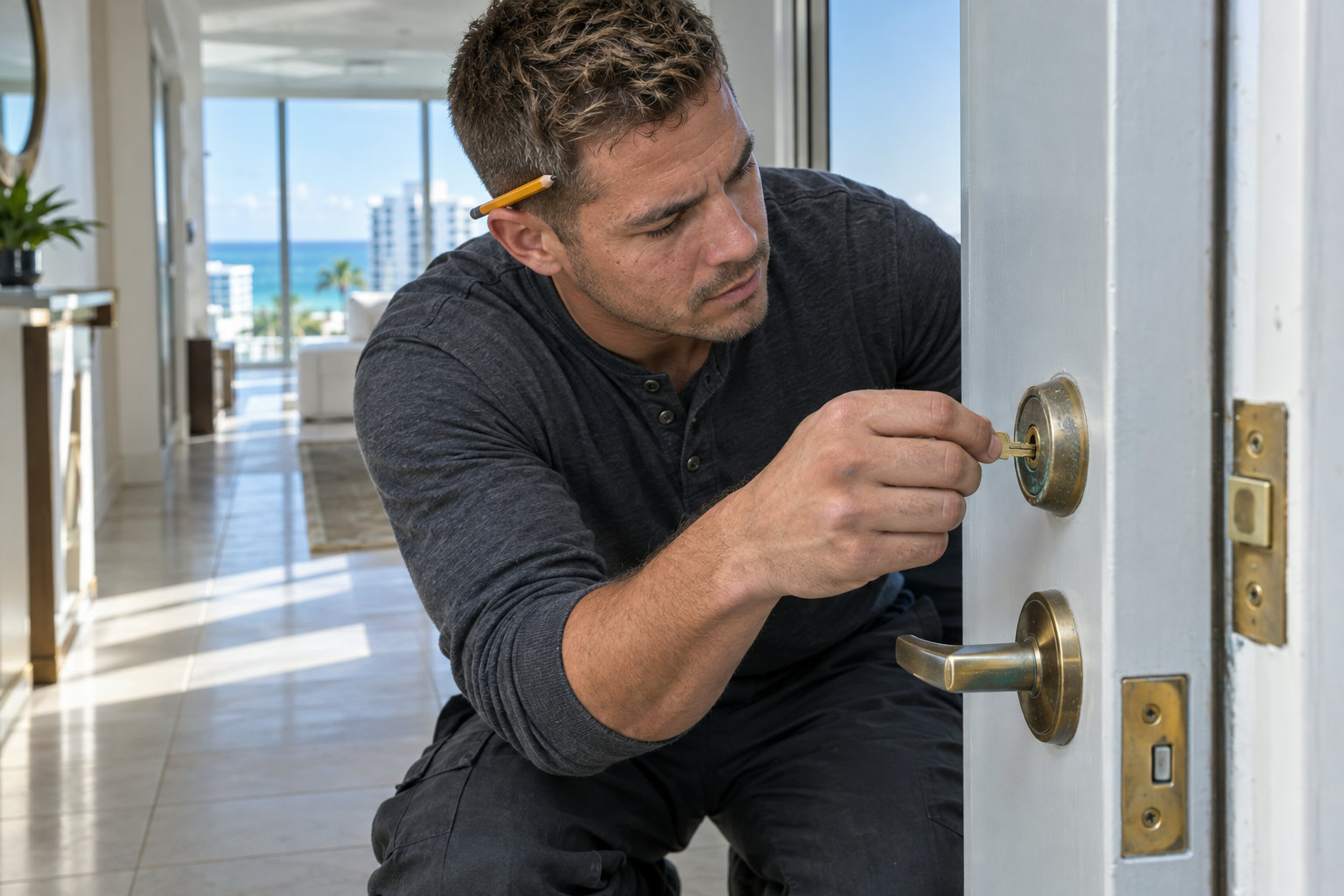
- The open-door test separates the two causes: a key that stays stiff with the door wide open points to a corroded or dirty cylinder, while a key that only binds with the door closed points to door or strike misalignment.
- Sea salt is hygroscopic, meaning it pulls moisture out of humid air, so salt deposits inside a Miami Beach lock cylinder stay damp and keep corroding the brass pins and steel springs.
- A smooth inside thumbturn paired with a stiff key (door open) places the friction inside the cylinder’s keyway and pins, not in the bolt or the door.
- Dry lubricant such as powdered graphite or a PTFE-based lock lube suits coastal cylinders better than oil or grease, which hold salt and grit against the pins.
- High-security cylinders from Medeco, Mul-T-Lock and ASSA Abloy add key control and pick resistance, not salt immunity, so they still need cleaning and dry lubrication in oceanfront buildings.
- Florida’s milestone inspection law (Section 553.899, Florida Statutes) covers condo building structure, not the lock hardware on your unit’s door.
The Short Answer: Salt Air Cylinder Corrosion vs Door Alignment in a Miami Beach Condo
The short answer on salt air door lock cylinder corrosion vs door alignment in a Miami Beach condo is that the friction lives in one of two places: inside the keyway, or where the deadbolt meets the strike plate. Corrosion makes the key fight you no matter where the door is. Misalignment only shows up when the door is closed.
If you’re a condo owner whose front door opens onto an open-air walkway facing the Atlantic, put corrosion at the top of your suspect list, because that keyway takes direct salt spray every time the wind comes off the water. If your door opens onto an enclosed, air-conditioned corridor, salt still gets in on keys and clothing, but alignment problems move higher on the list.
Either way, the open-door test in the next section gives you the answer before you buy a single part. It takes a few minutes.
The Full Answer: How Do You Tell a Corroded Cylinder From a Misaligned Door?
A corroded lock cylinder and a misaligned condo door both make a key hard to turn, but they create friction in different parts of the lock. Each sub-section below isolates one piece of the salt corrosion vs door alignment question, so you can jump straight to the one that matches what your lock is doing.
How does salt air corrode a lock cylinder in a Miami Beach condo?
Salt air corrodes an oceanfront condo lock cylinder by leaving a fine film of sea salt inside the keyway that never fully dries out. Onshore breezes carry salt spray off the Atlantic and Biscayne Bay, and it settles on exposed metal across the barrier island, including the face of your deadbolt.
The real problem is that salt is hygroscopic: it pulls moisture out of humid air. In South Florida humidity, those deposits stay damp, which turns the inside of your cylinder into a slow corrosion cell around the brass plug, the brass pins and the tiny steel springs that push them.
Mixed metals make it worse. When brass, steel and the zinc die-cast parts found in many budget lock housings sit together with a salty film between them, galvanic corrosion attacks the less noble metal faster, and zinc parts often show it as a chalky white powder.
Cylinder corrosion usually shows up as a cluster of these signs:
- The key drags or catches while going in, not just while turning.
- The key is stiff whether the door is open or closed.
- Green, white or dark residue sits around the keyway, or the key comes out grimy.
- The stiffness crept up over months and feels worst on muggy, rainy days.
Corrosion rarely appears overnight. It builds.
What does door misalignment feel like, and why do condo doors drift?
Door misalignment makes a condo lock feel stiff because the deadbolt or latch rubs on the strike plate instead of sliding cleanly into it. The cylinder may be perfectly healthy; your key is just the lever that has to drag a bolt through a pinch point.
Misalignment usually shows up as a cluster of these signs:
- The key turns freely with the door open and binds with it closed.
- Turning gets easier when you push, pull or lift the door by the handle.
- Bright, freshly scraped metal shows on the bolt tip or the edge of the strike plate.
- The gap between door and frame is wider at one top corner than the other.
Condo doors drift for ordinary reasons. Hinge screws loosen under heavy doors, and impact-rated exterior doors are heavy, which matters because Miami-Dade and Broward counties sit in the Florida Building Code’s High-Velocity Hurricane Zone, where exterior openings face stricter wind and impact requirements. Wood and composite doors swell in humidity, and a strike plate set for an old lock may not line up with a new one.
For the seasonal owner who closes up a South Beach unit for the summer, a stiff key on the first day back is a strong alignment clue. A door that sat for months in a unit with the air conditioning set high or off can swell or sag just enough for the bolt to start catching the strike.
What is the quickest at-home test to separate corrosion from misalignment?
The quickest way to separate salt corrosion from door misalignment is to take the door out of the equation and see whether the stiffness stays. Work through these steps in order:
Open the door all the way
Prop it so it can’t swing. Now the bolt has nothing to rub against.
Insert and withdraw the key slowly
Grit, catching or a gritty sound on the way in points to debris or corrosion in the keyway.
Compare the thumbturn with the key
Throw the bolt with the inside thumbturn, then with the key. A smooth thumbturn and a stiff key means the friction is inside the cylinder; if both are stiff, the bolt mechanism itself is dirty or corroded.
Close the door and repeat
If the key was smooth open and stiff closed, push, pull and lift the door while turning. Any change in effort confirms an alignment problem.
Mark the bolt
Color the bolt tip with a dry-erase marker, close the door, throw and retract the bolt, then open up. Where the mark transfers on the strike shows which way the door has drifted.
Try your least-used key
If the spare from the kitchen drawer turns smoothly where your daily key won’t, the key is worn and the lock may be fine.
| Check | Points to salt corrosion in the cylinder | Points to door alignment |
|---|---|---|
| Key turned with door wide open | Still stiff or gritty | Turns smoothly |
| Pushing, pulling or lifting the door while turning | No change in effort | Noticeably easier in one direction |
| Key insertion | Drags or catches going in | Slides in normally |
| Visible clues | Green, white or dark residue at the keyway; grimy key | Bright scrape marks on bolt or strike; uneven door gap |
| How it started | Gradually, over months | Often suddenly, after a storm season, a long absence, or a lock swap |
| Usual fix | Cleaning, dry lubrication, rekeying or cylinder replacement | Hinge tightening, strike adjustment, or door and frame repair |
A key that is stiff with the door open is a cylinder problem; a key that is only stiff with the door closed is an alignment problem. A smooth thumbturn next to a stiff key isolates the fault to the keyway and pins.
Does the lock brand change how salt air affects the cylinder?
Lock brand changes how a cylinder is built, but no residential cylinder from Schlage, Kwikset, Yale, Mul-T-Lock, Medeco or ASSA Abloy is immune to salt air. What changes is how the mechanism reacts once grit and corrosion get inside.
Conventional pin-tumbler cylinders, the design behind most Schlage and Yale residential locks, use a row of pin stacks pushed by small springs. Kwikset SmartKey cylinders use a different, sidebar-style mechanism that owners can rekey with a tool, so their internals behave differently when they get dirty.
High-security cylinders work to finer tolerances. Medeco pins must rotate to a specific angle as well as lift to a specific height, and Mul-T-Lock uses telescoping pin-in-pin stacks; that precision adds key control and pick resistance, and it is also why grit and corrosion deserve prompt attention on these locks.
The finish matters as much as the mechanism. Metal finishes are commonly tested with salt fog exposure under ASTM B117, and ANSI/BHMA standards grade lock performance, so ask what a finish and lock have been tested to before choosing hardware for an ocean-facing door. For a side-by-side look, see this comparison of Medeco, ASSA Abloy and Mul-T-Lock deadbolts in Miami coastal humidity, or read what a Mul-T-Lock deadbolt installation in a Brickell condo involves.
Can a stiff condo lock be corroded and misaligned at the same time?
A stiff condo lock can be both corroded and misaligned, and the two problems feed each other. A bolt dragging on the strike makes you torque the key harder, which wears the pins and the cam at the back of the cylinder; a corroded cylinder makes you force the key, which can loosen the lock’s mounting screws and shift the bolt out of line.
A common mistake is to keep forcing a stiff key until it snaps off inside the cylinder. Servicing the tumblers while the lock is merely stiff avoids a broken-key extraction and a rekey later.
When both tests point somewhere, correct the alignment first. Then repeat the open-door key test, because whatever stiffness remains belongs to the cylinder.
What should you spray into a salt-exposed lock cylinder, and what should you skip?
A salt-exposed lock cylinder is usually best served by a dry lubricant, either powdered graphite or a PTFE-based dry lock lube. Dry films don’t grab onto salt crystals and beach sand the way oil does.
Heavy oil and grease are the wrong move in a keyway, because they hold grit and salt against the pins until it turns to paste. A water-displacing spray such as WD-40 can help flush loose debris, but it is a cleaner rather than a long-term lock lubricant, so follow it with a proper dry lube once the cylinder has dried.
Check the manufacturer’s guidance first, since some high-security makers specify the lubricant for their cylinders. And no lubricant fixes a bolt that is hitting the strike plate.
Rekeying a lock cylinder swaps the pins so a new key works, which is the right call when the pins are fine and you only want new keys. It does not repair a pitted plug, a corroded housing or broken springs, so a cylinder with corrosion in its body needs replacing instead. If your building uses a master-keyed or restricted keyway system, ask the association before changing anything, because the replacement may have to match it.
When the Answer Is Different: What If It’s the Key, the Car or the Building?
A stiff lock near the ocean is not always salt corrosion or door alignment. Four other situations produce the same feel, and each one changes what you should do next.
What if the key itself is worn or badly cut?
A worn key or a poorly cut duplicate makes a healthy cylinder feel stiff, because it no longer lifts the pins to the exact heights the lock expects. Duplicates cut on aftermarket blanks such as ilco can work well when the cut is accurate, but a copy of a copy drifts further from the original each time.
This related write-up shows how an ilco replacement key and a failing door lock cylinder in Aventura can look like the same problem. If your least-used key turns smoothly, start there.
What if it’s your car door lock in the condo garage?
Car door key cylinders corrode the same way, and on fob-equipped vehicles they often fare worse because nobody uses them. A car parked in an open or partly open beachside garage can go years without a key in the driver’s door cylinder while salt keeps settling in it, and the problem only surfaces when the fob battery dies.
Strattec is one of the major makers of factory automotive lock cylinders, and the same open-door test applies: open the car from another door, then try the key in the driver’s cylinder. If the key won’t turn even with that door open, the cylinder is seized; if the fob is the real issue, read whether a locksmith can program a key fob without the original.
What if the door is fire-rated or controlled by the association?
Many high-rise condo entry doors that open onto an enclosed corridor are fire-rated and must self-close and latch. Don’t drill new holes, trim the door or swap in an unlisted strike yourself, because field modifications can affect the door’s rating.
Check your condo declaration as well. Some associations own or control entry hardware, or require a specific keyway so staff can reach units in an emergency.
What if the frame is moving with the building?
A door that suddenly goes out of alignment while new cracks appear in the wall around its frame is a building question, not a lock question. Report it to your association rather than moving the strike plate to chase it.
Florida’s milestone inspection law, Section 553.899 of the Florida Statutes, requires structural inspections for condominium buildings of three or more habitable stories. Those inspections look at the building, not your deadbolt, so lock upkeep stays on your own list.
Our view
Our opinion on Miami Beach condo salt air door lock cylinder corrosion vs door alignment: most people reach for a spray can before they have answered the only question that matters, which is whether the stiffness survives with the door open. That one check decides whether you need a can of dry lube, a screwdriver for the hinges, or a new cylinder. Skipping it is how a simple strike adjustment turns into a gummed-up keyway.
We also think brand gets overweighted for corrosion and underweighted for security. Upgrading to Medeco, Mul-T-Lock or ASSA Abloy is a sound decision for key control and pick resistance, but on an ocean-facing walkway, a routine of cleaning and dry lubrication does more for smooth operation than the name on the cylinder.
The one thing not to wait on is a key that is getting harder to turn. A stiff lock is a warning. A key snapped off inside the cylinder is a lockout.
Frequently Asked Questions
How often should I lubricate a condo lock cylinder near the beach?
A condo lock cylinder near the beach does best with a dry graphite or PTFE lubricant applied on a regular routine, for example whenever you change your AC filter or test your smoke detectors. Doors on open-air, ocean-facing walkways need attention more often than doors on enclosed, air-conditioned corridors.
Can a locksmith fix a misaligned condo door, or does the association handle it?
A misaligned condo door can often be corrected by tightening hinge screws or repositioning the strike plate, which is routine lock work. If the door is fire-rated, controlled by the association under your condo declaration, or the frame is moving alongside new wall cracks, involve the association first.
Do Medeco or Mul-T-Lock cylinders resist salt air better than Schlage or Kwikset?
Medeco and Mul-T-Lock cylinders are built for key control and pick resistance, not immunity to salt air, so they still need cleaning and dry lubrication on an oceanfront door. Their tight tolerances are a reason to deal with grit early. On any door facing the Atlantic, the finish and the maintenance routine matter as much as the brand.
Why is my car door key cylinder seized when my condo lock works fine?
A car door key cylinder often seizes because a fob-equipped vehicle can go years without its mechanical key being used, while salt air in a beachside parking garage keeps settling in the keyway. Factory cylinders, including those made by Strattec, benefit from occasional use and dry lubrication. Test the key in the door before the fob battery dies, not after.
Have a similar question? If your lock is still stiff after the open-door test, or you can’t tell whether the cylinder, the key or the door is at fault, Easy Keys 4 Cars can look at it with you. Ask about pricing directly when you get in touch.
Sources
- Milestone structural inspections for condominium buildings of three or more habitable stories: Section 553.899, Florida Statutes (The Florida Senate)
- Salt spray (fog) testing used to evaluate corrosion resistance of metal finishes: ASTM B117, Standard Practice for Operating Salt Spray (Fog) Apparatus
- ANSI/BHMA performance standards and grading for locks and cylinders: Builders Hardware Manufacturers Association
- Florida Building Code and the High-Velocity Hurricane Zone covering Miami-Dade and Broward: Florida Building Commission
Easy Keys 4 Cars
Automotive locksmith services
Have a Similar Question? Get Your Stiff Condo Lock Cylinder Diagnosed
 Listen to this articleAudio version
- Medeco vs ASSA Abloy vs Mul-T-Lock: Which High-Security Deadbolt Cylinder Survives Miami’s Coastal Humidity Longest
- Will a Mul-T-Lock High-Security Deadbolt Fit a Brickell Condo Door Without New Holes? What a Miami Locksmith Checks
- Mul-T-Lock vs Medeco: Which High-Security Deadbolt Actually Holds Up in Miami’s Salt Air
- The Aventura Customer Whose Ilco Replacement Key Kept Failing — What We Found Inside the Door Lock Cylinder
- Locksmith for Car Door in Coral Gables: Is a Freely Spinning Cylinder a Lock Problem or a Door Linkage Problem?