


Last updated: November 6, 2026
Published November 6, 2026 · Updated November 6, 2026
 Listen to this articleAudio version
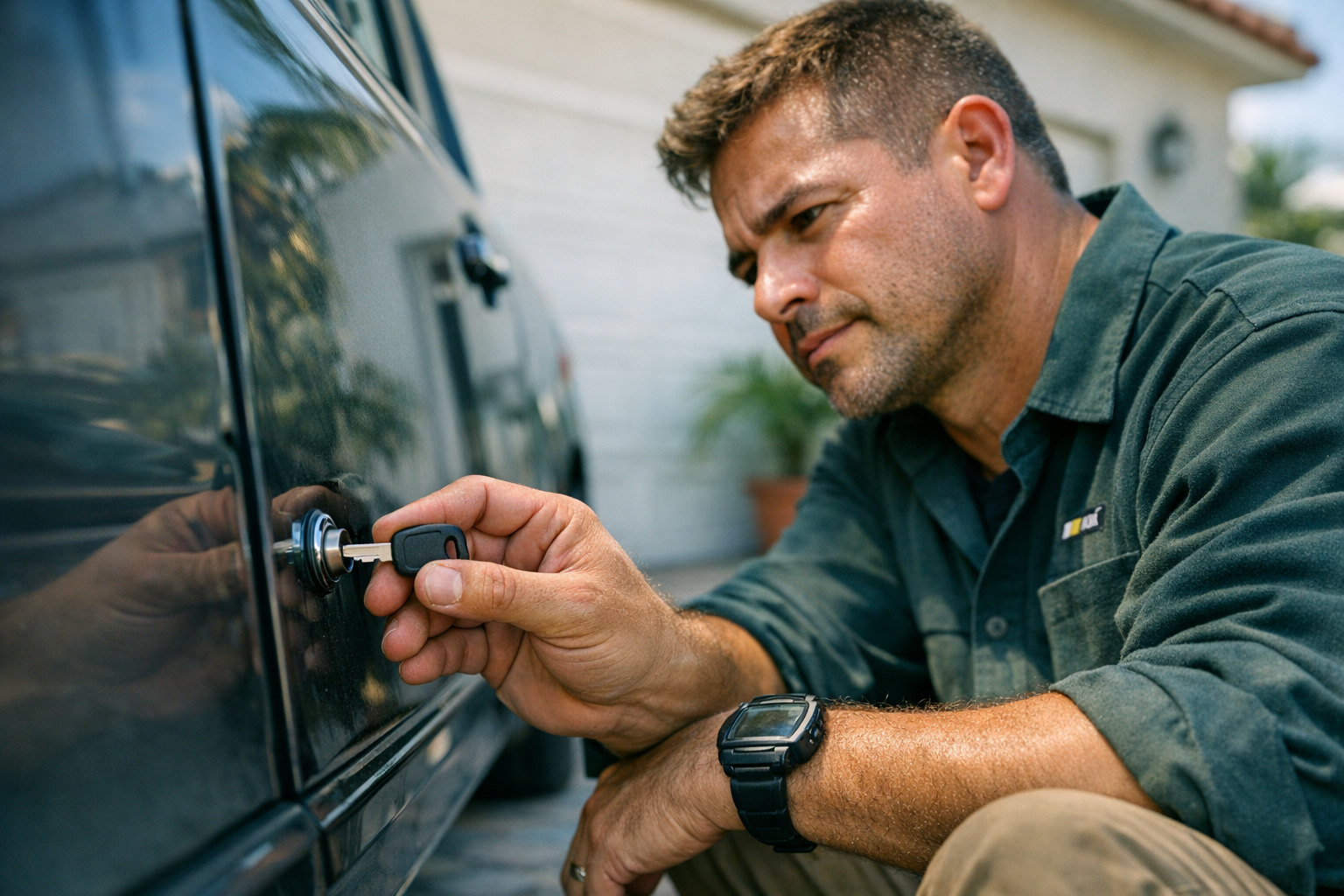
Yes. A mobile locksmith in Miami can make a working key after a car door lock has been replaced. There are two ways to do it: decode the new cylinder, or cut a key to the factory code and rekey the replacement so one key runs both the door and the ignition. The door cylinder plays no part in the transponder chip that lets the engine start, so a swapped lock changes how the blade is cut, not whether the car can be programmed.
This city is different because of the conditions working on that door lock. Salt air comes off Biscayne Bay and the Atlantic, and the wet season pushes water into keyways for months. Many cars here are push-to-start, so their owners rarely touch the metal blade until the day the fob dies. As a result, door cylinders fail quietly, get replaced in a hurry, and often end up keyed differently from everything else on the car.
This guide is for two situations. Maybe you bought a used car in South Florida and found that the door key and the ignition key are two different keys. Or a body shop returned your car with a driver’s door lock your key won’t turn. It is not about a simple lockout with the keys sitting on the seat, which is a different and quicker job.
- A replaced car door lock does not change the transponder chip or immobilizer. Whether a key starts the engine depends on the ignition and on OBD-II programming, not on the door cylinder.
- Locksmiths registered with NASTF (the National Automotive Service Task Force) can request a vehicle’s factory key code by VIN. That code matches the original lock, not a used or aftermarket replacement cylinder.
- Uncoded service cylinders, such as those Strattec supplies for many domestic models, are built to be loaded with wafers that match the original key. That lets one key work both the door and the ignition.
- The Atlantic hurricane season runs June 1 to November 30. A door replaced after flood or collision repair often arrives with a lock keyed to a different car.
- Proof of ownership is the standard requirement before any locksmith cuts a car key by code. That means a title or registration plus a matching government photo ID.
- The Atlantic hurricane season officially runs from June 1 to November 30. Storm-related flood and collision repairs can include replacing whole doors and their locks.
- South Florida’s wet season runs roughly from mid-May to mid-October. Frequent afternoon thunderstorms drive water into exterior keyways.
- Brickell and Coconut Grove sit on Biscayne Bay and Sunny Isles Beach faces the Atlantic. Cars parked outdoors in those neighborhoods sit in salt-laden air that speeds up corrosion of metal lock parts.
- Brickell’s high-rise condo towers keep many cars in covered garages. Doral, beside the airport, is a dense business and warehouse district full of fleet vans and work trucks.
What makes Miami different for a mobile locksmith matching a replaced lock?
Three local conditions shape the job of matching a key to a replaced car door lock here: corrosive coastal air, a long wet season, and parking that ranges from tower garages to open commercial lots. Each one changes why the lock was replaced in the first place and what the new key has to fit.
Salt air and seldom-used cylinders
Most car door cylinders use small spring-loaded wafers, the automotive cousin of the pin tumblers in a house lock. Salt and humidity corrode those wafers and their springs. Corrosion works fastest on a cylinder that never moves, and on a push-to-start car the driver’s door cylinder can go years without a key in it.
When the fob battery finally dies and the owner slides out the emergency blade, a seized cylinder won’t turn. The usual fix is replacing it, quickly and with whatever part is on hand. That is how many cars end up with a door lock that answers to a different cut than the ignition.
Months of rain and storm repairs
South Florida’s wet season runs roughly from mid-May to mid-October, and wind-driven rain gets into exterior keyways all summer. Hurricane season overlaps it from June 1 to November 30. A car that sits in floodwater may need door modules, actuators and sometimes complete doors replaced.
Every one of those repairs is a chance for a lock cylinder to change. Few body shops code a replacement door lock to the owner’s key unless someone asks.
Garages, lots and cars that have had many owners
Parking here runs from Brickell condo garages to Doral warehouse lots and driveways in Hialeah. A car with no working key can’t be driven to a shop, so the work comes to it. Decoding a cylinder, cutting a blade on a code machine and programming a chip can all be done with portable equipment beside the car.
South Florida also has a busy used-car, auction and rental market. Every extra owner, fleet or repair shop in a car’s history is another chance that a lock was swapped and never recoded. The new owner usually finds out the day they first try the door key.
Why does a replaced car door lock stop matching the original key?
A replaced car door lock stops matching the original key because the new cylinder arrives with its own wafer combination, and nobody coded it to the car’s factory key code during installation. The ignition still answers to the original key. The car ends up with two cuts: one for the door and one for starting.
That split almost always traces back to one of four situations.
1. A used cylinder pulled from another car
A salvage-yard door lock from the same make and model bolts in and works perfectly, but only with the key from the donor car. Same model does not mean same code. Manufacturers spread key codes across a large range of combinations precisely so one car’s key does not open another.
Unless the installer rekeyed that cylinder, the owner now has a door that answers to a stranger’s key, often without any copy of it.
2. An aftermarket cylinder that came with its own keys
Budget aftermarket door lock kits are commonly sold pre-keyed, with two keys in the box. They are a fast fix after a break-in, but they leave the driver carrying a second key for as long as they own the car.
Many dealer and OEM service cylinders take the opposite approach. They ship uncoded, with loose wafers meant to be loaded to match the vehicle’s existing key. Installed without that coding step, an uncoded cylinder may not lock properly, or it may turn with any blank that fits the keyway.
3. A whole door replaced after a flood or collision
Collision and flood repairs sometimes replace an entire door shell, and a used door often comes with its lock still inside. The paint matches, but the lock does not. After a storm, cars that took on water can also need new lock actuators and wiring, and the mechanical cylinder gets swapped in the same repair.
4. A forced lock replaced after a break-in
Thieves who attack a driver’s door cylinder usually pry or punch it, which destroys the wafers. The quickest repair is a new cylinder off the shelf. That is how a car ends up with a door lock keyed to nothing the owner carries.
Two mistakes that make it worse
The first is driving away from a used-car purchase with a single key. Dealers often hand over only one, and if that key is lost, a replacement has to be built from scratch instead of copied. Getting a spare made in the first week costs far less effort than an all-keys-lost job later.
The second is ignoring a door cylinder that has started to stick until the key snaps inside it. Early lubrication or cylinder service is much simpler than an extraction followed by a rekey. If a blade has already broken off, read about getting a broken key out of a car door lock before forcing anything.
| How the lock was replaced | What is usually in the door | How the key gets made | Usual best outcome |
|---|---|---|---|
| Salvage-yard or used door | Factory cylinder coded to a different car | Decode the cylinder, or rekey it to the original code | One key, once rekeyed |
| Pre-keyed aftermarket kit | Random code, often with two included keys | Rekey if the cylinder allows it; otherwise replace with a codeable part | One key with a codeable cylinder |
| OEM service cylinder installed uncoded | Partly loaded or empty wafer stack | Load wafers to the factory key code from the VIN | One key, done correctly |
| Quick fix after a break-in | Whatever cylinder was on hand | Identify the part, then decode or rekey | One key in most cases |
How does a mobile locksmith cut a key for a replaced door lock?
A mobile locksmith cuts a key for a replaced door lock by working out two codes: the factory code that matches the ignition, and the actual code of the cylinder now in the door. The job then comes down to one decision. Either the door gets rekeyed to match the ignition, or the driver gets a separate key for the door.
This is closely related to making a car key without the original. The difference is that a replaced lock adds a second code to deal with. The sequence below matches how a matched key is typically produced.
Verify ownership and the VIN
The locksmith checks the title or registration against a photo ID and reads the 17-character VIN from the dashboard or door jamb. The VIN confirms the exact model year and trim, which determines the keyway and chip type.
Identify the key system
Edge-cut keys and high-security internal-track keys (sometimes called laser-cut or sidewinder keys) need different blanks and cutters. An ilco reference blank is matched to the exact keyway profile.
Get the original code
The factory key code comes from a dealer or, for locksmiths registered with NASTF, through its secure data release process. If the code isn’t available, the ignition or another original cylinder, such as the trunk or glovebox lock, can be decoded instead.
Decode the replacement door cylinder
A pick-decoder reads the wafer depths through the keyway without removing the lock. If the cylinder is corroded or damaged, the locksmith pulls it from the door and reads the wafers directly.
Rekey the door or cut a second key
When the cylinder accepts standard wafers, it is rekeyed to the original code so one key runs the whole car. When it doesn’t, a codeable service cylinder replaces it, or the owner chooses to carry a separate door key.
Cut the key and program the chip
The blade is cut on a code machine. If a new transponder or smart key is needed, it is programmed through the OBD-II port with diagnostic equipment for that make.
Test every lock
The new key is tried in the driver’s door, the passenger door if it has a cylinder, the trunk, the glovebox and the ignition. A key that works the door but binds slightly in the ignition gets recut before anyone leaves.
Parts that hold up in humid, salty air
Strattec is a long-standing OEM supplier of locks and keys to automakers, including General Motors. It sells service lock cylinders designed to be coded to an existing key, which keeps the door and ignition on one cut. ilco supplies key blanks, transponder keys and the code-cutting machines many automotive locksmiths use.
Home and commercial brands such as Schlage, Kwikset, Medeco, Mul-T-Lock and Yale make pin-tumbler and high-security door hardware for buildings. Car doors mostly use wafer tumblers instead. That is why the locksmith who rekeys a front door in Coral Gables and the one who rekeys a car door carry different tools.
After rekeying, apply a dry lock lubricant, such as a graphite or PTFE-based product. It generally holds up better in salt air than general-purpose oil, which collects grit and gums up wafers over a wet season.
A matched key starts with the VIN and the factory key code, available from a dealer or through NASTF’s secure data release for registered locksmiths. The replacement door cylinder is decoded and, where possible, rekeyed to that code, so one ilco or OEM blade runs the door, trunk and ignition.
Does replacing a car door lock affect the chip key or the remote?
No. Replacing a car door lock does not affect the chip key or the remote. The transponder chip talks to an antenna around the ignition or to the push-button start system, and the remote talks to the body control module by radio. Neither one reads the shape of the door cylinder.
That separation makes the job simpler. If the original key still starts the car, the work is purely mechanical: make a blade that fits the door. If every key is lost, the blade is cut by code first, and then a new transponder or smart key is programmed through the OBD-II port. For many makes, that programming step needs a security PIN as well as the right diagnostic equipment.
Push-to-start cars add one wrinkle. Their driver’s door cylinder is often hidden under a small cap at the end of the handle, and the emergency blade slides out of the fob. If that hidden cylinder was replaced, the emergency blade has to be cut to match it, or the cylinder rekeyed to the blade. Otherwise a dead fob battery means the door can’t be opened at all. For more on that side of the job, see this guide to smart fob and car key replacement across South Florida.
Should you call a dealer or a mobile locksmith for a mismatched key?
Both a dealer and a mobile locksmith can fix a mismatched door key. The better choice depends on whether the car can be driven and what else is wrong with it. Each option wins in a specific situation.
- A dealer wins when the lock problem is covered by a warranty or recall, when the car is already booked in for service, or when a newer model needs programming only the manufacturer’s network supports.
- A mobile automotive locksmith wins when the car has no working key, can’t be driven, or is parked in a garage or lot. It also wins when you want the replacement cylinder decoded and rekeyed on site instead of towing the car.
- A body shop wins when the door itself is bent, the handle linkage is broken, or the actuator has failed. Those are door repairs first and key problems second. This breakdown of whether a damaged car door lock should be repaired or replaced covers that decision.
Picture a dealership service manager with a full lot, or a property manager who needs a fleet van running by morning. Both care less about who does the work than about whether the car leaves with one key that opens and starts it. Ask for that result by name.
What to ask before hiring a mobile locksmith
- Can you decode the replacement door cylinder on site, or does it have to come out of the door?
- Will you rekey the door to my existing key, or cut a separate door key?
- Can you program a transponder or smart key for my make and model year if I need one?
- What proof of ownership do you need? A locksmith who asks for nothing before cutting a key by code is a warning sign.
- How is the price put together? It depends on the key type, the vehicle and whether rekeying is needed, so ask Easy Keys 4 Cars for a quote on your specific car before work starts.
Our view
This is opinion, plainly labeled. Whenever the hardware allows it, rekey a replaced car door lock to the original key instead of living with two keys. A second key looks harmless until it is the one that goes missing, and then the door is the lock nobody can open.
Drivers tend to put too much weight on getting any key quickly and too little on what kind of cylinder is in the door. A codeable service cylinder from a supplier like Strattec, loaded to the factory code, fixes the problem for good. A pre-keyed budget cylinder only moves it down the road.
The transponder chip is the part that feels technical, but it is rarely the hard part of this job. The mechanical match between blade and cylinder is where shortcuts happen. A good mobile locksmith treats it as seriously as the programming.
- A South Beach Tourist Asked: ‘Can a Locksmith Make a Car Key for a Rental Vehicle if I’m Locked Out?’ — What’s Actually Allowed
- How to Extract a Broken Key From a Car Door Lock
- How We Replaced a Broken Transponder Key for a Coral Gables Customer Locked Out at Midnight — and Found a Damaged Ignition
- The Aventura Customer Whose Ilco Replacement Key Kept Failing — What We Found Inside the Door Lock Cylinder
- Will a Mul-T-Lock High-Security Deadbolt Fit a Brickell Condo Door Without New Holes? What a Miami Locksmith Checks
Frequently asked questions
Will my old key still work after the door lock is replaced?
Your old key will still start the car after a door lock replacement, because the ignition and the transponder chip are unchanged. It will open the new door lock only if that cylinder was coded to the factory key code. Uncoded OEM service cylinders and pre-keyed aftermarket kits usually are not.
Can a locksmith rekey a car door lock to match my ignition key?
A locksmith can rekey most car door locks to match the ignition key by loading the cylinder’s wafers to the factory code, which comes from the VIN through a dealer or NASTF. Some budget aftermarket cylinders can’t be rekeyed. In that case a codeable service cylinder, such as a Strattec part, replaces them so one key runs everything.
How long does it take to make a key for a replaced door lock?
Making a key for a replaced door lock is usually finished in a single visit at the car. The time depends mostly on whether the cylinder can be decoded through the keyway or has to be pulled from the door. Programming a new transponder or smart key through the OBD-II port adds a separate step on top of the cutting.
What do I need to show a locksmith to get a car key made by VIN?
To get a car key made by VIN, you need the vehicle’s title or registration and a government photo ID with a name that matches it. NASTF’s secure data release process is built around verifying ownership before factory key codes are released. Expect a careful locksmith to check both documents before cutting anything.
Sources
- Atlantic hurricane season dates (June 1 to November 30): NOAA National Hurricane Center
- South Florida wet season and local climate: National Weather Service, South Florida forecast office
- Locksmith access to vehicle key codes and the Vehicle Security Professional registry: National Automotive Service Task Force (NASTF)
- Decoding a VIN to confirm make, model year and trim: NHTSA Vehicle Product Information Catalog VIN Decoder
Easy Keys 4 Cars
Automotive locksmith services