


Last updated: October 11, 2026
Published October 11, 2026 · Updated October 11, 2026
A Toyota transponder key opens the door but won’t start the engine when the metal blade is cut correctly but the chip in the key head has not been registered to the car’s immobilizer. A Fort Lauderdale automotive locksmith fixes it by identifying the chip generation (Toyota has used Texas Instruments 4C and 4D chips plus the later G and H types), confirming the key matches the vehicle, and programming it through the OBD-II port.
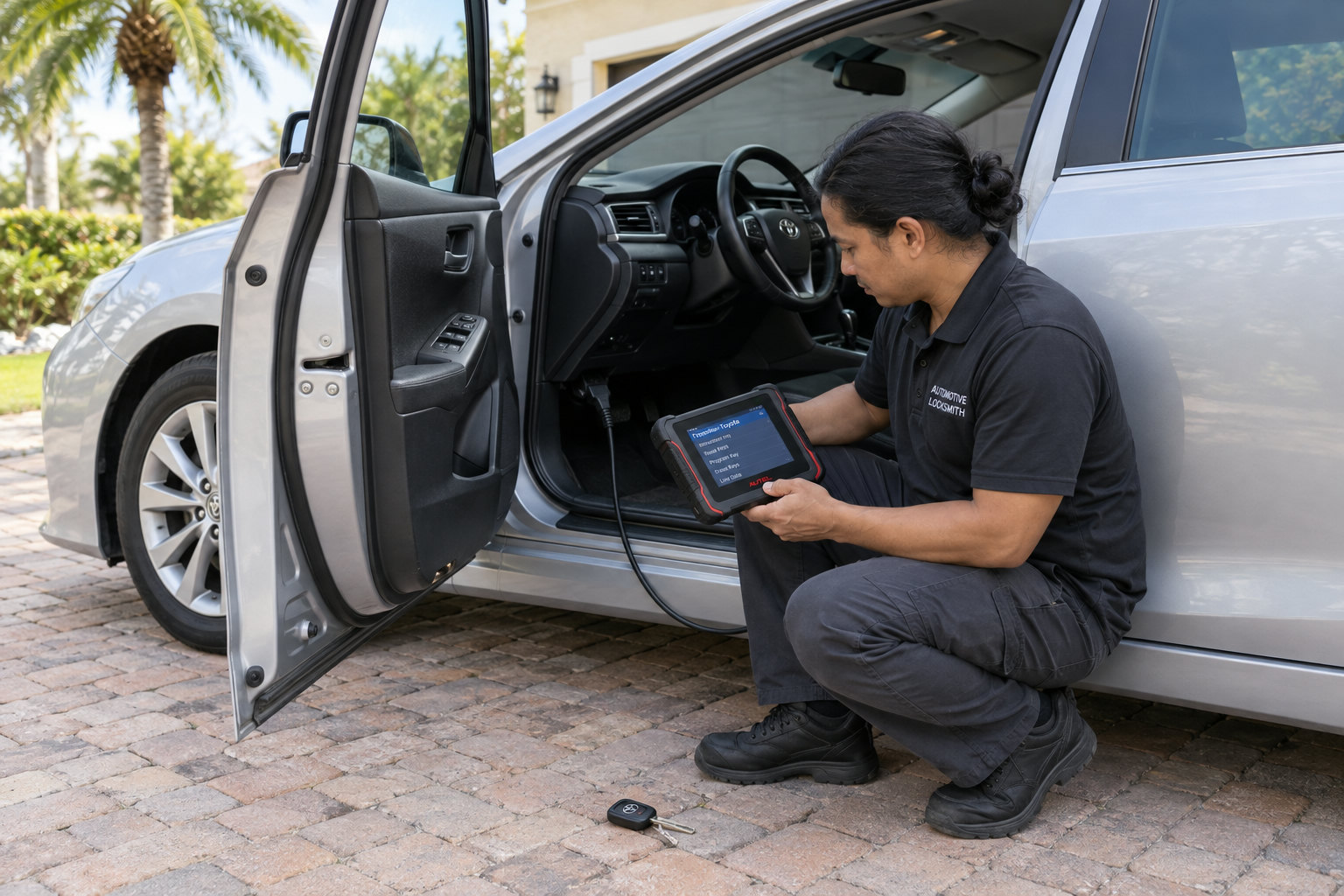
Fort Lauderdale adds its own complications. Cars here live in salt air and humidity, flood-exposed vehicles circulate after hurricane seasons and king tides, and used Toyotas often change hands with a single key, which is exactly when owners hurry to get a spare cut wherever it is fastest.
If you’re a Toyota owner in Broward County holding a freshly cut spare from a hardware kiosk or an online blank, and the engine cranks without catching, this guide explains what failed and what to ask for. It is written for bladed-key Toyotas such as many Corolla, Camry, Tacoma and RAV4 trims, not for push-button cars with a smart key, which fail for different reasons.
- A newly cut Toyota key opens the doors with its blade alone, but the engine only runs when the transponder chip in the key head is registered to the car’s immobilizer.
- Toyota has used several transponder chip generations, including Texas Instruments 4C and 4D chips and the later G and H chips, and many keys carry a stamped dot, G or H on the blade near the head.
- A Toyota security indicator light that keeps flashing or stays lit with the key switched on usually means the immobilizer did not accept the chip.
- On many Toyotas the door cylinder uses fewer cut positions than the ignition, so a key can open the door and still refuse to turn the ignition if those extra cuts are wrong.
- The Atlantic hurricane season runs June 1 to November 30, and flood-exposed cars resold around Fort Lauderdale can carry corroded immobilizer antennas and wiring.
- A Toyota valet key cannot register a new key; older on-board programming generally needs a working master key, and many newer models need dedicated diagnostic equipment.
- Fort Lauderdale is the county seat of Broward County and is nicknamed the Venice of America for its extensive network of canals and waterways.
- The Atlantic hurricane season, as defined by the National Hurricane Center, runs from June 1 through November 30 each year.
- Low-lying streets near the canals and the Intracoastal Waterway are prone to seasonal king tide flooding, most often in the fall, which the City of Fort Lauderdale tracks and publishes guidance on.
- The city sits directly on the Atlantic, so vehicles parked along A1A and near the beach spend their lives in humid, salt-laden air.
Why Does a Toyota Transponder Key Open the Door but Not Start the Engine?
A Toyota transponder key opens the door but won’t start the engine because the door lock only checks the shape of the blade, while the engine checks a coded chip. Those are two separate systems. Passing one says nothing about the other.
Inside the plastic head of a bladed Toyota key sits a small glass or ceramic transponder. When you turn the key to the ON position, an antenna ring around the ignition cylinder energizes that chip, reads its code, and passes it to the immobilizer. If the code matches one stored in the car, fuel and ignition are enabled. If not, the engine typically cranks without firing, or fires and dies within a second or two.
A new blade cut by a key machine has no way to tell the car anything. The chip still has to be registered, a step that happens electronically, usually through the OBD-II diagnostic port that every car sold in the United States has carried since the 1996 model year. A spare Toyota key that was cut but never programmed is the single most common reason a copied key turns but the car won’t start.
What does the Toyota security light tell you?
The Toyota security indicator is the fastest free diagnostic you have. On many models, Toyota’s owner’s manuals describe an immobilizer light (often a key or car-and-key symbol) that flashes when the key is out to show the system is armed, then goes out once a registered key is inserted and switched on.
If that light keeps flashing or stays solid with the new key switched on, the immobilizer did not accept the chip. If the light goes out normally and the engine still won’t crank, the problem is more likely the battery, starter, or a gear selector switch, and no amount of key programming will help.
How do you identify which chip a Toyota key uses?
Toyota key chips can often be identified by a small stamp on the metal blade right where it meets the plastic head. Many keys from the 4D-67 era carry a stamped dot, many later keys carry a G, and newer 128-bit keys carry an H. Older keys with Texas Instruments 4C chips often have no stamp at all.
This matters because the chip in a replacement key has to be the same generation the car expects. A G-chip key will not program into a car that wants an H chip, no matter how perfect the cut. For a deeper look at how chip keys and transponder keys differ, see our guide to the difference between a chip key and a transponder key.
What do the different no-start symptoms mean?
Toyota no-start symptoms with a new key point to different causes, and an automotive locksmith reads them in roughly this order. The table pairs each symptom with its usual cause.
| What you notice with the new key | Most likely cause | What gets checked |
|---|---|---|
| Opens the door, turns the ignition, security light keeps flashing, engine cranks but won’t run | Chip present but never registered to the immobilizer | Chip type with a transponder reader, then registration through OBD-II |
| Opens the door but will not turn in the ignition | Cuts wrong in positions the door lock does not use, or worn ignition wafers | Key decoded against the vehicle’s code, ignition cylinder inspected |
| Engine fires, then stalls within a couple of seconds | Immobilizer rejecting the code after start-up | Registration status and chip generation |
| Reader shows no chip at all | Empty aftermarket shell, or chip lost from the head | New key with the correct chip, then programming |
| Starts only after removing the other keys from the ring | Signal collision with another transponder on the key ring | Test with the key alone near the ignition |
| Original key also fails now and then | Weak antenna ring or wiring at the ignition | Antenna and connector testing |
A Toyota key’s blade and chip are checked by two separate systems, so a door that opens proves only the cut. A flashing security light with the key on means the immobilizer rejected the chip, and the fix is matching the chip generation (4C, 4D, G or H) and registering it through the OBD-II port.
Why Fort Lauderdale Is Different
Fort Lauderdale is different for Toyota key problems because water, salt and the local used-car market all push on the same weak points. A city built around canals, sitting on the Atlantic, with a six-month hurricane season, treats a car’s electronics harder than an inland suburb does.
Flood exposure reaches the immobilizer, not just the carpet
Flood water in a Toyota cabin can reach connectors under the dash and around the steering column, where the immobilizer antenna and its wiring live. Corrosion there can make the car read chips intermittently, which looks exactly like a bad new key.
Between hurricane season (June 1 to November 30) and fall king tides in low-lying neighborhoods, water-exposed vehicles are a real factor in the South Florida resale market. The National Insurance Crime Bureau’s free VINCheck tool lets a buyer search for insurance-reported flood and theft records before blaming a key for a no-start.
Salt air wears lock cylinders unevenly
Salt air near A1A, the beach and the Intracoastal Waterway corrodes door and ignition cylinders over time. A worn ignition can make a fresh, factory-accurate cut feel wrong, while the less-used door lock still turns easily. That mismatch confuses owners into thinking the new key is the problem when the cylinder is.
Heat kills remote batteries, but not transponder chips
South Florida heat shortens the life of the coin battery that powers a Toyota remote’s lock and unlock buttons. Here is the counter-intuitive part: on a bladed key, that battery has nothing to do with starting. The transponder chip is passive and draws its power from the ignition antenna’s field.
Swapping the remote battery will not fix a bladed Toyota that cranks but won’t run. If the buttons are dead and the car still starts, the chip is fine. If the buttons work and the car won’t start, the chip or immobilizer is the issue.
Common Problems in Fort Lauderdale: What Usually Keeps a New Toyota Key From Starting the Car?
Fort Lauderdale Toyota owners with a new key that turns but won’t start usually run into one of four problems. Each has a distinct fix, and two of them start with a decision made before the key was ever cut.
1. A hardware-store or online key with the wrong chip, or no chip
A common mistake is assuming any key that fits the lock can start a modern Toyota. Hardware counters can cut a blade accurately, but a transponder-equipped Toyota also needs the right chip and, in most cases, OBD-II programming that a general key counter is not set up to perform.
Online listings make this worse. Many sell shell only keys, which are empty plastic heads with no transponder inside, and others ship a chip from the wrong generation. A transponder reader identifies either problem in seconds.
2. A cloned chip that did not clone
Toyota key cloning copies the data from your existing chip onto a special cloneable chip instead of adding a new key to the car’s memory. It works well for many older 4C and 4D keys. Support for Toyota’s 128-bit H chips is more limited, so a cloned H key can look finished and still be rejected.
3. A do-it-yourself programming attempt that went wrong
Another common mistake is trying to program a Toyota key without proper diagnostic equipment. Most DIY attempts fail because the immobilizer never syncs to the transponder chip, and some older on-board sequences include a mode that erases every stored key except the one in the ignition.
The on-board methods posted online also tend to assume a working master key, which on older Toyotas typically has a black head. A gray-headed valet key cannot register anything, and many newer G and H models skip on-board programming entirely in favor of a diagnostic tool.
4. Ignition wear, antenna faults and key-ring interference
Toyota ignition problems sometimes disguise themselves as key problems. On many Toyotas the door lock does not use every cut position the ignition does, so a key can open the door yet bind or refuse to turn in a worn ignition. If the cylinder itself is the problem, our page on Toyota ignition repair in Fort Lauderdale covers that service.
Two smaller culprits are worth ruling out yourself. A second transponder key or chipped fob hanging next to the new key can confuse the antenna, so test the new key alone. And if the original key also fails occasionally, suspect the antenna ring or its wiring before the new key.
For a used-car buyer who drove home from a Broward lot with one Toyota key, the timing matters. Dealers often hand over only a single key, and registering a spare while that key still works is far simpler than recovering from an all-keys-lost situation later.
How We Approach This Area: What Does an Automotive Locksmith Check First?
A Fort Lauderdale automotive locksmith diagnosing a Toyota transponder key that opens the door but won’t start works from the cheapest test to the most involved. The goal is to separate a key problem from a car problem before anything is reprogrammed.
Watch the security light
With the new key switched on, a flashing or solid immobilizer light points to the chip, while a light that goes out points elsewhere.
Read the chip
A transponder reader confirms whether a chip exists and whether it is the 4C, 4D, G or H generation the vehicle expects.
Verify the cut
The blade is checked against the vehicle’s key code and tested in the ignition, since the door cylinder alone cannot prove every cut is right.
Test the original key and the antenna
If the original key also misreads, the antenna ring and wiring near the column get checked, especially on cars with any flood history.
Register the key through OBD-II
With the right chip confirmed, the key is added to the immobilizer with diagnostic equipment, keeping the existing working keys stored.
Test every key, not just the new one
Each key should start the engine and clear the security light, which confirms nothing was dropped from memory during programming.
Key stock matters in a humid, coastal climate. Transponder keys and blanks from established suppliers such as ilco (whose Toyota blank families include the TOY43 and TOY44 series) and Strattec come with documented chip types, which removes the guesswork that empty or mislabeled online shells create.
Before you call, have four details ready: the year and model, whether the car uses a blade or push-button start, how many working keys you have, and what the security light does with the new key. Our Fort Lauderdale car locksmith page lists the services available in the area.
Our view
This is opinion, plainly labeled. Toyota owners tend to overweight the cut and underweight the chip. A beautifully cut blade is the easy half of the job. The question that decides whether the car starts is whether the chip is the right generation and whether it was registered, and that question is worth asking before anyone touches a key machine.
We also think the fastest route is rarely the cheapest-looking one. A shell-only key from an online listing or a blade from a general key counter can turn into a second trip, a second key and a programming visit anyway. Starting with a properly chipped key and programming in one visit is usually the simpler path.
Finally, the best time to fix a Toyota key problem is while you still have one working key. In South Florida, where flood-exposed and single-key used cars are part of the market, having a registered spare is cheap insurance against a far harder all-keys-lost situation.
FAQ: Toyota Keys That Open the Door but Won’t Start in Fort Lauderdale
Can a hardware store in Fort Lauderdale make a Toyota key that starts the car?
A hardware store in Fort Lauderdale can usually cut a Toyota blade that opens the doors, and some offer chip cloning for older 4C and 4D keys. Most transponder Toyotas, especially those with G or H chips, still need the key registered to the immobilizer through the OBD-II port, which is automotive locksmith work.
Will a Toyota key that got wet in a flood still start the car?
A Toyota transponder chip is sealed and often survives water, but a wet remote circuit board can corrode, and flooding during hurricane season (June 1 to November 30) can damage the car’s immobilizer antenna wiring too. If the security light keeps flashing after a flood, both the key and the antenna near the ignition should be tested.
I bought a used Toyota in Broward County with one key. What should I do?
A used Toyota bought in Broward County with a single key should get a second key registered while the first one still works. Adding a key to an immobilizer that already recognizes one is simpler than an all-keys-lost job, and it is also a good moment to run the VIN through NICB’s free VINCheck for flood or theft records.
How do I find out what Toyota transponder key programming costs in Fort Lauderdale?
Toyota transponder key programming cost in Fort Lauderdale depends on the model year, the chip generation (4C, 4D, G or H), and whether you still have a working key, so the accurate answer comes from a direct quote. Contact Easy Keys 4 Cars with your year, model and key count, and see our overview of what affects replacement car key programming in Fort Lauderdale.
Sources
- Atlantic hurricane season dates (June 1 to November 30): National Hurricane Center (NOAA)
- Toyota immobilizer indicator behavior and key information in owner’s manuals: Toyota Owners
- Fort Lauderdale canals, waterways and king tide guidance: City of Fort Lauderdale
- Free vehicle flood and theft record lookup: National Insurance Crime Bureau VINCheck
 Listen to this articleAudio version
- A Doral Driver Asked: ‘Why Does My Push-to-Start Car Keep Saying Key Not Detected Even With a New Fob?’, A Tech’s Diagnosis
- A Miami Driver Asked: ‘What’s the Difference Between a Chip Key and a Transponder Key — and Does It Change What I Pay?’ — Explained Simply
- A Coconut Grove Driver Asked: ‘Is It Safe to Buy a Cheap Aftermarket Key Fob Online Instead of Going to a Locksmith?’ — The Real Risk
- A Hialeah Customer Asked: ‘Why Won’t My Car Key Turn in the Ignition Even Though It’s the Right Key?’ — A Tech’s Diagnosis
- A Miami Beach Driver Asked: ‘Can a Locksmith Program a New Key Fob Without the Original?’ — Here’s the Honest Answer