


Last updated: October 16, 2026
Published October 16, 2026 · Updated October 16, 2026
How many keys to cut for a new commercial location in Coconut Grove follows a simple formula that any Miami locksmith can apply. Cut one key per person for each door that person actually opens, add at least two spares per lock held by the owner, and keep two programmed keys for every company vehicle. Most owners count keys by counting employees, and that habit is where key control starts to break down before the doors even open.
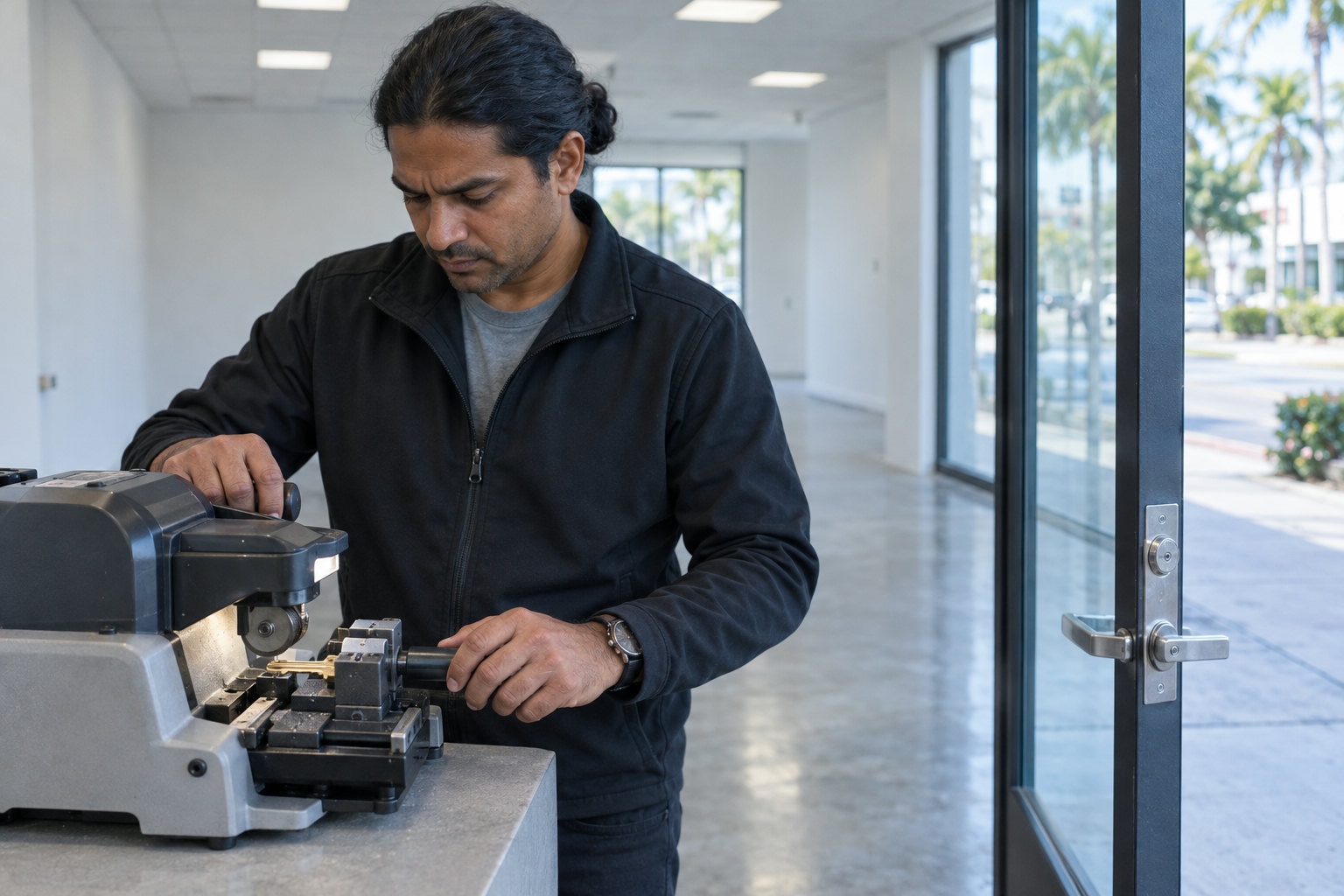
- The core key-count formula is one key per person per door they actually use, plus at least two spares per lock, plus one owner-held control set.
- Rekeying before opening day resets the count to zero, because keys left by a previous tenant, builder or property manager are an unknown quantity.
- Restricted keyways such as Medeco X4 and Mul-T-Lock Interactive+ limit duplicates to authorized dealers working from the owner’s authorization, unlike standard blanks any key counter can copy.
- Every company vehicle needs two programmed keys, since modern transponder and proximity keys require OBD-II programming and chip coding that a hardware store cannot perform.
- OSHA standard 29 CFR 1910.36 requires that employees can open exit route doors from the inside without keys, tools or special knowledge, so no key plan should lock staff in.
- The Atlantic hurricane season runs June 1 to November 30, according to the National Hurricane Center, which makes a sealed, off-site spare set a sensible part of any South Florida key plan.
The key question usually surfaces at a predictable moment. The lease is signed, the build-out is wrapping up, and someone hands over a ring of keys nobody can fully explain.
That moment matters. Every key cut in the first week becomes a key you have to account for until the locks change.
If you’re a business owner in Coconut Grove who just took over a storefront, office suite or restaurant space and you’re about to hand keys to a new team, this walk-through is written for you. It is not aimed at a homeowner adding one deadbolt. Commercial keying brings restricted keyways, master systems, landlord access and company vehicles into the picture.
What follows is the actual sequence a locksmith works through, from the floor plan to the sign-out log. Once you know how the count is built, you can tell whether the number of keys being recommended makes sense.
- The seven-step order a locksmith follows to build a key count door by door, not person by person.
- Why rekeying or swapping to new cores comes before cutting a single new key.
- How restricted keyways from Medeco, Mul-T-Lock and Schlage control who can make copies.
- Why company vans and cars need their own line in the plan, with OBD-II programming for each key.
- The questions to ask before any key leaves the locksmith’s bench.
The Process, Step by Step: How Many Keys to Cut for a New Commercial Location
The number of keys to cut for a new commercial location is built door by door in seven steps, and staff headcount is only one input. Each step narrows the count. The final figure is often smaller than a headcount-based guess, and it is far easier to track.
- Walk every lockable point before counting anything. The process starts with the floor plan, not the staff list: front entry, rear or service door, private office, stockroom, cash or safe room, electrical and telecom closets, mailbox and any gate. Each one gets its own line on the worksheet. Interior doors fitted with passage sets have no cylinder, so they drop off the list entirely.
- Build the access roster. Next to each lock goes the list of roles that genuinely need it: owner, general manager, opening and closing shift leads, cleaning contractor, landlord or property manager, and the alarm responder. Staff who only work while a manager is on site usually need no exterior key at all.
- Reset the count to zero by rekeying. Keys from the previous tenant, the general contractor or the property manager are an unknown quantity, so cylinders are rekeyed or their cores replaced before opening day. Many commercial build-outs run on temporary construction cores, and Schlage and Medeco both make interchangeable-core cylinders that let a permanent core drop in once construction ends.
- Choose the keying system and the keyway. Small shops often key the exterior doors alike and keep the cash room and office on different keys, while larger spaces may justify a master key system. Exterior cylinders on a restricted keyway such as Medeco X4, Mul-T-Lock Interactive+ or Schlage Everest 29 limit who can cut a copy, while Kwikset SmartKey or standard Yale cylinders suit low-risk interior storage.
- Do the arithmetic, lock by lock. For each cylinder, the count is the number of roles on the roster plus at least two spares, and the owner holds a control set that covers every lock. Spares are tagged, sealed and stored, never handed out as a convenience copy.
- Add the company vehicles. Every van, truck or car registered to the business gets at least two working keys, cut on the correct blank (Strattec or ilco transponder blanks are common) and programmed through the vehicle’s OBD-II port so the immobilizer recognizes the chip. The difference between chip keys and transponder keys decides which programming the vehicle needs.
- Stamp, log and issue. Each key gets a number, stamped or tagged, matched to a sign-out sheet with the holder’s name and the issue date. For restricted systems, the owner keeps the authorization card or signature authority, not the manager.
A commercial key count is built from lockable points and access roles, not headcount. Rekeying comes first, restricted keyways such as Medeco X4 or Mul-T-Lock Interactive+ protect the exterior, and each company vehicle gets two OBD-II-programmed keys.
What Tools Does a Locksmith Use to Cut and Control Business Keys?
Locksmith tools for a new business key plan fall into three groups. Some machines cut keys to exact codes, some kits change which key a lock accepts, and programmers pair chip keys to company vehicles. The table lists the typical equipment of the trade and what each piece does for your count.
| Tool of the trade | Role in a new-location key plan |
|---|---|
| ilco Futura code-cutting machine | Cuts keys from the lock’s key code rather than tracing a worn original, so every copy matches factory spec. |
| Pinning kit and plug follower | Rekeys existing Schlage, Kwikset or Yale cylinders so keys from the previous tenant stop working. |
| Restricted-keyway blanks and machines (Medeco, Mul-T-Lock) | Available through authorized dealers; copies are cut against the owner’s key-control record. |
| OBD-II key programmer with Strattec or ilco transponder blanks | Codes chip and proximity keys into the company vehicle’s immobilizer so the engine will start. |
| Locking key cabinet and numbered tags | Gives spares and returned keys a fixed home, so the sign-out log matches what is physically on hand. |
One detail in that table matters more than it looks. A key cut by code on a machine like the ilco Futura matches the manufacturer’s original dimensions. A key traced from a worn copy inherits the wear, and a copy of a copy can drift far enough to stick in the cylinder.
That is why the original key codes belong in the owner’s file from day one. With the codes on record, a fresh spare is always cut to spec instead of from whatever copy happens to be in a drawer.
Where It Gets Tricky
Commercial key planning gets tricky in five places: master key design, restricted keyway paperwork, vehicle programming, life-safety rules and coastal conditions. None of them shows up on a staff list. Each one can undo a careful count.
Master key systems that try to do too much
A master key system lets one key open several locks by adding extra pins, called master pins, inside each cylinder. Every added level creates more key cuts that will turn that cylinder. A badly calculated system can let an employee’s key open a door it was never meant to open, a fault known as cross-keying.
This is where formal training in key bitting and master key charts shows. For a small shop with a handful of cylinders, a planned mix of keyed-alike exterior doors and keyed-different interior locks is often simpler and tighter than a master system.
Restricted keyways only work with the paperwork
A restricted keyway from Medeco or Mul-T-Lock controls duplication through patented key profiles and authorized dealers. The protection depends entirely on who holds the owner’s authorization. If a manager keeps the card or the signature authority, the owner has quietly handed away control of the count.
A key stamped “Do Not Duplicate” is weaker still. The stamp asks the person at the key counter to refuse, and nothing in the blank itself stops a copy. For a side-by-side look at how these systems differ, see this comparison of ASSA Abloy, Medeco and Mul-T-Lock restricted keyways for commercial doors.
Company vehicles and the hardware-store assumption
A common mistake is assuming every car key can be cut at a hardware store. Modern vehicles need OBD-II programming and chip coding so the immobilizer accepts the transponder in the key, and that is automotive locksmith work. A key that is cut but not programmed may turn the door lock and still refuse to start the engine.
Another common mistake is accepting a used company vehicle with a single key. Dealers often provide only one, and replacing the only key is a much bigger job than copying a working one. If that has already happened, here is what goes into making a new car key without the original.
Exit doors cannot depend on a key
OSHA standard 29 CFR 1910.36 requires that employees be able to open an exit route door from the inside at all times without keys, tools or special knowledge. A key plan that adds a double-cylinder deadbolt to a rear exit can break that rule. Egress hardware such as a panic bar keeps the door secure from outside while leaving the inside free.
Salt air and storm season in Coconut Grove
The neighborhood sits along Biscayne Bay, and humid, salt-carrying air is hard on lock internals over time. Exterior cylinders that start to feel gritty or stiff are worth servicing early rather than waiting for them to fail.
The National Hurricane Center lists the Atlantic hurricane season as June 1 to November 30. Storm prep adds access points owners forget, such as keyed storm-shutter locks. It is also a good reason to keep one sealed spare set somewhere other than the building itself.
What This Means for You as the Customer
For a business owner, the locksmith’s process turns into a short list of questions to ask before any key is cut for a new commercial location. Asking them up front keeps the count accurate. It also puts control of future copies in your hands rather than a manager’s or a former tenant’s.
For a restaurant owner whose opening and closing managers rotate, the answer shifts slightly. Shift leads may need exterior keys, but the office, safe room and liquor storage can stay on separate keys held by fewer people.
- How many keys does each lock need, and which role is each one for?
- Will every cylinder be rekeyed or re-cored before opening, so no old keys work?
- Is the exterior keyway restricted (Medeco X4, Mul-T-Lock Interactive+ or Schlage Everest 29), and who holds the authorization?
- How many spares are being cut, and where will they be stored?
- Are the company vehicles covered, with at least two programmed keys each?
- What happens to the locks when a key holder leaves?
The worksheet below shows how a typical small commercial space breaks down. It is a planning guide for deciding how many copies of each business key to make, not a fixed rule.
| Access point | Roles that typically need a key | Spare guidance |
|---|---|---|
| Front entry | Owner, manager, opening and closing leads, cleaning contractor | At least two, sealed and logged |
| Rear or service door | Owner, manager, staff who receive deliveries | At least two; confirm inside egress hardware |
| Private office | Owner, manager | At least two, held by the owner |
| Cash or safe room | Owner and one designated manager | At least two, stored off-site or in a separate safe |
| Electrical and telecom closet | Owner, landlord if the lease requires it | At least two |
| Each company vehicle | Assigned driver | Two programmed keys minimum per vehicle |
If a company vehicle is already down to its last key, or one has gone missing, start with car key replacement for business and personal vehicles before the next shift needs it.
Ask who each key is for, confirm rekeying before opening, and find out who holds the authorization for restricted Medeco or Mul-T-Lock keys. Count company vehicles separately at two programmed keys each.
Our view
This section is opinion. When owners ask how many keys to cut for a new commercial location, they tend to focus on the total number of keys and not on who can make more of them. A plan with a few extra keys and tight authorization on a Medeco or Mul-T-Lock keyway holds up better than a lean plan on a blank anyone can copy.
Company vehicles are the part of the plan most likely to be skipped, and they deserve equal weight. A delivery van with one key is a single lost key away from a stalled route, and a transponder key cannot be replaced over the counter at a hardware store.
The written log matters more than any hardware choice. A numbered key matched to a signed sheet tells you exactly what to rekey when someone leaves. Memory does not.
Frequently Asked Questions
Should the landlord get a key to a new commercial space?
A landlord key to a commercial space is usually a lease question first. Many commercial leases give the landlord a right of entry for inspections and emergencies. If yours does, issue one numbered key, record it on the sign-out log, and keep it off the cash room and office locks unless the lease specifically requires them.
Can a restricted Medeco or Mul-T-Lock key be copied?
Restricted Medeco and Mul-T-Lock keys can be copied only through authorized dealers, typically when the registered owner presents the system’s authorization card or signs for the copy. That control is the main reason to put exterior doors on a restricted keyway such as Medeco X4 or Mul-T-Lock Interactive+. It only works if the owner, not a manager, holds the authorization.
What happens to the locks when an employee leaves?
When an employee leaves, collect the numbered key on the last day and check it against the sign-out log. If even one key is missing, rekey every lock that key opened. On a master key system, that can mean every cylinder at that level, which is one more reason to keep small systems simple.
How many keys should a company van have?
A company van should have at least two programmed keys, one in daily use and one locked in the owner’s key cabinet. Used vans often come from the dealer with only one key. Each new key must be cut on the correct blank, such as a Strattec or ilco transponder blank, and programmed through the OBD-II port before it will start the engine.
Easy Keys 4 Cars provides automotive locksmith services across Miami and South Florida, from Brickell to Coral Gables. If your new location in Coconut Grove includes company vehicles, contact the team to talk through spare keys and programming. Prices are not published online, so ask directly for pricing on your specific vehicles.
Sources
- Exit route doors must open from the inside without keys, tools or special knowledge: OSHA, 29 CFR 1910.36
- Atlantic hurricane season dates, June 1 to November 30: National Hurricane Center, Tropical Cyclone Climatology
- Medeco restricted key control and high-security cylinders: Medeco
- Schlage commercial cylinders, interchangeable cores and restricted keyways: Schlage
 Listen to this articleAudio version
- A Coconut Grove Driver Asked: ‘Is It Safe to Buy a Cheap Aftermarket Key Fob Online Instead of Going to a Locksmith?’ — The Real Risk
- A Doral Driver Asked: ‘Why Does My Push-to-Start Car Keep Saying Key Not Detected Even With a New Fob?’, A Tech’s Diagnosis
- The Hialeah Business Owner Who Needed 12 Rekeyed Locks After a Staff Turnover — How We Secured the Property in 4 Hours
- How We Responded to a Locked-Out Elderly Resident in Coconut Grove at 2 AM — and Why the Door Cylinder Was the Real Problem
- A Miami Beach Driver Asked: ‘Can a Locksmith Program a New Key Fob Without the Original?’ — Here’s the Honest Answer